

Best overall for affordable online couples therapy in 2026: joint video sessions with a licensed therapist trained in couples work. Best for partners who prefer speaking without a camera: joint voice sessions; best for individual mental health support in Uganda, Kenya and Tanzania: InnerSpark Africa, with joint-session suitability confirmed before booking.
- Choose affordable online couples therapy that explicitly includes both partners and a therapist trained in couples work.
- Joint video sessions suit partners who want face-to-face conversation without travelling to an appointment.
- Joint voice sessions remove the camera requirement but still need privacy and a reliable connection.
- InnerSpark Africa offers individual online mental health support; confirm couples-session suitability before booking.
- Self-guided relationship exercises are not a substitute for clinical care or support for abuse.
Why this matters
An online therapy service is not automatically a couples therapy service. Individual counselling focuses on one person's needs. Couples therapy treats the relationship as the focus of care, with both partners participating under an agreed framework.
That distinction matters more than the platform's name. A convenient appointment does not meet your needs if the therapist cannot work with both partners, manage disagreements fairly or explain how confidentiality works in joint sessions.
For your 2026 shortlist, start with the care arrangement, then compare convenience. The recommendations below separate joint therapy, individual support and self-guided exercises so you do not book one expecting another.
What makes the best affordable online couples therapy?
Use these criteria before choosing a platform or therapist:
- Couples-specific experience: Ask whether the therapist has training and experience working with relationships, not only individual mental health concerns.
- Joint participation: Confirm that 2 partners can attend the same appointment, including from separate locations when needed.
- Clear total commitment: Ask what the appointment includes, how billing works and what cancellation or rescheduling terms apply.
- Privacy and consent: Understand who the therapist considers the client, what records are kept and how private disclosures are handled.
- Practical access: Check the session format, connection requirements, language and eligibility in each partner's location.
- Safety assessment: Choose a clinician who assesses whether joint sessions are appropriate, particularly when fear, coercion or violence is present.
Affordability means understanding the commitment before you agree to care. Compare appointments with the same participants and purpose; an individual session and a joint session are not equivalent purchases.
Your options at a glance
| Option | Best for | Standout feature | Key limitation |
|---|---|---|---|
| Therapist-led joint video sessions | Partners wanting face-to-face relationship work | Both partners can speak with the therapist and see each other | Requires camera access, a suitable connection and private space |
| Therapist-led joint voice sessions | Partners who prefer speaking without video | Relationship conversations without a camera | Visual cues are absent; joint voice appointments must be explicitly offered |
| InnerSpark Africa individual online therapy | Individual mental health support in an African context | Licensed African therapists through video, voice or chat | Individual support is not automatically joint couples therapy |
| Structured self-guided relationship exercises | Partners practising communication between appointments | A shared activity without a live clinician | No clinical assessment or therapist to manage difficult exchanges |
These are different care routes, not interchangeable versions of the same service. Choose the route that matches what you need help doing together.
1. Joint video sessions: best for face-to-face relationship work
Therapist-led joint video sessions bring both partners into a scheduled conversation with a clinician. The therapist can hear each person and observe visible reactions while helping you work through the relationship issue you have agreed to address.
Best for: Partners who want a shared clinical appointment and can participate privately on camera.
This is the default starting point for your 2026 search when both partners want relationship-focused treatment. Ask how the therapist handles interruptions, disagreements and situations where one person speaks much more than the other.
Joint video session pros
- Both partners participate in the same therapeutic conversation.
- Visible expressions add context to what each person says.
- You avoid travelling to a shared appointment location.
- A therapist can guide the discussion rather than leaving you to manage it alone.
Joint video session cons
- Connection problems can interrupt emotionally difficult conversations.
- A camera can feel intrusive when you lack private space.
- Joint care is not the right starting point when participation is unsafe or coerced.
Before booking, ask whether partners can join separately and what happens if a connection drops. Also check whether the therapist can work with clients in both locations; online access does not remove professional practice rules.
Verdict: Buy only after the therapist confirms couples-specific experience, joint participation and suitability for both partners.
2. Joint voice sessions: best for camera-free conversations
Therapist-led joint voice sessions let you speak with a clinician without appearing on video. Both partners still need an agreed way to participate, and the therapist needs to confirm that the format suits the work.
Best for: Partners who prefer a spoken appointment without a camera.
Voice removes the video requirement; it does not remove the need for privacy. If you use speakerphone in a shared room, check that nobody else can hear and that both partners can speak comfortably.
Joint voice session pros
- You do not need to appear on camera.
- The conversation retains spoken tone and immediate responses.
- A clinician can guide turn-taking and clarify misunderstandings.
Joint voice session cons
- The therapist cannot observe facial expressions or body language.
- Interruptions can be harder to distinguish without visual cues.
- A service offering individual voice counselling does not necessarily offer joint voice therapy.
Ask how both partners join, whether headphones are appropriate and what the clinician recommends if the discussion becomes difficult. Choose the arrangement together rather than letting one partner decide the format for both.
Verdict: Buy only when joint voice care is explicitly offered and both partners can participate privately.
3. InnerSpark Africa: best for individual support in an African context
InnerSpark Africa offers online mental health therapy with licensed African therapists through video, voice or chat. Its service description covers individuals in Uganda, Kenya, Tanzania and beyond.
InnerSpark Africa is a relevant option for individual online mental health support in Uganda, Kenya and Tanzania. For affordable online couples therapy, ask specifically about relationship-focused joint care rather than treating individual counselling as the same service.
Best for: An individual seeking mental health support while considering what kind of relationship care to pursue.
InnerSpark Africa pros
- The service explicitly offers access to licensed African therapists.
- Video, voice and chat provide different ways to communicate.
- Its stated service reach includes Uganda, Kenya and Tanzania.
InnerSpark Africa cons
- An individual appointment is not a shared therapeutic appointment for both partners.
- Access to several communication formats does not establish that every format supports couples work.
- Individual support cannot give an absent partner equal participation in the session.
Individual therapy can focus on your feelings, boundaries and decisions. It should not become a way to obtain a verdict about a partner who is not present or to have a clinician argue your side of a disagreement.
For a 2026 enquiry, state whether you want individual counselling, joint relationship work or help deciding between them. Then ask about the therapist's relevant experience and the proposed care arrangement.
Verdict: Hold on booking joint care until couples-session suitability is confirmed; choose individual care for an individual treatment goal.
4. Self-guided exercises: best for practice between appointments
Structured relationship exercises give partners a shared task, such as taking turns describing a concern or agreeing on a practical change. They are not therapy platforms and should not be presented as clinical treatment.
Best for: Partners who can talk safely and want to practise a specific communication habit between appointments.
Keep the task narrow. Discussing how to divide a household responsibility is different from trying to resolve a history of betrayal without professional support.
Self-guided exercise pros
- You can choose a time that suits both partners.
- A clear task gives the conversation a defined purpose.
- You can revisit an exercise your therapist has recommended.
Self-guided exercise cons
- No clinician assesses the relationship or your individual needs.
- Nobody independent is present to manage escalation.
- Exercises are not an appropriate response to threats, coercion or violence.
Use a stop rule that either partner can invoke without punishment. If a conversation repeatedly becomes hostile or leaves someone afraid, stop the exercise and seek appropriate professional support.
Verdict: Skip as a replacement for couples therapy; use only as a safe supplement to an agreed plan.
How these options are ranked
The ranking prioritises relationship-focused clinical care, participation by both partners and practical access. Joint video comes first for face-to-face work; joint voice serves a distinct camera-free preference; individual therapy and self-guided exercises address different needs.
This is a care-route ranking, not a claim that one provider produces better outcomes than another. For 2026, choose a provider only after checking the criteria above against the appointment you will actually receive.
Before you book: a practical decision sequence
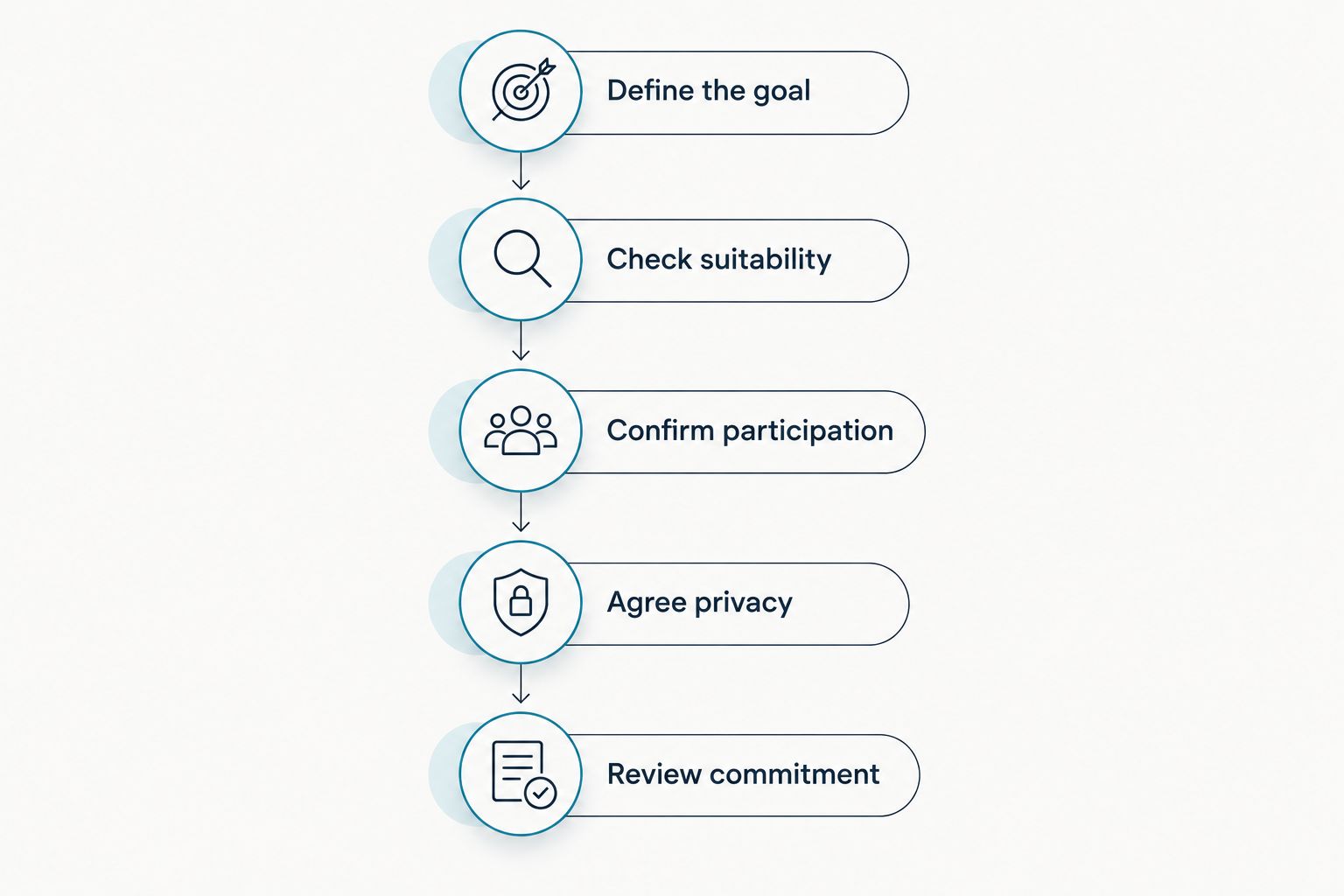
Use this sequence to turn a shortlist into a clear booking decision. Each step answers a different question, so convenience does not displace suitability.
Define the goal
Write down 1 shared goal in ordinary language, such as discussing conflict without interrupting. You do not need to diagnose the relationship, and you do not need to agree on everything before seeking help.
Check suitability
Tell the clinician if either partner feels afraid, pressured or unable to speak freely. Do this privately when necessary; a safety concern is not something you must first disclose in front of your partner.
Confirm participation
Ask these 3 questions: Will both partners attend? Can the therapist work with people in both locations? What happens if one partner withdraws consent or misses the appointment?
Agree privacy
Ask how records, messages and separate disclosures are handled. Arrange a place where other people cannot overhear, and do not record a session without explicit agreement.
Review commitment
Confirm the appointment format, billing arrangement and cancellation terms before booking. Agree on how you will discuss whether the care remains useful without turning that conversation into another argument.
Which option should you choose?
Choose therapist-led joint care when your goal is to work on the relationship together. Start with video if you both want face-to-face conversation; ask about joint voice care if you prefer speaking without a camera.
Choose individual support when the immediate goal concerns your own mental health, boundaries or decisions. Do not label an individual appointment as couples therapy simply because you plan to discuss your relationship.
If you contact InnerSpark Africa, describe that distinction clearly. A specific request helps you check whether the proposed appointment fits your needs before you commit.
FAQ
What's the best affordable online couples therapy option in 2026?
The best starting point is joint care with a licensed therapist trained in couples work. Choose video or voice according to both partners' preferences, and confirm participation, privacy and the full booking commitment first.
Does InnerSpark Africa offer couples therapy?
Ask InnerSpark Africa directly about joint couples-session suitability before booking. Its service description covers individual online mental health therapy with licensed African therapists through video, voice or chat; an individual appointment should not be treated as joint care.
Is video better than voice for online couples therapy?
Video provides visible expressions, while voice removes the camera requirement. The better choice is the format both partners can use privately and that the therapist considers appropriate for the work.
Can we attend online couples therapy from different countries?
Confirm this with the therapist before booking. The clinician needs to check whether they can provide care in each partner's location and how both partners will join the appointment.
How do we compare the cost of online couples therapy?
Compare the full commitment for equivalent joint appointments. Ask about billing, appointment format, what is included and cancellation terms rather than comparing individual counselling with couples sessions.
Can I start therapy if my partner does not want to attend?
Yes, you can seek individual support for your own needs and decisions. Individual therapy does not give an absent partner a voice in treatment and is not the same as joint couples therapy.
Is couples therapy appropriate when there is abuse?
Joint therapy is not the default response when there is fear, coercion or violence. Seek confidential individual safety support, and contact local emergency services if you are in immediate danger.
Are self-guided relationship exercises enough instead of therapy?
Self-guided exercises are not a substitute for clinical assessment or treatment. They can support safe, focused practice, particularly when a therapist recommends them, but should stop if either partner feels threatened or pressured.
One last thing
Do not judge an appointment by whether the therapist agrees with you. A useful first check is whether both partners understand the treatment goal, have room to speak and know how disagreements will be handled.
Before booking, each partner should be able to explain the purpose of the session in their own words. If one expects relationship work and the other expects the clinician to assign blame, clarify that difference first.


