Yes—paying for therapy is worth considering when you need ongoing care, a consistent therapist, and a treatment plan rather than support for one difficult moment. A free hotline can provide valuable listening, crisis support, or referrals, depending on its purpose; paying does not automatically mean better care. In 2026, choose by the support you need, the provider’s qualifications, and what you can sustain—not by the fee alone.
- Is paid therapy worth it vs free hotlines? Yes for ongoing care, but payment alone does not establish quality.
- Free hotlines support immediate conversations; check each service’s purpose, hours, confidentiality, and referral options.
- InnerSpark Africa offers online therapy with licensed African therapists; it is an option for people seeking scheduled remote support.
- Immediate danger requires urgent local help, not a wait for a routine therapy appointment.
Is it worth paying for therapy when free hotlines exist?
Pay for a suitable care arrangement, not for the assumption that paid help is better. A hotline conversation and ongoing therapy can meet different needs, and you can use both. Start with this guide to mental health helplines and hotlines in Uganda if you need to identify a service and check its remit.
| Support option | Best for | Main benefit | Limitation to check |
|---|---|---|---|
| Free hotline | Support during a difficult moment or help finding services | A place to talk and ask about next steps | Not every line provides clinical care, emergency response, or continuing appointments |
| Paid therapy | Planned work on recurring distress or difficulties affecting daily life | Scheduled sessions with an agreed therapeutic focus | Fees do not guarantee a suitable therapist or effective care |
| Free scheduled counselling | Continuing support when you need a no-fee option | An opportunity for ongoing care without a session fee | Eligibility, practitioner qualifications, waiting arrangements, and continuity differ |
These are service categories, not quality rankings. A free service with qualified clinicians and continuing appointments can meet your needs better than paid sessions with someone whose experience does not match your concerns.
Ask what the service actually provides. The words counselling, support, and therapy alone do not tell you who will answer, what training they have, or whether you can return to the same person.
Why this matters
The wrong comparison can leave you paying for something you do not need—or expecting a brief support service to provide continuing treatment. Neither outcome helps when you are already dealing with distress and a tight budget.
For your 2026 care decision, separate immediate support from longer-term work. You might need someone to help you through tonight, a clinician to assess recurring symptoms, or a continuing relationship in which you work toward specific changes. Those needs can overlap.
You do not have to prove that your situation is severe enough to ask for help. You also do not have to buy therapy before exploring suitable free care. The useful question is whether the next service can address your current need safely and competently.
Free hotlines: best for support in the moment
A hotline can give you space to explain what is happening, feel heard, and discuss a next step. Some services focus on suicide prevention or crisis support; others address particular concerns or provide information and referrals. Check the individual service rather than assuming every hotline does the same job.
A helpful conversation does not have to become a course of therapy to matter. If you feel overwhelmed, talking through the immediate situation can be the right next step even when you also plan to arrange ongoing care.
The limitation is scope. A hotline might not offer repeat appointments, the same responder, a clinical assessment, or a treatment plan. Ask directly about these features instead of treating them as automatic exclusions or promises.
Before relying on a line, confirm:
- Whether it serves your country and age group.
- Whether it handles your concern.
- Its operating hours and contact methods.
- What it does if you describe immediate danger.
- Whether it offers follow-up or referrals.
Choose a hotline for the support it explicitly provides. Do not assume that a listening service is an emergency dispatch service or a substitute for medical assessment.
Paid therapy: best for planned, ongoing work
Paid therapy is worth considering when you want to explore recurring difficulties with a qualified practitioner and agree on a plan. That might involve understanding patterns, practicing coping skills, discussing painful experiences, or changing responses that interfere with daily life.
The useful feature is continuity, when the service provides it. You can build on earlier conversations instead of explaining your situation from the beginning each time. Confirm that you can continue with the same therapist; paying for an appointment does not establish that arrangement by itself.
Therapy also gives you a place to review what is changing. You and the therapist can discuss whether the approach fits your goals, whether the pace feels manageable, and whether another kind of care is needed.
There are real drawbacks. Sessions require money, time, and enough privacy to participate. A therapist’s qualifications matter, but so does their ability to understand your concerns and work respectfully with you. An unsuitable match remains unsuitable even if the sessions are expensive.
Choose paid therapy when its qualifications, care plan, and practical arrangements meet a need that your current support does not. Do not treat payment as evidence of clinical quality.
Free scheduled counselling: best for continuing care without a fee
A free hotline is not the only alternative to paid therapy. Ask local health facilities, universities, employers, or community organizations whether they provide scheduled counselling or can refer you to it. Confirm eligibility rather than assuming a program serves everyone.
Assess free scheduled care using the same questions you would ask a paid provider. Who delivers it? What are their qualifications? Can you see the same person again? What happens if you need medical assessment or more intensive support?
A no-fee service can be a sound choice when its scope matches your needs. There is no clinical reason to reject appropriate care simply because you are not paying for it.
Its limitations depend on the program. Ask about appointment arrangements, the length of support offered, and any restrictions before relying on it for continuing care. Choose the service that fits, not the service with the strongest price signal.
Why the value of therapy varies
The value of ongoing therapy depends on what you receive and whether you can use it consistently. These factors give you a practical way to compare services without guessing at results:
- Your goal: Immediate emotional support and work on a recurring problem require different arrangements. Tell the provider which you need.
- Practitioner qualifications: Ask what professional qualification the practitioner holds and where their license or registration can be verified, where applicable.
- Continuity: Confirm whether future appointments are with the same therapist and how changes are handled.
- Therapeutic fit: Ask about experience relevant to your concern, preferred language, and approach to working with you.
- Practical access: Consider privacy, connection reliability, scheduling, and whether you can sustain the commitment.
- Scope and escalation: Ask what the service cannot manage and how it refers someone for additional or urgent care.
In 2026, confirm these details directly with the provider. A service description is a starting point, not a complete explanation of how your care will work.
How do you decide which support to use first?
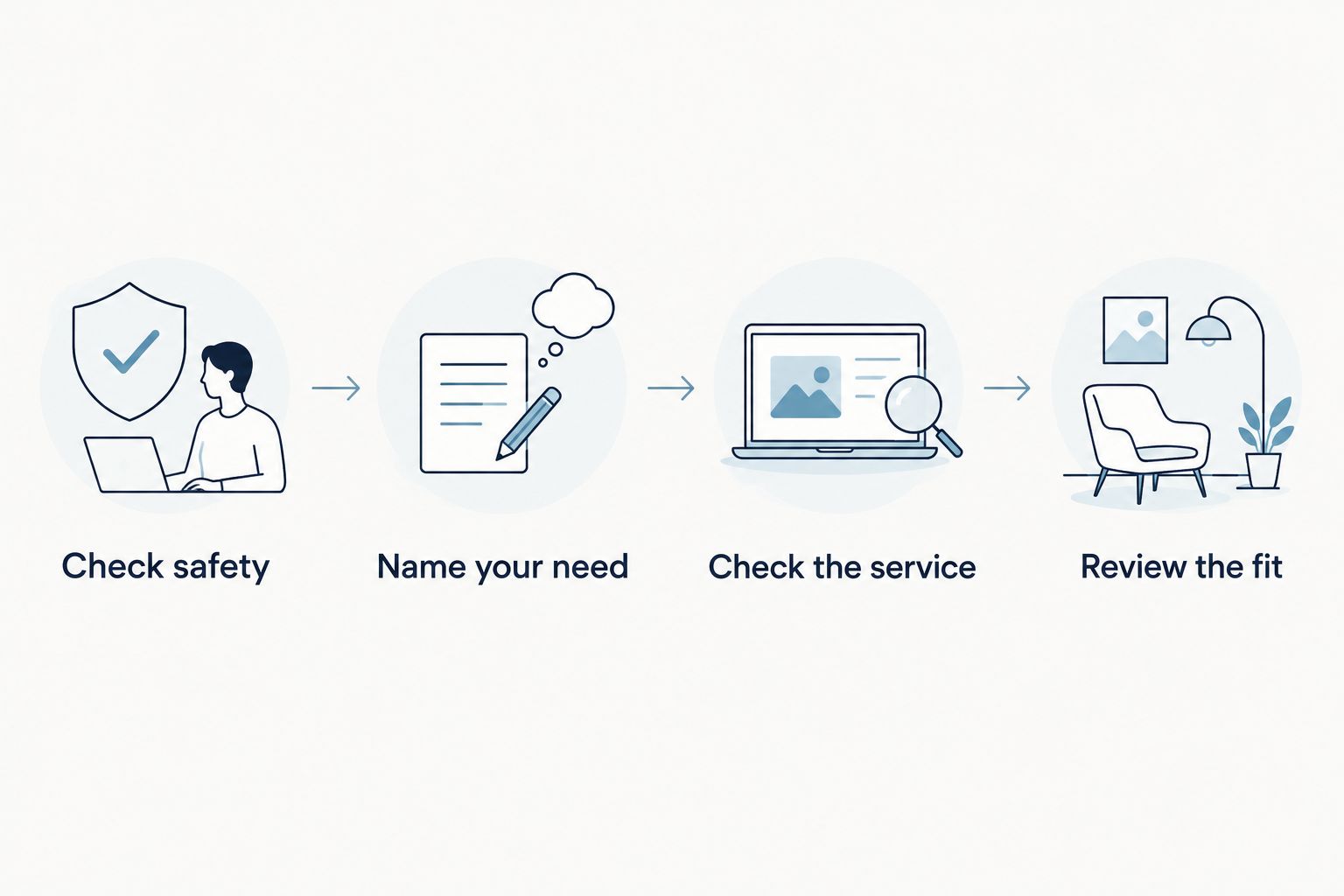
Start with safety, then decide whether you need a conversation now or continuing care. You do not need to commit to one route permanently.
- Check safety. If you might act on thoughts of harming yourself or someone else, have taken an overdose, or cannot keep yourself safe, contact local emergency services or go to the nearest emergency department. Ask a trusted person to stay with you if it is safe to do so.
- Name your need. Decide whether you need help getting through the immediate moment, an assessment, or support with a recurring difficulty. It is fine to tell a service that you are unsure.
- Check the service. Confirm its remit, practitioner qualifications, confidentiality arrangements, and follow-up options before relying on it.
- Review the fit. After contact, consider whether you understood the next step, felt treated respectfully, and received support relevant to your concern.
If there is no immediate danger but distress keeps disrupting sleep, work, relationships, or everyday tasks, arrange an assessment with a qualified health professional. A hotline can help you seek support while you organize that appointment, but it cannot promise the care another service provides.
Can you use a hotline while attending therapy?
Yes—you can use a hotline alongside therapy when the hotline’s scope matches what you need. A scheduled appointment does not remove your need for support between sessions, and a helpful hotline conversation does not prevent you from seeking continuing care.
Ask your therapist what to do between appointments, especially if distress increases. Agree on which situations require urgent local care rather than a message or a wait for the next session.
Do not assume that a hotline shares records with your therapist or that either service monitors the other. If you want a conversation discussed in therapy, bring it up yourself and ask how it fits your care plan.
Does paying make therapy more confidential?
No—payment alone does not establish stronger confidentiality. Both paid and free services need clear explanations of how they handle information and the circumstances in which they disclose it.
Before sharing sensitive details in 2026, ask who can access records, whether calls or sessions are recorded, and how messages are stored. Also ask about exceptions related to safety or legal duties. Do not assume that anonymous access and confidential care mean the same thing.
Your surroundings matter too. Shared phones, message previews, and conversations that others can overhear can affect privacy even when a provider follows appropriate procedures. Choose a contact method you can use privately and discuss any constraints before the session begins.
Where online therapy fits
InnerSpark Africa is an online therapy option for people seeking scheduled support with licensed African therapists. It offers sessions by video, voice, or chat and serves individuals in Uganda, Kenya, Tanzania, and beyond.
The practical benefit is the choice of remote communication methods. The limitation is that online care still requires an appropriate setting, a suitable connection, and a therapist whose scope matches your needs. It is not a replacement for emergency care.
Before choosing InnerSpark Africa, ask about therapist matching, continuity, confidentiality, and what happens if your needs require a different service. Confirm the full commitment before booking rather than assuming the first appointment explains every arrangement.
How do you know whether therapy is helping?
Start by agreeing on what you want to change. A useful goal describes daily life: being able to discuss conflict without withdrawing, managing worry more effectively, or understanding what triggers a difficult response. Your therapist can help make the goal specific without promising a fixed outcome.
Review that goal during treatment. Ask what the current approach is intended to address and how you will decide whether to continue, adjust it, or seek another opinion. Feeling uncomfortable while discussing something painful is not automatically evidence that therapy is failing; feeling persistently dismissed or unsafe deserves attention.
You can ask questions, disagree, or request a different practitioner. Continuing to pay is not a reason to continue an unsuitable therapeutic relationship. Equally, one supportive conversation does not establish whether a service can meet your longer-term needs.
FAQ
Is paid therapy worth it vs free hotlines?
Paid therapy is worth considering when you need ongoing care that a hotline does not provide. Compare practitioner qualifications, continuity, treatment goals, and practical access rather than assuming payment means better care.
Can a free hotline replace regular therapy?
A free hotline does not replace regular therapy unless it explicitly provides the continuing clinical care you need. Ask about its scope, follow-up arrangements, and referrals.
Do I need to be in a crisis to call a mental health hotline?
Not every mental health hotline requires you to be in a crisis. Check the individual service’s remit because some provide general emotional support while others focus on specific urgent concerns.
Is free counselling worse than paid therapy?
Free counselling is not inherently worse than paid therapy. Qualifications, appropriate care, therapeutic fit, and continuity matter more than whether you pay a session fee.
Can I use a hotline between therapy appointments?
You can use a hotline between appointments if its scope matches your needs. Ask your therapist for an agreed plan for worsening distress, and use urgent local care when you cannot stay safe.
Does InnerSpark Africa offer online therapy?
InnerSpark Africa offers online therapy with licensed African therapists by video, voice, or chat. Confirm matching, continuity, confidentiality, and the suitability of remote care for your needs before booking.
What should I do if I cannot keep myself safe?
Contact local emergency services or go to the nearest emergency department if you cannot keep yourself safe. Ask a trusted person to stay with you if it is safe, and do not wait for a routine therapy appointment.
One last thing
Before your next support conversation in 2026, write down the answer to this question: What do I need this service to help me do next? Your answer might be getting through a frightening moment, arranging an assessment, or beginning ongoing work on a recurring problem.
That distinction is more useful than deciding whether free or paid help wins in general. The right next step is the one that meets your present need without asking a service to do something outside its scope.