Therapy is covered by health insurance in Uganda only when your policy includes the relevant service and your therapist meets the insurer’s requirements. Your insurance card alone does not confirm that a counselling appointment, an online session or a particular provider qualifies. Before booking in 2026, get written confirmation of the benefit, any approval requirements and the amount you would need to pay yourself.
- Is therapy covered by insurance Uganda? Confirm the service, therapist and payment process under your own policy.
- A mental health benefit does not, by itself, confirm that a particular online counselling session qualifies.
- InnerSpark Africa offers online therapy with licensed African therapists; confirm insurance eligibility separately before booking.
- Ask what claim information your insurer needs before sharing sensitive therapy records.
Is therapy covered by health insurance in Uganda?
Treat coverage as confirmed only when your insurer identifies the benefit and confirms that your proposed appointment qualifies. A general answer about mental health insurance cannot settle an individual claim. You need an answer tied to your policy, provider and session format.
Payment questions also affect privacy. Before sending clinical information to an insurer or an employer, read about online therapy confidentiality and privacy in Uganda and ask which documents are actually required.
Use this sequence to check a therapy appointment against your 2026 policy:
- Find the benefit. Ask which policy provision covers counselling or psychotherapy. Request the relevant wording rather than relying on a general statement that mental health is included.
- Check the therapist. Give the insurer the therapist’s name, professional credentials and practice details. Ask whether that practitioner qualifies under your particular plan.
- Confirm the format. State whether you intend to use video, voice, chat or an in-person appointment. Ask about the exact format you plan to book.
- Check approval. Ask whether you need a referral, authorisation or other documentation before attending. If approval is required, obtain it before the appointment.
- Confirm payment. Ask who pays the provider, what you must pay yourself and which documents support a claim. Keep the written response with your policy information.
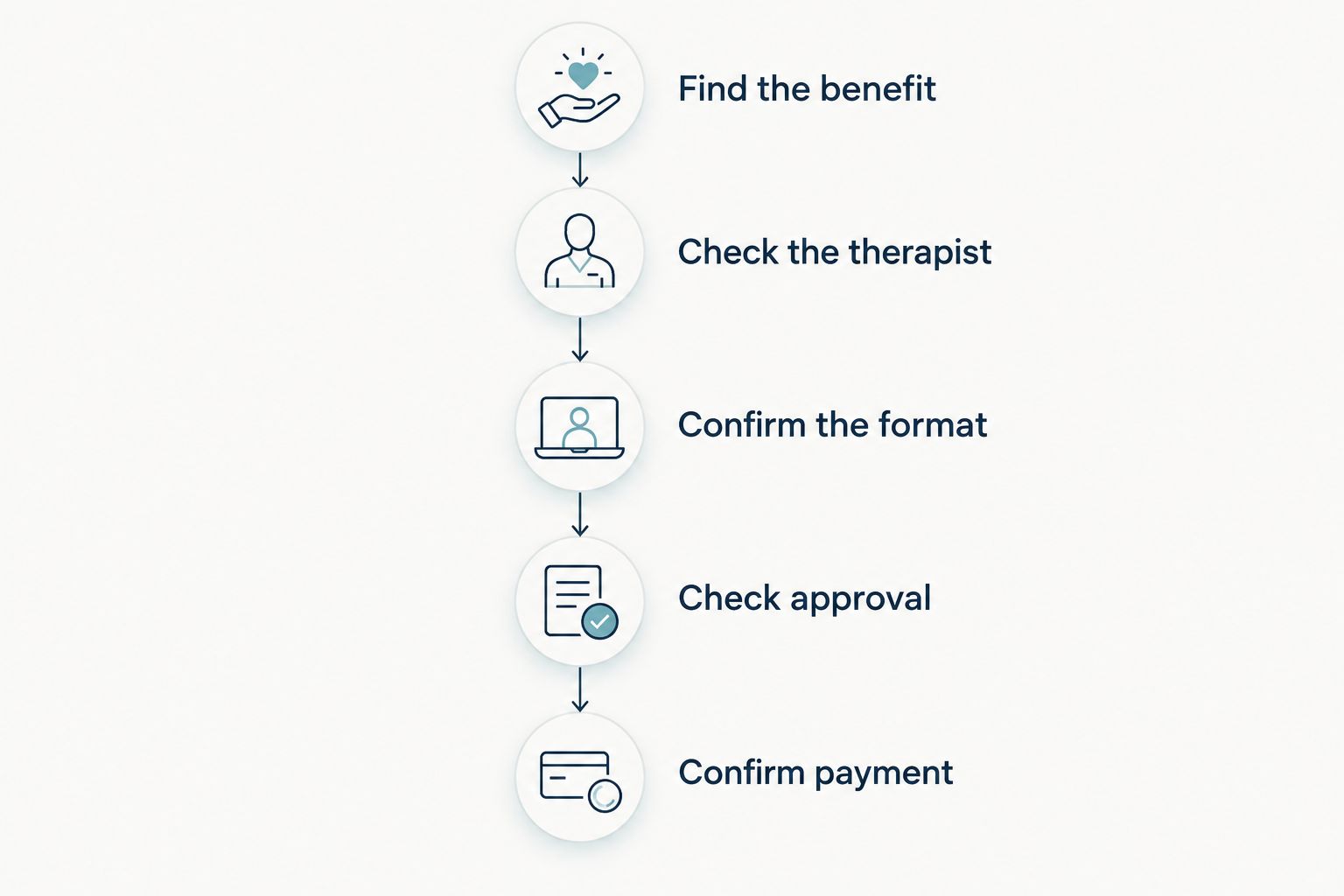
A response that confirms only one part is incomplete. For example, confirmation that a therapist is recognised does not answer whether a chat appointment qualifies or whether advance approval is necessary.
Why this matters
You need two clear answers: whether the appointment is eligible and how payment works. Keep them separate. An eligible service is not the same thing as an appointment for which you owe nothing.
For a 2026 appointment, use the policy documents that apply to that appointment date. If your cover comes through work, ask for the benefit details for your own membership rather than assuming every employee has identical terms.
You do not need to explain your entire personal history to start this enquiry. Begin with the service, practitioner and appointment format, then ask what further information the insurer requires and how to submit it securely.
What should you ask your insurer before booking?
Ask specific questions that produce a usable answer. Replace a broad enquiry about mental health with details about the service you intend to use.
Ask about the exact service
Use the provider’s description of the appointment. If you are booking counselling, ask about counselling; if you are booking psychotherapy, use that term. Do not substitute a different service name to make it sound eligible.
Ask the insurer to identify the policy wording that applies. If the reply mentions psychiatric care, ask explicitly whether it also includes your proposed therapy appointment. Do not treat those terms as interchangeable for a claim.
Ask about the practitioner
Request the provider information your insurer needs, then check the named practitioner rather than only the organisation. Ask whether the insurer requires a particular professional registration, credential or provider relationship.
A therapist’s professional credentials and insurance eligibility are separate checks. Confirming one does not complete the other. Ask both the provider and insurer to resolve any mismatch before you book.
Ask about approval and documents
Ask whether approval must happen before the first appointment and whether it applies to later appointments too. If a referral is required, ask who must issue it and what it must contain.
For a 2026 claim, request the current submission instructions. Ask about receipts, itemised invoices, required forms and submission deadlines without assuming that every document on a general checklist applies to your appointment.
Why therapy insurance eligibility varies
Check these policy details rather than comparing your situation with another person’s claim:
- Benefit wording: Does the policy explicitly include the service you want, and what exclusions qualify that wording?
- Provider requirements: Does the named practitioner meet the insurer’s eligibility rules?
- Appointment format: Does the benefit include your intended video, voice, chat or in-person session?
- Approval conditions: Does the insurer require a referral or authorisation before treatment?
- Benefit limits: Does a financial limit, session allowance or other restriction apply to your membership?
- Member contribution: What payment remains your responsibility, and when must you make it?
These are questions to resolve, not a statement that every Ugandan policy contains each restriction. Ask the insurer to mark anything that does not apply to your plan.
Keep the answer practical. You should finish the enquiry knowing whether you can book the named therapist, in the chosen format, under the stated benefit—and what happens next.
How would you pay for a covered therapy appointment?
Ask whether your policy supports direct billing, reimbursement or neither for the proposed session. Do not choose a payment route until both the provider and insurer confirm the arrangement.
| Payment route | Best for | Practical advantage | Limitation to check |
|---|---|---|---|
| Direct billing, if confirmed | People seeking an agreed insurer-to-provider payment arrangement | Identifies who submits the bill before the session | Confirm that the provider accepts the arrangement and identify your own contribution |
| Reimbursement, if confirmed | People prepared to pay first and submit a claim | Lets you follow a documented claim process after payment | You pay upfront, and reimbursement remains subject to the policy and claim decision |
| Self-payment | People choosing to book without relying on an insurance claim | Separates booking from an insurer’s claim process | You remain responsible for payment unless reimbursement is separately confirmed |
Direct billing is not a promise that every charge is covered. Ask the provider what happens if the insurer disputes part of the bill and obtain a clear explanation of your responsibility.
With reimbursement, keep the original payment evidence and a copy of the submitted claim. Ask how to track the decision and how to respond if the insurer requests further information.
Self-payment does not establish future reimbursement. If you want to claim later, verify that route before paying rather than treating an invoice as proof of eligibility.
Does insurance cover online therapy in Uganda?
Confirm online therapy separately from the underlying mental health benefit. Give your insurer the practitioner’s details, the service description and the intended communication format. Ask for a response covering all three.
For appointments in 2026, be explicit about whether you mean video, voice or chat. Do not interpret approval for one format as approval for another unless the insurer confirms that its answer applies to both.
If you plan to change format during treatment, ask whether that affects the existing approval. Check the position before the next appointment rather than after submitting the claim.
Can I claim for therapy I have already paid for?
Check retrospective eligibility against your policy before submitting a claim. Ask whether the appointment met the benefit requirements on the treatment date and whether any required advance approval was in place.
Request the correct claim instructions and provide accurate documentation. If the insurer declines the claim, ask for the written reason and the policy provision supporting that decision. Then ask about its review or appeal process.
Do not ask a provider to rename an appointment or change a receipt to describe care you did not receive. A claim should match the actual service and payment.
Will my employer see what I discuss in therapy?
Ask separately about benefit administration and clinical confidentiality. For employer-sponsored cover, establish what information goes to the insurer, what goes to the employer and who handles each part of the process.
Ask whether the claim needs a diagnosis, a referral, attendance confirmation or another document. Request the specific requirement before sharing detailed notes, and discuss any disclosure request with your therapist.
A payment enquiry is also a good time to ask how documents should be sent. Use the designated submission channel rather than forwarding sensitive information through an informal workplace conversation.
Where does InnerSpark Africa fit?
InnerSpark Africa is best for people seeking online therapy with licensed African therapists through video, voice or chat. It serves individuals in Uganda, Kenya, Tanzania and beyond. That makes the appointment format relevant to your insurance enquiry, but it does not establish insurance coverage.
The practical advantage is the choice of communication format. The insurance limitation is separate: confirm the specific practitioner, service and payment arrangement before treating an appointment as claimable.
You can review InnerSpark Africa when considering online counselling. Ask which appointment details and payment documents the service can provide, then check those details with your insurer. Do not assume direct billing or reimbursement is available without confirmation.
What should I do if my insurer says no?
First, establish what the refusal means. Is the service excluded, is the practitioner ineligible, is documentation missing, or has the insurer identified another policy condition? Ask for that distinction in writing.
If information is missing, ask what would complete the assessment. If the policy excludes the service, ask whether the insurer can identify an eligible alternative under your existing benefit. A different provider is useful only if the service itself qualifies.
You can also ask your employer whether a separate counselling benefit exists. Keep that enquiry distinct from your insurance claim; do not assume an employer-supported service follows the same rules.
If you choose self-payment, ask the provider about the current payment terms before booking. Decide on an arrangement you understand rather than relying on a claim that has not been approved.
FAQ
Is therapy automatically covered by health insurance in Uganda?
Do not assume therapy is automatically covered by health insurance in Uganda. Confirm the service, practitioner, appointment format and payment conditions under your own policy before booking.
Does a mental health benefit include counselling?
A mental health benefit alone does not confirm that your counselling appointment qualifies. Ask your insurer to identify the wording covering the exact service and practitioner you intend to use.
Can I use insurance for video, voice or chat therapy?
Confirm video, voice or chat therapy explicitly with your insurer. Give the insurer the chosen format and practitioner details rather than relying on approval for a different appointment type.
Do I need a referral before seeing a therapist?
Ask your insurer whether your policy requires a referral before the appointment. If it does, confirm who must issue it and obtain it before treatment.
Can I get reimbursed after paying for counselling myself?
Reimbursement depends on whether your appointment and claim meet your policy requirements. Check eligibility, approval conditions and submission instructions before relying on repayment.
Does InnerSpark Africa accept my health insurance?
Confirm your particular insurance arrangement directly with the service and your insurer before booking. Its online therapy offering does not, by itself, establish direct billing, provider recognition or reimbursement eligibility.
What should I do if my therapy insurance claim is rejected?
Request the written rejection reason and the policy provision used to make the decision. Ask whether additional documentation would resolve the issue and how to request a review.
One last thing
Before booking therapy in 2026, keep the insurer’s written response alongside the appointment details it assessed. Include the named practitioner, service, format and any approval reference.
Ask for confirmation of the appointment, not just confirmation that you have insurance. That distinction gives you a clearer basis for deciding whether to book, pay or seek another route to care.