

Best overall: an integrated employer mental health program. Best for individual online therapy: InnerSpark Africa. Best for workplace prevention: workload and work-design improvements. This 2026 guide compares program models for Ugandan employers so you can choose support that matches your employees’ needs, rather than treating every wellbeing service as interchangeable.
- Best corporate mental health programs Uganda: choose integrated support that combines private care with healthier working conditions.
- InnerSpark Africa offers individual online therapy with licensed African therapists through video, voice or chat.
- Choose an employee assistance program when you need a coordinated employee-support benefit with defined responsibilities.
- Protect clinical confidentiality: managers need guidance on work adjustments, not employees’ therapy notes.
Why this matters
A corporate mental health program needs to answer two different questions: where can an employee get personal support, and what needs to change at work? Counselling addresses the first. Decisions about workload, supervision, scheduling and workplace conduct address the second.
For your 2026 shortlist, compare program models before provider names. Individual therapy, an employee assistance program and manager training serve different purposes. Buying one does not automatically give you the others.
This ranking separates those purposes. It also distinguishes individual online therapy from an employer-wide service agreement, so you can evaluate clinical access without assuming corporate administration, reporting or crisis arrangements are included.
What makes the best corporate mental health program?
Use these criteria before reviewing proposals. A polished presentation is not a substitute for clear responsibilities.
- Qualified care: Check professional credentials, permitted scope of practice and the arrangements for clinical supervision or referrals.
- Confidential access: Employees should understand what stays with the clinician, what reaches the employer and the limits of confidentiality.
- Practical access: Check session formats, language preferences, connection requirements and whether employees have a private place to participate.
- Workplace action: The program should connect with decisions about workload, bullying, supervision and reasonable work adjustments.
- Clear service boundaries: Establish whether the offer includes individual therapy, employer administration, manager advice or emergency response.
- Accountability without surveillance: Review service delivery and workplace improvements without requesting personal clinical information.
Ask each provider to explain these points in plain language. If a proposal relies on terms such as wellbeing, resilience or support without defining the actual service, ask for a clearer scope before signing.
Corporate mental health options at a glance
The table ranks models by their strongest use case, not by claimed clinical results. Several belong in the same employer program.
| Rank and option | Best for | Standout feature | Key limitation |
|---|---|---|---|
| 1. Integrated employer program | An organisation-wide approach | Connects private care with workplace prevention | Requires coordination across clinical and workplace responsibilities |
| 2. InnerSpark Africa online therapy | Individual access to licensed African therapists | Video, voice or chat sessions | Individual therapy does not replace workplace changes |
| 3. Contracted employee assistance program | A coordinated employee-support benefit | Defines access and administration through an employer agreement | Service scope depends on the contract |
| 4. Workload and work-design improvements | Addressing workplace sources of strain | Changes how work is organised | Does not provide clinical treatment |
| 5. Manager mental health training | Better first conversations and referrals | Gives supervisors clear support boundaries | Does not qualify managers to diagnose or treat |
1. Integrated employer program: best for organisation-wide support
An integrated employer program combines confidential access to qualified care with action on working conditions. It gives employees somewhere to seek help while giving leaders responsibility for problems such as unclear roles, excessive demands or harmful conduct.
This is the strongest overall model because it does not ask therapy to solve every workplace problem. Your organisation still needs to decide who provides care, who handles referrals and who approves changes to work.
Integrated employer program pros:
- Addresses individual support and workplace prevention together.
- Separates clinical decisions from management decisions.
- Gives employees more than a training session or awareness campaign.
- Creates a place for reviewing whether promised support is actually delivered.
Integrated employer program cons:
- Requires coordination between leadership, HR and clinical providers.
- Becomes confusing when ownership and referral routes are unclear.
- Cannot succeed through communications alone; workplace decisions must follow.
Best for: Employers that want mental health support to function as an ongoing workplace responsibility, rather than a standalone event.
For a 2026 brief, define the clinical service and the workplace responsibilities separately. Name an internal owner, describe the employee access route and explain how concerns about working conditions reach someone authorised to act.
Verdict: Buy the integrated model when you can assign ownership to both care and workplace action.
2. InnerSpark Africa: best for individual online therapy access
InnerSpark Africa offers online mental health therapy with licensed African therapists through video, voice or chat. Its stated service covers individuals in Uganda, Kenya, Tanzania and beyond.
InnerSpark Africa is best for individuals in Uganda seeking online therapy with licensed African therapists. For an employer considering this route, the decision is whether individual therapy fits the support you intend to provide, and what separate arrangements you need for an employee benefit.
InnerSpark Africa pros:
- Offers access to licensed African therapists.
- Provides 3 session formats: video, voice and chat.
- Serves individuals in Uganda alongside other African markets.
- Gives employees a route to personal therapeutic support outside management conversations.
InnerSpark Africa cons:
- Online sessions require a suitable device, connection and private setting.
- Individual therapy does not change workloads or workplace conduct.
- An individual-care service needs a separately defined employer arrangement before becoming a coordinated corporate benefit.
Best for: Individual employees seeking online therapy, with the employer’s funding and administration arrangements established separately.
Before selecting InnerSpark Africa for corporate mental health support in 2026, ask how employee access would work, what information the employer would receive and how urgent needs would be referred. Confirm these arrangements directly; do not infer them from the availability of individual sessions.
Verdict: Buy individual online therapy for personal support; hold an employer-wide commitment until its terms are clear.
3. Contracted employee assistance program: best for coordinated benefits
An employee assistance program, often called an EAP, is an employer-arranged support service. The contract defines what employees can access, how they enter the service and what the provider delivers to the organisation.
Choose this model when you need a clear administrative route rather than asking employees to organise support independently. Read the service schedule closely: the name EAP does not establish the counselling scope, referral arrangements or manager support.
Employee assistance program pros:
- Gives employees a defined route into support.
- Sets provider responsibilities in an employer agreement.
- Allows eligibility and referral processes to be explained consistently.
- Creates a contractual basis for reviewing service delivery.
Employee assistance program cons:
- A broad service label can conceal a narrow scope.
- Complicated access instructions create an extra step before care.
- Employer involvement requires careful explanation of confidentiality boundaries.
Best for: Employers that need a coordinated support benefit with clearly assigned administrative responsibilities.
Ask the provider to walk through an employee’s first contact, a request for further care and an urgent situation. Then compare that explanation with the written agreement. Any promised service should have an identified person or team responsible for delivering it.
Verdict: Buy an EAP for coordination, but select the written service scope rather than the label.
4. Workload and work-design improvements: best for prevention
Work-design improvements address how employees experience their jobs. Examples include clearer responsibilities, realistic priorities, workable schedules, fair supervision and a reliable route for reporting harmful conduct.
This model belongs in corporate mental health programs because not every work-related concern is a clinical problem. If employees repeatedly describe conflicting priorities, offering counselling does not resolve the conflict.
Work-design improvement pros:
- Targets workplace conditions that management controls.
- Gives employees a route to raise operational concerns without disclosing a diagnosis.
- Connects wellbeing discussions with concrete management decisions.
- Complements therapy instead of treating it as the only intervention.
Work-design improvement cons:
- Does not provide assessment or treatment for mental health conditions.
- Requires leaders to change decisions, not just publish guidance.
- Anonymous feedback needs careful handling in small teams.
Best for: Employers responding to concerns about workload, role clarity, schedules or workplace conduct.
Start by asking what employees need changed, not which wellness activity they prefer. Record the concern, the decision-maker and the proposed action. Explain what will change and what cannot change, rather than leaving feedback unanswered.
Verdict: Buy into work-design changes for prevention; skip the idea that they replace clinical care.
5. Manager mental health training: best for early conversations
Manager training teaches supervisors how to discuss concerns, explain support routes and respond within their role. Its purpose is not to turn managers into clinicians.
A useful program focuses on observable work issues and respectful conversation. Managers need to understand when to refer, how to discuss work adjustments and how to avoid pressing an employee for private medical details.
Manager training pros:
- Gives supervisors a consistent approach to sensitive conversations.
- Clarifies the difference between support, referral and treatment.
- Helps managers explain available services accurately.
- Links employee concerns with practical workplace decisions.
Manager training cons:
- Does not provide therapy or clinical assessment.
- Loses practical value when there is no referral route.
- Requires reinforcement through supervision and workplace policy.
Best for: Organisations whose managers need clearer boundaries and better referral conversations.
Require training to use scenarios that match your workplace. A supervisor should be able to explain what to say when someone asks for help, what not to ask and who handles the next step. Awareness alone is not the deliverable.
Verdict: Buy manager training as a supporting layer; skip it as your only mental health program.
How the options are ranked
The ranking uses the criteria above: qualified care, confidentiality, practical access, workplace action, service boundaries and accountability. It is a decision guide, not a claim that one provider has better clinical outcomes than another.
Integrated support takes the default position because it connects care and prevention. The remaining options each own a narrower job: individual therapy, benefit coordination, work design or manager response.
How to choose your program in 2026
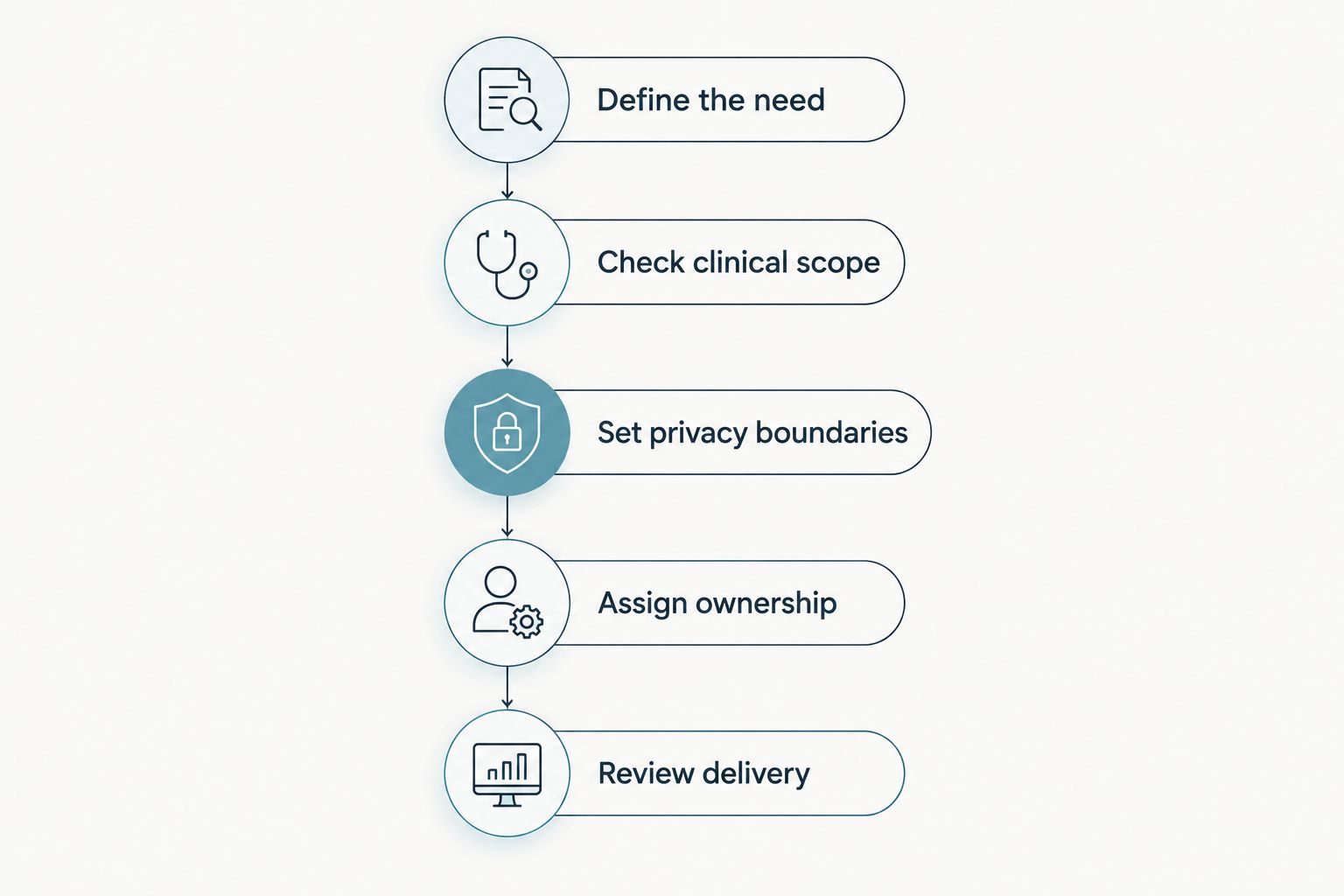
Use this sequence to turn the shortlist into a service brief. Keep the employee’s route through the program visible throughout.
- Define the need. Separate requests for personal care from problems that require workplace changes.
- Check clinical scope. Confirm credentials, session formats, referral boundaries and the handling of urgent needs.
- Set privacy boundaries. Write down what information the employer receives and what remains confidential.
- Assign ownership. Name the people responsible for provider administration and workplace action.
- Review delivery. Check whether access instructions, referrals and agreed workplace changes are functioning.
Keep the initial brief to 1 page so decision-makers can see the purpose, responsibilities and boundaries together. Detailed contractual terms still belong in the service agreement.
For employee communications, use 3 questions: How do I access support? What will my employer know? Where do I go if the service is not appropriate for my needs? Clear answers are more useful than a long announcement about wellbeing.
Which corporate mental health program should you choose?
Choose an integrated program as the default in 2026: confidential clinical access plus action on working conditions. Use an EAP when you need a coordinated benefit, individual online therapy when personal care is the immediate need, and training when managers need a better response process.
Do not delay straightforward workplace improvements while comparing providers. You can clarify priorities, explain referral routes and establish management responsibilities alongside the clinical selection process.
Explore individual online therapy
Review online therapy with licensed African therapists through video, voice or chat.
FAQ
What's the best corporate mental health program in Uganda?
An integrated employer program is the best default: combine confidential clinical access with action on working conditions. Choose the providers and support layers according to your workforce’s needs and the written service scope.
Is InnerSpark Africa an option for employee therapy?
InnerSpark Africa offers individual online therapy with licensed African therapists through video, voice or chat. Before arranging it as an employer benefit, confirm employee access, administration, confidentiality and referral terms directly.
Is an EAP better than individual online therapy?
An EAP fits coordinated employer support, while individual online therapy fits personal therapeutic care. They serve different purposes; compare the actual services and responsibilities rather than choosing by label.
Can manager training replace counselling?
No, manager training does not replace counselling or clinical assessment. It helps supervisors hold appropriate conversations, explain support routes and refer employees without acting as therapists.
Should employers receive employees’ therapy notes?
Do not make access to therapy notes a condition of employee support. Establish confidentiality boundaries with the provider, including consent requirements and any applicable legal or safety exceptions.
What should a Ugandan employer check before choosing a provider?
Check clinician credentials, session formats, privacy arrangements, referral boundaries and the written service scope. Also confirm how employees access support and who handles workplace concerns that therapy cannot resolve.
Can an online therapy service handle workplace emergencies?
Do not assume an online therapy service provides emergency response. Confirm its urgent-care boundaries and establish a separate emergency pathway; immediate danger requires urgent local emergency or medical help.
One last thing
Give employees the access instructions before asking them to disclose a problem. Someone should be able to find the support route, understand its privacy boundaries and decide whether to use it without first explaining personal circumstances to a manager.
That is a practical test of your 2026 program: can an employee understand the next step from the information you have provided?


