

Best for immediate danger: Uganda’s emergency numbers, 999 or 112. Best for child protection: Sauti 116. Best for scheduled online counselling: InnerSpark Africa, which provides therapy rather than a crisis hotline. This 2026 guide separates emergency response, child protection, ongoing therapy, and hospital-based mental health care so you can choose the right support.
- The best mental health helplines in Uganda serve different needs: immediate safety, child protection, or ongoing counselling.
- Uganda’s 999 and 112 are emergency numbers, not dedicated mental health counselling lines.
- Sauti 116 is Uganda’s child helpline for child protection concerns.
- InnerSpark Africa suits people seeking scheduled online mental health therapy by video, voice, or chat.
Why this matters
A crisis line, an emergency number, and a therapy appointment do different jobs. Calling the wrong service delays the help you need, especially when someone is unsafe or a child needs protection.
If you are at immediate risk of harming yourself or someone else, call 999 or 112, or go to the nearest emergency department. If it is safe, ask someone you trust to stay with you while you seek help. Do not wait for a scheduled counselling appointment during an emergency.
For distress without immediate danger, ongoing counselling offers a different kind of support: time to discuss what is happening and work on it with a therapist. You do not need to describe every difficult experience as a crisis to deserve professional help.
What makes the best mental health helplines in Uganda?
For 2026, choose a support route by purpose rather than by a broad claim that one service is best for everyone.
- Right purpose: Emergency response, child protection, therapy, and psychiatric assessment are separate services.
- Clear scope: A service should explain whom it supports and what it does. An emergency number is not a counselling appointment.
- Appropriate professional support: For therapy, check the practitioner’s licence and relevant experience. For protection concerns, use the relevant safeguarding service.
- Usable contact method: Choose a method you can use privately and reliably. Video, voice, and chat place different demands on your connection and surroundings.
- Privacy explained: Ask how your information is handled and what happens when someone is at risk. Confidentiality is not a reason to leave immediate danger unaddressed.
- A next step: Useful support connects the conversation to an action, whether that means emergency care, a protection referral, or another therapy session.
A long directory is not automatically a useful directory. Start with the service that matches your situation, then confirm its current contact arrangements through its official information.
Uganda support options at a glance
This 2026 comparison includes two telephone support routes and two alternatives. The alternatives are not presented as helplines. Their inclusion helps you distinguish urgent telephone help from ongoing clinical care.
| Option | Best for | Standout feature | Key limitation |
|---|---|---|---|
| Uganda emergency numbers: 999 or 112 | Immediate danger | A route to emergency assistance | Not a dedicated mental health counselling line |
| Sauti 116 | Child protection concerns | Uganda’s child helpline | Not a general adult therapy service |
| InnerSpark Africa | Scheduled online counselling | Licensed African therapists via video, voice, or chat | Not an emergency hotline |
| Butabika National Referral Mental Hospital | Specialist psychiatric assessment | A dedicated mental health referral hospital | Not a telephone counselling helpline |
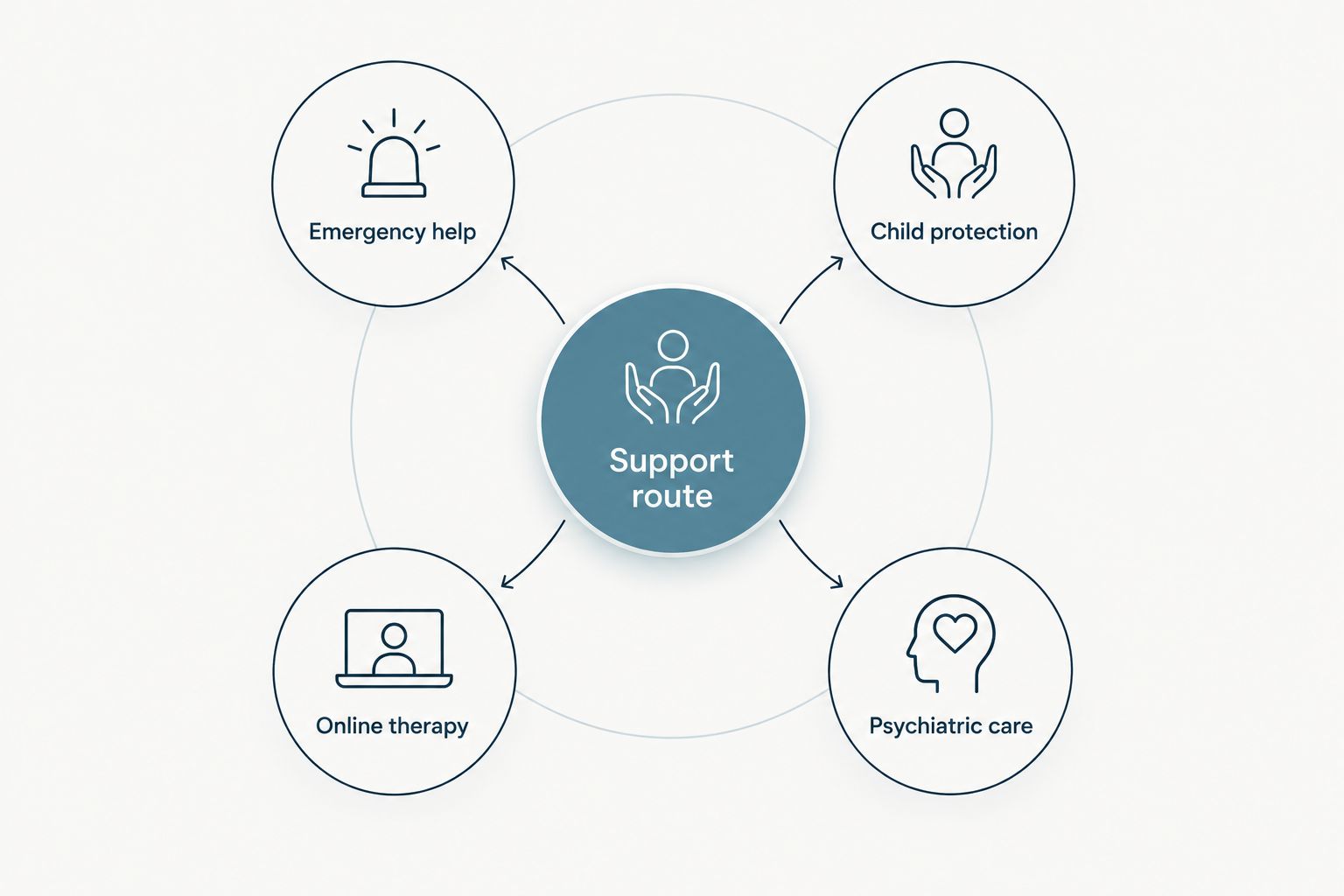
Your support route should follow the problem you need addressed: emergency help, child protection, online therapy, or psychiatric care. These are different functions, not interchangeable versions of the same service.
1. Uganda emergency numbers: best for immediate danger
Uganda’s emergency numbers, 999 and 112, are the first telephone route in this guide for immediate danger. They are not dedicated mental health helplines, and you should not expect a scheduled counselling conversation through them.
Use emergency help when someone has attempted suicide, taken an overdose, sustained a serious injury, or faces an immediate threat of violence. State the immediate danger and your location first; a detailed personal history comes later.
Uganda emergency numbers pros:
- Address urgent safety concerns rather than routine appointment requests.
- Provide a clear telephone route when the situation is an emergency.
- Keep immediate danger separate from longer-term counselling needs.
Uganda emergency numbers limitations:
- Do not replace ongoing mental health therapy.
- Do not provide a basis for promising a particular response time or outcome.
- Require you to explain the location and nature of the emergency clearly.
If a call does not connect, do not treat that as a reason to stop seeking help. Go to the nearest emergency department if you can do so safely, or ask a trusted person to help you reach urgent care.
Best for: Someone in immediate danger who needs emergency assistance, not a routine discussion about stress.
Verdict: Use for emergencies; skip for routine counselling.
2. Sauti 116: best for child protection concerns
Sauti 116 is Uganda’s child helpline. Its role concerns children’s safety and protection, making it a more relevant starting point than an adult therapy provider when abuse, exploitation, neglect, or another child protection concern is involved.
A child’s distress and a protection concern can occur together. When you call, explain the safety issue plainly rather than trying to diagnose the child or supply a clinical label.
Sauti 116 pros:
- Has a clearly defined child protection purpose.
- Offers a telephone contact specifically associated with children’s concerns.
- Helps distinguish safeguarding needs from general adult counselling requests.
Sauti 116 limitations:
- Is not a general adult mental health therapy service.
- Does not replace emergency medical attention for an injured child.
- Does not remove the need for further care when a child needs clinical assessment.
Give the child’s location and describe the concern as accurately as you can. Avoid repeatedly questioning a child about traumatic events just to assemble a detailed account before seeking help.
If a child faces immediate danger or needs urgent medical treatment, seek emergency assistance as well. Child protection and emergency care address different parts of the same situation.
Best for: Children, caregivers, or others seeking help with a child protection concern.
Verdict: Use for child protection; skip as a substitute for adult therapy.
3. InnerSpark Africa: best for scheduled online mental health therapy
InnerSpark Africa is best for people in Uganda seeking scheduled online mental health therapy with licensed African therapists. Sessions are offered through video, voice, or chat, and the service serves people in Uganda, Kenya, Tanzania, and beyond.
This is an ongoing-care option, not a crisis hotline. Choose it when you want professional counselling and are able to arrange a session rather than needing immediate emergency intervention.
InnerSpark Africa pros:
- Provides online therapy with licensed African therapists.
- Offers video, voice, and chat as session formats.
- Serves people in Uganda alongside other African countries.
- Lets you consider a format that fits your communication preferences.
InnerSpark Africa limitations:
- Does not replace emergency services or an emergency department.
- Requires a suitable device, a working connection, and a private setting for online sessions.
- Requires you to confirm the therapist’s fit for your needs before proceeding.
For your 2026 appointment, ask about the therapist’s relevant experience, the session format, and how confidentiality is handled. Ask about language options directly rather than assuming that every therapist speaks your preferred language.
Best for: People seeking scheduled counselling who prefer speaking or writing to a therapist online.
Verdict: Choose for ongoing therapy; skip during an immediate emergency.
4. Butabika: best for specialist psychiatric assessment
Butabika National Referral Mental Hospital is a specialist mental health hospital in Uganda, not a counselling hotline. It belongs in this guide because telephone support and online counselling are not substitutes for every type of clinical assessment.
Consider hospital-based assessment when you need a psychiatric evaluation or a clinician advises you to seek specialist mental health care. For an acute emergency, seek the nearest appropriate emergency care rather than delaying treatment to reach a particular institution.
Butabika pros:
- Is a dedicated mental health referral hospital.
- Provides a different care route from a telephone support conversation.
- Is relevant when specialist psychiatric assessment is the next clinical step.
Butabika limitations:
- Is not a general telephone counselling helpline.
- Requires confirmation of current access and referral arrangements for non-emergency visits.
- Does not remove the need to seek immediate local emergency care when someone is unsafe.
Before a non-emergency visit in 2026, check the hospital’s official information for current attendance arrangements. Bring relevant treatment information if you have it, including medicines you take and previous clinical records.
Best for: People who need specialist psychiatric assessment rather than a helpline conversation alone.
Verdict: Choose for specialist assessment; skip as a replacement for immediate local emergency care.
How these options are ranked
The ranking follows the criteria above: immediate safety first, child protection next, then scheduled counselling and specialist assessment. It is a decision guide, not a claim that every reader should contact every service.
The telephone references are Uganda Police Force emergency information for 999 and 112, and Uganda’s Ministry of Gender, Labour and Social Development information for Sauti 116. Butabika’s role is that of a national mental health referral hospital.
This is not a live call test or a response-time ranking. For a non-emergency enquiry in 2026, confirm current contact arrangements with the relevant organisation. For immediate danger, act on the emergency guidance rather than waiting to compare providers.
What to say when you contact support
You do not need a polished explanation. Start with the information that helps the service understand what you need.
For an emergency, state your location, what has happened, and whether anyone is injured or unsafe. For child protection, explain who is at risk and the concern you are reporting. For therapy, describe what is troubling you and what you want help with.
A short preparation list keeps the conversation focused:
- Your concern: Describe the main problem in plain language.
- Your safety: Say directly if you are at risk of harming yourself or someone else.
- Your location: Give this early when emergency assistance is needed.
- Your preference: For counselling, say whether you prefer video, voice, or chat.
- Your next step: Ask what to do after the conversation or appointment.
If speaking feels difficult, start by saying that. Do not delay urgent help because you cannot explain everything clearly.
Which support option should you choose?
Choose emergency help when safety is the immediate issue. Choose Sauti 116 for child protection. Choose InnerSpark Africa for scheduled online mental health therapy, and specialist hospital care when psychiatric assessment is needed.
For a non-emergency therapy decision in 2026, check clinical fit, privacy, and communication format before booking. A service that matches those needs is more useful than one chosen simply because it appears first in a list.
Explore online therapy
Consider licensed African therapists offering sessions by video, voice, or chat.
FAQ
What are the best mental health helplines in Uganda?
The right contact depends on the help you need: 999 or 112 for emergencies and Sauti 116 for child protection. These are not interchangeable with ongoing mental health counselling, and neither should be described as a general adult therapy service.
What number should I call if someone is in immediate danger in Uganda?
Call 999 or 112, or seek the nearest emergency department. State your location and the immediate danger clearly, and ask a trusted person to stay with you if it is safe.
Is Sauti 116 a mental health hotline for adults?
No. Sauti 116 is Uganda’s child helpline for child protection concerns, not a general adult counselling service.
Is InnerSpark Africa an emergency hotline?
No. InnerSpark Africa provides scheduled online therapy with licensed African therapists through video, voice, or chat. Use emergency services or an emergency department when there is immediate danger.
Can I use online therapy without turning on a camera?
InnerSpark Africa offers voice and chat alongside video sessions. Confirm the format for your appointment and choose a setting where you can communicate privately.
Are mental health helpline conversations always confidential?
Do not assume absolute confidentiality. Ask the service how it handles personal information and what its safeguarding obligations require when a child or another person is at risk.
What should I do if a helpline call does not connect?
If someone is in immediate danger, seek another emergency route or the nearest emergency department. For a non-emergency enquiry, check the organisation’s current official contact information before trying again.
When should I choose a psychiatric hospital instead of counselling?
Choose specialist psychiatric assessment when a clinician recommends it or you need an evaluation beyond a support conversation. During an acute emergency, seek immediate care rather than waiting for a routine assessment.
One last thing
Save contacts with their purpose, not just their number. Label 999 and 112 as emergency contacts and 116 as the child helpline, so you do not have to remember the distinction while distressed.
For ongoing care, keep your appointment information separately. Knowing which contact addresses safety and which provides therapy is a practical part of being prepared.


