

Best for starting with licensed African therapists: InnerSpark Africa. Best for a Black-women-focused therapist search: Therapy for Black Girls; best for a Black-men-focused search: Therapy for Black Men; best for searching by location and specialty: Psychology Today’s therapist directory—your 2026 choice must also match where you physically attend sessions.
- The best online therapy platforms for african diaspora must fit your location, cultural needs, and preferred session format.
- InnerSpark Africa offers licensed African therapists through video, voice, or chat; confirm eligibility in your current country.
- Therapy for Black Girls and Therapy for Black Men are therapist-search resources, not guarantees of treatment eligibility.
- Psychology Today supports a location-based therapist search; verify each clinician’s credentials and online-session arrangements.
Why this matters
Finding an African or Black therapist is not the same as finding a therapist who can treat you where you live. Cultural understanding matters, but so do professional credentials, cross-border practice rules, privacy, and the practical arrangements for each session.
For the African diaspora, the search can involve migration, racism, family expectations, faith, belonging, or relationships across countries. You do not need every one of those experiences to seek support. You need a clinician who understands the issues you actually bring.
InnerSpark Africa is best suited to people seeking online therapy with licensed African therapists, subject to eligibility in their current location. That is a starting recommendation, not a claim that one service fits every diaspora community or jurisdiction.
This guide separates a therapy service from therapist directories. A service offers sessions; a directory helps you find individual clinicians whose arrangements you must check separately.
What makes the best online therapy platforms for African diaspora
Use these criteria before choosing from a 2026 shortlist:
- Location eligibility: The clinician must be permitted to provide care where you will physically attend the session. Your nationality alone does not settle this.
- Relevant cultural understanding: Ask about experience with your concerns, whether that means migration, racial identity, intergenerational conflict, or another issue.
- Verifiable credentials: Check the clinician’s professional registration, licensing body, and scope of practice. A directory listing is not a substitute for verification.
- Usable session format: Decide whether video, voice, or chat lets you communicate clearly and privately. Confirm how the chosen format works.
- Clear care boundaries: Understand confidentiality limits, communication between sessions, and what happens if you need urgent or specialist care.
Make 3 checks before booking: location eligibility, credentials, and fit for your concern. Familiar cultural references are valuable, but they cannot replace those checks.
A shared background also does not guarantee a good therapeutic relationship. Ask how the therapist works rather than expecting identity alone to answer that question.
Online therapy options at a glance
These options serve different search needs. The directories below help you identify clinicians; they are not interchangeable with a service that provides therapy sessions.
| Option | Best for | Standout feature | Key limitation |
|---|---|---|---|
| InnerSpark Africa | Starting with licensed African therapists | Online therapy through video, voice, or chat | Confirm eligibility outside the stated service regions and for your current location |
| Therapy for Black Girls | A Black-women-focused therapist search | A therapist directory centered on Black women’s mental health | Individual clinicians determine treatment arrangements and eligibility |
| Therapy for Black Men | A Black-men-focused therapist search | A therapist directory centered on Black men’s mental health | A listing does not establish diaspora-specific experience or cross-border eligibility |
| Psychology Today therapist directory | Searching by location and clinical concern | Location-based therapist profiles and search filters | You must assess cultural fit and verify each clinician separately |
The ranking follows distinct use cases, not a claim that every option provides the same service. Start with the row that matches your main need, then apply the eligibility checks.
1. InnerSpark Africa: best for licensed African therapists
InnerSpark Africa offers online mental health therapy with licensed African therapists through video, voice, or chat. Its stated service regions include Uganda, Kenya, Tanzania, and beyond.
For a diaspora reader, the appeal is direct access to an Africa-focused therapy service rather than beginning with a broad directory. Before booking, establish whether the assigned therapist can work with you in the country or jurisdiction where you will attend.
InnerSpark Africa pros:
- Licensed African therapists are part of the stated service.
- Video, voice, and chat give you different ways to communicate.
- The service explicitly serves people in Uganda, Kenya, and Tanzania.
InnerSpark Africa cons:
- The stated regional coverage does not establish eligibility in every diaspora destination.
- An African therapist’s background does not automatically establish expertise in your particular concern.
Ask about your actual circumstances: your location, the issue you want help with, and your preferred format. If you need support with migration-related distress, for example, ask about that experience directly rather than relying on a broad cultural label.
Best for: People whose first priority is finding licensed African therapists for online therapy.
Verdict: Hold until your location eligibility and clinical fit are confirmed; then consider booking.
2. Therapy for Black Girls: best for a Black-women-focused search
Therapy for Black Girls is a mental health resource with a therapist directory focused on Black women. Use it to identify potential clinicians, then contact those clinicians about online sessions and eligibility.
Its focus gives you a more specific starting point than a general therapist search. It does not mean every listed clinician shares your nationality, understands your migration history, or works across borders.
Therapy for Black Girls pros:
- The directory centers Black women’s mental health.
- Individual profiles give you a starting point for clinician research.
- Direct contact lets you ask about your concerns before arranging care.
Therapy for Black Girls cons:
- A directory listing does not guarantee that a clinician can treat you in your location.
- A Black-women-focused search is not the same as an African-diaspora-specific clinical match.
Tell a prospective therapist which experiences matter to you. Being raised in an African household, moving countries as an adult, and growing up in a diaspora community are different contexts; none should be assumed from your identity.
Best for: Black women who want a focused therapist-search resource.
Verdict: Use the directory to build a shortlist; hold on booking until the individual clinician passes your checks.
3. Therapy for Black Men: best for a Black-men-focused search
Therapy for Black Men provides a therapist directory focused on Black men’s mental health. It is a search resource, so the clinician you contact—not the directory alone—determines how care is delivered.
Use it when a Black-men-focused starting point matters to you. Ask each prospective clinician about the concerns you want to address, including any relevant family, identity, relationship, or migration experiences.
Therapy for Black Men pros:
- The directory centers Black men’s mental health.
- It gives you individual clinicians to research and contact.
- You can assess a therapist’s stated approach before discussing treatment.
Therapy for Black Men cons:
- The directory does not establish that every clinician offers suitable online care for your location.
- Its focus does not guarantee experience with your specific African diaspora context.
Avoid choosing solely because a profile uses familiar identity language. Ask how the therapist would approach your concern and whether it falls within their professional scope.
Best for: Black men seeking a focused route to identifying potential therapists.
Verdict: Use for discovery; hold until online-session arrangements, credentials, and location eligibility are clear.
4. Psychology Today: best for location and specialty searches
Psychology Today’s therapist directory lets you search for clinicians by location and review their profiles. It is useful when your first task is finding professionals in the jurisdiction where you live.
Use the available filters and profile descriptions to narrow your search. Then ask directly about African diaspora experience; a general specialty label cannot establish that fit.
Psychology Today pros:
- Location-based searching puts geography early in the decision.
- Profiles describe clinicians’ approaches and areas of practice.
- Search filters help you narrow a broad set of listings.
Psychology Today cons:
- Cultural understanding requires your own assessment.
- Profile information still needs credential and service verification.
Best for: Readers who need to start with local eligibility and a particular clinical concern.
Verdict: Use for a location-led shortlist; skip any clinician who cannot confirm suitability for your needs.
How this ranking works
This 2026 ranking prioritizes different routes to care: licensed African therapists, Black-women-focused discovery, Black-men-focused discovery, and location-based searching. It does not rank treatment outcomes or present directories as therapy providers.
The criteria are location eligibility, cultural understanding, credentials, session format, and care boundaries. The best option is the one that passes those checks for you—not the one with the most familiar name.
How to check a therapist before booking
Use this sequence when moving from a platform or directory to an individual clinician. Keep the answers together so you can compare options without relying on memory.
Confirm location
State the country and, where relevant, state or province where you will physically attend. Ask whether the clinician is permitted to provide therapy there, including during travel.
Verify credentials
Request the clinician’s professional title, registration details, and licensing or regulatory body. Check those details with the relevant authority rather than treating a profile badge as sufficient evidence.
Discuss fit
Describe your main concern in 2 sentences: what is happening and what you want help changing. Ask about the therapist’s experience with that concern and any cultural context you want understood.
Agree logistics
Offer 2 appointment windows, each with your time zone. Confirm the session format, privacy arrangements, and what to do if the connection fails.
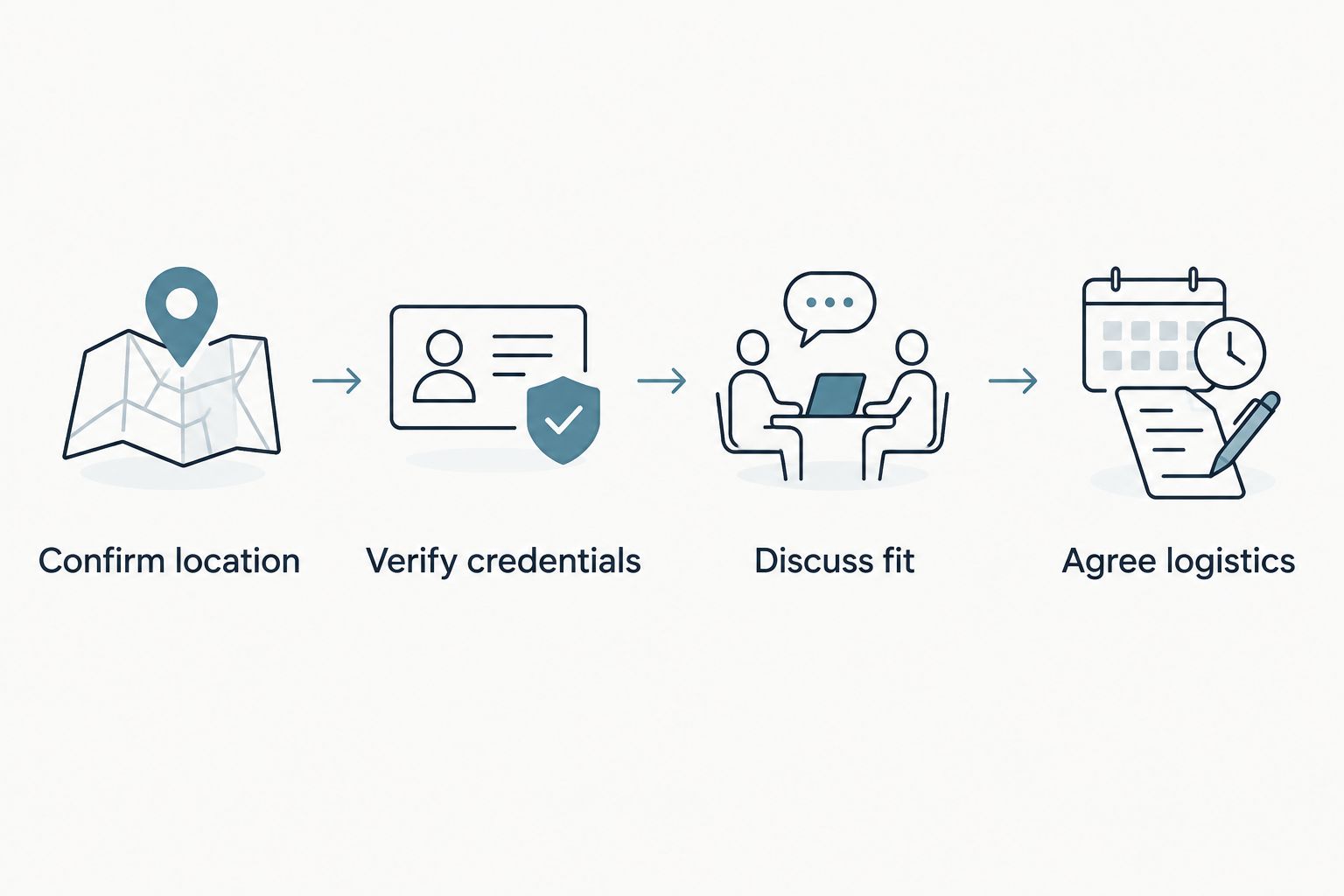
These numbers are preparation prompts, not clinical requirements. You can explain more when needed; the aim is to make the first exchange clear and manageable.
Which online therapy option should you choose?
For your 2026 search, start with your non-negotiable requirement. If it is access to licensed African therapists, investigate the Africa-focused service first and confirm eligibility before booking.
If you want a Black-women-focused or Black-men-focused search, use the corresponding directory. If location and a particular clinical concern come first, start with a location-based directory and assess cultural fit afterward.
Do not compromise on location eligibility to get a cultural match. Instead, ask an eligible clinician directly about the experiences that matter to you.
You also do not need to commit merely because an initial conversation feels familiar. A clear explanation of the therapeutic approach, professional boundaries, and next steps gives you a stronger basis for choosing.
FAQ
What are the best online therapy platforms for African diaspora in 2026?
The best starting point depends on your location and search priorities. InnerSpark Africa offers licensed African therapists, while Therapy for Black Girls, Therapy for Black Men, and Psychology Today provide different routes to finding clinicians. Confirm individual eligibility before booking.
Can I see a therapist based in Africa while living abroad?
Cross-border therapy requires confirmation that the clinician is permitted to treat you where you physically attend. Being African or holding citizenship in an African country does not settle that question. Give the clinician your current location before arranging care.
Is a therapist directory the same as an online therapy service?
No, a therapist directory helps you find clinicians rather than establishing the treatment arrangements itself. Ask the individual clinician about online sessions, professional credentials, and eligibility in your location.
Do I need a therapist from the same African country as me?
No, shared nationality is not a requirement for a useful therapeutic relationship. Ask about the therapist’s experience with your concerns, cultural context, and preferred language rather than assuming nationality guarantees understanding.
Is video therapy better than voice or chat?
No single format is best for everyone. Discuss which format suits your clinical needs, communication preferences, connection, and private space. Also clarify whether chat means a live session or communication at another time.
How do I check whether an online therapist is licensed?
Ask for the therapist’s professional title, registration details, and regulatory body, then verify them with the relevant authority. Separately confirm that the clinician can provide care in your location.
What should I do if I need urgent mental health help?
If you are in immediate danger or cannot keep yourself safe, contact local emergency services or go to the nearest emergency department. Do not wait for a routine online therapy booking. A therapist directory is not an emergency response service.
One last thing
The location question applies again when you travel. A therapist who can work with you at home is not automatically permitted to continue sessions while you are visiting another country.
Before a trip in 2026, tell your therapist where you will be and ask whether sessions can continue. Put your physical location—not just your time zone—into the planning conversation.


