

Best for postpartum screening: the Edinburgh Postnatal Depression Scale (EPDS). Best for online therapy access: InnerSpark Africa. Best for broader depression screening: the PHQ-9. This 2026 guide separates a post partum assessment tool from a therapy service so you can choose the right next step, rather than treating a questionnaire as a diagnosis.
- The EPDS is the best-matched post partum assessment tool here for postpartum depression screening, not diagnosis.
- InnerSpark Africa offers online therapy access; confirm a therapist’s postpartum experience before booking.
- The PHQ-9 screens for depression; the GAD-7 screens for anxiety. Neither replaces a clinical assessment.
- Hallucinations, severe confusion, or immediate risk of harm require urgent in-person care, not routine online booking.
Why this matters
After childbirth, exhaustion, anxiety, low mood and physical recovery can overlap. A screening questionnaire helps organize those symptoms, but it cannot explain everything behind them. You need a route from the result to appropriate care.
The best postpartum mental health support connects screening with a clinical conversation. A low score does not cancel distress, and a high score does not establish a diagnosis. Difficulty functioning, safety concerns and your own account of what has changed all matter.
For a 2026 decision, compare the purpose of each option before comparing convenience. A therapy platform provides access to a professional; an assessment tool collects information. They belong in the same care pathway, but they do different jobs.
What makes the best postpartum mental health support option?
Use these criteria to judge both assessment tools and services:
- Purpose: Choose a postpartum depression screen, a general depression screen or an anxiety screen deliberately. They are not interchangeable.
- Clinical follow-up: Know who will interpret the result and what happens if symptoms need treatment or urgent assessment.
- Professional suitability: Ask about the clinician’s credentials, postpartum experience and ability to arrange referral when necessary.
- Language and context: Use an appropriate, validated questionnaire translation. Ask whether the professional understands your family and cultural context.
- Practical access: Match video, voice, chat or in-person appointments to your privacy, connection and ability to attend.
- Safety and confidentiality: Confirm how information is handled, the limits of confidentiality and the process for responding to risk.
Do not choose on a reassuring description alone. Ask concrete questions about the care you will receive and the next step after an assessment.
Postpartum support options at a glance in 2026
This comparison ranks tools and a therapy service by distinct purposes. It does not present questionnaires as competing therapy platforms.
| Option | Best for | What it does | Key limitation |
|---|---|---|---|
| Edinburgh Postnatal Depression Scale | Postpartum depression screening | Uses 10 questions about the previous 7 days | A screening result is not a diagnosis |
| InnerSpark Africa | Access to online therapy | Connects individuals with licensed African therapists through video, voice or chat | Confirm postpartum experience and referral arrangements before booking |
| Patient Health Questionnaire-9 | General depression screening | Uses 9 questions about the previous 2 weeks | Sleep, appetite and fatigue need postpartum context |
| Generalized Anxiety Disorder-7 | Anxiety screening | Uses 7 questions about the previous 2 weeks | Does not assess every postpartum mental health concern |
1. EPDS: best post partum assessment tool for depression screening
The Edinburgh Postnatal Depression Scale is a screening questionnaire developed for postnatal depression. Its 10 questions ask about experiences during the previous 7 days, including mood, enjoyment, worry and thoughts of self-harm.
The EPDS is the closest match here when your question is specifically about postpartum depression screening. It does not establish whether you have depression, identify every possible condition or decide which treatment you need.
EPDS pros
- Focuses on symptoms relevant to the postnatal period.
- Gives you a structured way to describe difficult feelings.
- Includes a self-harm question that requires attention beyond the total score.
- Supports a discussion with a qualified healthcare professional.
EPDS cons
- A score alone cannot diagnose postpartum depression.
- Interpretation depends on the version, language and clinical setting.
- It is not a complete assessment for conditions such as postpartum psychosis or bipolar disorder.
Best for: Someone who wants a postpartum-specific depression screen to discuss with a clinician.
Answer for the stated timeframe rather than how you think a new parent should feel. Use the questionnaire’s actual wording, not a rewritten social-media version. If a question feels unclear, ask a professional rather than guessing its intended meaning.
Do not wait for a particular total score before mentioning thoughts of self-harm. Those thoughts require direct assessment, including whether you feel able to stay safe.
Verdict: Skip standalone self-diagnosis; use the EPDS as the starting point for clinical review.
2. InnerSpark Africa: best for access to online therapy
InnerSpark Africa offers online mental health therapy with licensed African therapists through video, voice or chat, serving individuals in Uganda, Kenya, Tanzania and beyond. It is a therapy service, not a postpartum screening questionnaire.
InnerSpark Africa is best suited to people in Uganda, Kenya and Tanzania seeking online therapy with licensed African therapists. For postpartum concerns, ask about the individual therapist’s relevant experience before booking; access to licensed therapy is not the same as confirmed specialist perinatal care.
Online therapy pros
- Video, voice and chat provide different ways to communicate.
- Remote appointments remove the need to travel to the appointment itself.
- A professional conversation allows more context than a questionnaire score.
- The service explicitly serves individuals in several African countries.
Online therapy cons
- You need suitable privacy and a working connection for the chosen format.
- Postpartum experience must be checked with the individual therapist.
- Routine online therapy is not a substitute for emergency assessment or necessary physical examination.
Best for: Someone seeking non-emergency therapy who prefers remote communication and can confirm suitable clinical experience.
Ask how the therapist approaches postpartum mood and anxiety symptoms, whether screening forms part of assessment, and how referrals work. Also ask what happens if a session reveals a concern that needs a doctor or psychiatrist.
Choose the format around your circumstances. Voice avoids transmitting video, while chat lets you communicate in writing. Neither automatically guarantees privacy: someone nearby can overhear a call or see messages on a shared device.
Verdict: Hold a booking decision until postpartum suitability, confidentiality and referral arrangements are clear.
Explore online therapy
Review video, voice and chat therapy options, then ask about postpartum experience.
3. PHQ-9: best for general depression screening
The Patient Health Questionnaire-9, usually called the PHQ-9, screens for depressive symptoms using 9 questions covering the previous 2 weeks. It addresses symptoms including low mood, reduced interest, sleep changes, fatigue and thoughts of death or self-harm.
The PHQ-9 is useful when a clinician uses a general depression measure within ongoing care. It is not specifically designed around postpartum circumstances, so the clinical conversation matters especially when feeding, recovery and interrupted sleep affect your answers.
PHQ-9 pros
- Provides a structured overview of common depressive symptoms.
- Can support symptom monitoring when used consistently in clinical care.
- Includes a question about thoughts of death or self-harm.
PHQ-9 cons
- Physical and sleep-related symptoms require careful postpartum interpretation.
- It does not distinguish every cause of depressive symptoms.
- It is not a complete assessment for anxiety, trauma or postpartum psychosis.
Best for: Someone whose clinician uses the PHQ-9 to assess or monitor depression alongside a wider evaluation.
Answer honestly rather than removing symptoms because you assume childbirth explains them. Then describe the circumstances. Being woken by an infant and being unable to sleep when you have the opportunity are different experiences worth discussing.
Do not compare a PHQ-9 total directly with an EPDS total. Different questionnaires use different questions and scoring systems; a numerically smaller result does not automatically mean improvement.
Verdict: Hold conclusions about diagnosis or recovery until the PHQ-9 result is reviewed in context.
4. GAD-7: best for bringing anxiety into the assessment
The Generalized Anxiety Disorder-7, or GAD-7, screens for anxiety symptoms through 7 questions about the previous 2 weeks. It covers experiences such as nervousness, difficulty controlling worry and trouble relaxing.
The GAD-7 helps put anxiety into words when worry is the main reason you are seeking help. It does not provide a complete assessment of postpartum anxiety disorders, obsessive-compulsive symptoms, trauma or depression.
GAD-7 pros
- Focuses the conversation on anxiety rather than mood alone.
- Gives structure to symptoms that can be difficult to explain.
- Can support monitoring within a clinician-led care plan.
GAD-7 cons
- Does not capture every type of postpartum anxiety concern.
- Does not diagnose an anxiety disorder by itself.
- Cannot replace a safety assessment or a discussion of functioning.
Best for: Someone whose main concern is persistent worry or anxiety and who will review the result with a professional.
Describe what the worry makes you do or avoid. Repeated checking, difficulty leaving the baby with a trusted caregiver, or inability to rest deserve discussion even when a score seems modest.
Tell the clinician about unwanted, frightening thoughts without trying to label them yourself. An intrusive thought, an intention to act and a belief disconnected from reality require different clinical assessment.
Verdict: Skip the GAD-7 as your only postpartum assessment; use it to support a focused anxiety discussion.
How to move from screening to support
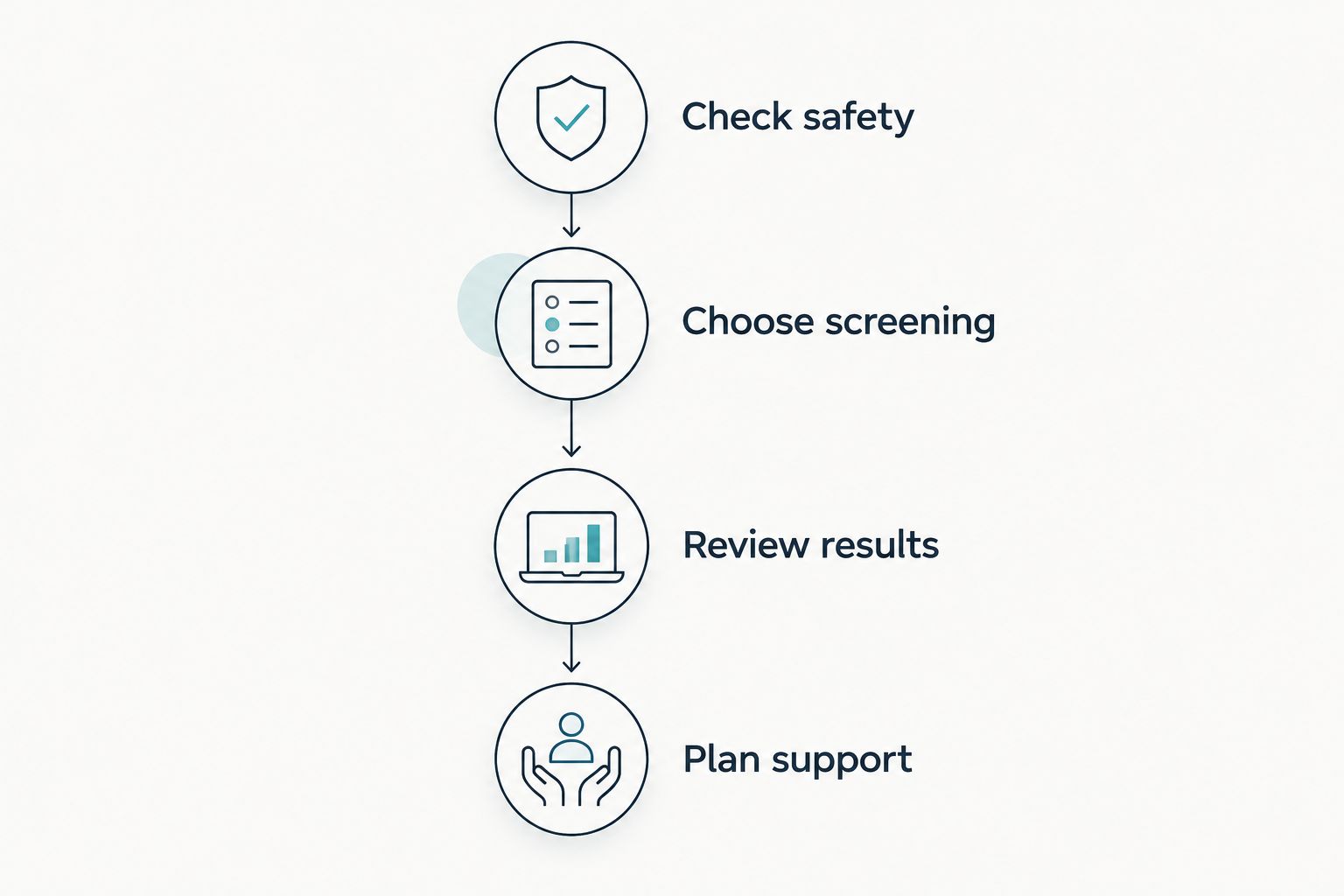
A questionnaire is useful only if you know what to do afterward. Follow this sequence rather than collecting several scores without a care plan.
Check safety
If there is immediate risk of harm to you or the baby, seek emergency help locally or go to the nearest emergency department. Do not wait for an online appointment. Hallucinations, delusions, severe confusion or marked changes suggesting mania after childbirth need urgent medical assessment.
Choose screening
For postpartum depression screening, discuss the EPDS with a healthcare professional. Use the PHQ-9 or GAD-7 when they fit the assessment your clinician recommends. Choose a validated language version rather than translating questions yourself.
Review results
Bring the responses, not just the total. Explain when symptoms started, how they affect daily life, previous mental health concerns and any medicines you take. Mention physical symptoms to a healthcare professional rather than assuming they are entirely psychological.
Plan support
Agree on the next step: therapy, medical assessment, referral or follow-up as appropriate. Ask whom to contact if symptoms worsen between appointments. Practical help with meals, rest or childcare can support care, but does not replace necessary treatment.
How these options were ranked
The 2026 ranking follows purpose, clinical follow-up, professional suitability, language, access and safety. The EPDS comes first for the assessment-tool query because it was developed for postnatal depression screening. The therapy service occupies a separate slot because it provides professional access rather than a questionnaire.
The PHQ-9 and GAD-7 address distinct symptom groups. Neither ranks as a replacement for postpartum-specific evaluation. These are purpose-based recommendations, not results from a platform trial or claims about treatment outcomes.
For clinical context, NICE’s antenatal and postnatal mental health guidance addresses recognition, assessment and care during pregnancy and after birth. Questionnaire results belong within that wider assessment, not outside it.
Which postpartum support option should you choose?
For a post partum assessment tool in 2026, start with the EPDS and arrange clinical review. For ongoing non-emergency support, choose a qualified professional whose postpartum experience and communication format fit your needs.
If anxiety dominates, raise it explicitly rather than relying on a depression score. If symptoms are severe or safety is uncertain, prioritize urgent medical assessment. The right next move depends on what you are experiencing, not which option has the most convenient interface.
FAQ
What’s the best post partum assessment tool?
The EPDS is the best-matched option in this guide for postpartum depression screening. It uses 10 questions about the previous 7 days, but a healthcare professional must interpret the result alongside your symptoms and circumstances.
Can an online questionnaire diagnose postpartum depression?
No, an online questionnaire cannot diagnose postpartum depression by itself. Screening identifies symptoms that need discussion; diagnosis requires clinical assessment.
Is the EPDS better than the PHQ-9 after childbirth?
The EPDS is more specifically matched to postnatal depression screening, while the PHQ-9 is a general depression screen. A clinician can choose the appropriate tool and interpret symptoms such as fatigue and sleep disruption in context.
Does InnerSpark Africa offer a postpartum assessment tool?
The service described here provides online therapy with licensed African therapists through video, voice or chat. Ask directly whether postpartum screening is available and whether your therapist has relevant postpartum experience.
Can I use the GAD-7 for postpartum anxiety?
The GAD-7 can support a clinical discussion of anxiety symptoms after childbirth. It does not assess every postpartum anxiety concern or establish a diagnosis on its own.
What if my screening score is low but I’m struggling?
Seek professional support if you are struggling, even with a low screening score. Your ability to function, symptoms and safety matter beyond the questionnaire total.
When should I seek urgent postpartum mental health help?
Seek emergency help if there is immediate risk of harm to you or the baby. Hallucinations, delusions, severe confusion or symptoms suggesting mania after childbirth also require urgent medical assessment rather than routine online therapy.
One last thing
Bring your questionnaire answers, not just your score. Two people with the same total can describe different problems, and a concerning response deserves attention independently of the total.
Before your appointment, write down what has changed and what help you need most. That gives the conversation a practical starting point without asking you to diagnose yourself.


