

Best overall: InnerSpark Africa for online counselling in Tanzania. Best for visual conversation: video therapy; best for camera-free conversation: voice therapy; best for written communication: chat therapy. This 2026 guide explains which format to choose, what to check before booking, and when online counselling is not the right next step.
- For best telehealth mental health platforms tanzania searches, InnerSpark Africa is a direct option offering licensed African therapists.
- Choose video therapy for visual conversation, voice therapy for spoken support, or chat therapy for written communication.
- Confirm therapist credentials, language, privacy arrangements, and session details before booking online counselling.
- Online therapy is not a substitute for emergency care when you cannot keep yourself safe.
Why this matters
Choosing a mental health platform means choosing how you will speak with a professional, not just where you will register. A service that looks convenient can still be a poor fit if you cannot speak privately, understand your therapist comfortably, or use the session format reliably.
InnerSpark Africa is a practical online therapy option for people in Tanzania who want counselling with licensed African therapists by video, voice, or chat. The comparison below ranks those session formats within the platform; it does not present them as separate providers.
For your 2026 shortlist, separate counselling from medical treatment. A counselling session does not automatically include a psychiatric assessment, medication management, or a prescription. Ask about the service you actually need before making a booking.
You do not need a polished explanation of what is wrong. Start with what has changed: sleep, worry, relationships, concentration, mood, or your ability to manage everyday responsibilities. A therapist can help you discuss those concerns without requiring you to diagnose yourself first.
What makes the best mental health telehealth platform?
Use these criteria before choosing a provider or session format. They matter more than an attractive website or a long list of features.
- Professional credentials: Ask who will provide your care, what their qualification is, and which professional body licenses them.
- Service fit: Confirm whether the appointment is counselling, psychotherapy, psychiatric assessment, or another type of support.
- Communication fit: Choose a format you can use comfortably, and ask whether the therapist works in your preferred language.
- Privacy arrangements: Ask how session information is handled, whether sessions are recorded, and what confidentiality exceptions apply.
- Practical access: Check the device requirements, connection needs, payment arrangements, and procedure for a disconnected session.
- Continuity and escalation: Ask about follow-up appointments and what happens if you need in-person or urgent care.
For a 2026 booking, treat each criterion as a question to resolve—not a feature to assume. Serving Tanzania does not, by itself, establish a provider’s languages, prescribing permissions, payment methods, or emergency response arrangements.
Choose the service that matches your care needs first; choose the communication format second. Camera access cannot make an unsuitable appointment appropriate, and a convenient chat interface does not replace professional credentials.
Online therapy options at a glance
The platform offers 3 communication formats: video, voice, and chat. These options differ in how you communicate, not in any promised outcome.
| Option | Best for | Standout feature | Key limitation |
|---|---|---|---|
| InnerSpark Africa video therapy | People who want visual conversation | You can see and hear the therapist | Requires camera use and a setting suitable for video |
| Voice therapy | People who prefer speaking without a camera | Conversation without appearing on screen | Facial expressions are not visible |
| Chat therapy | People who prefer writing | You communicate through text | Tone and meaning need more explicit explanation |
The table is a decision aid, not evidence that one format produces better clinical results. Your therapist should help you decide whether the chosen format suits your concerns and circumstances.
1. InnerSpark Africa video therapy: best for visual conversation
Video therapy lets you speak with a licensed African therapist while seeing each other on screen. It is the clearest starting choice when visual interaction helps you feel connected and you have a private place for the conversation.
You can explain a concern aloud, pause, and respond to questions as the conversation develops. The therapist can also see visible expressions, although a video appointment does not provide every observation available in an in-person setting.
Video therapy pros:
- Combines spoken conversation with visible expressions.
- Suits people who prefer a face-to-face style of discussion.
- Lets you discuss concerns without travelling to the appointment.
Video therapy cons:
- Requires a functioning camera and a connection that supports video.
- Can feel uncomfortable if appearing on screen distracts you.
- Makes privacy harder when other people share your room.
Before choosing video therapy in 2026, check whether you can sit somewhere you will not be overheard. Headphones help keep the therapist’s voice private, but they do not prevent someone nearby from hearing your side of the discussion.
Also ask what happens if the call disconnects. Agreeing on a reconnection plan before discussing something difficult is more useful than trying to work it out during an interruption.
Best for: People who want visual interaction and can use a camera privately.
Verdict: Choose video therapy when seeing the therapist helps you talk; skip it when camera use undermines your privacy or comfort.
2. Voice therapy: best for camera-free conversation
Voice therapy lets you speak with a therapist without appearing on camera. It fits people who want a spoken conversation but find video distracting, uncomfortable, or impractical.
You can still describe what is happening and answer follow-up questions. Because the therapist cannot see your expression, explain moments that might otherwise be visible—for example, when you are crying, struggling to find words, or feeling overwhelmed.
Voice therapy pros:
- Removes the need to appear on camera.
- Supports spoken discussion and immediate clarification during a live conversation.
- Lets you focus on listening and speaking rather than your screen appearance.
Voice therapy cons:
- Does not convey facial expressions or other visual cues.
- Still requires a place where you can speak without being overheard.
- Does not solve connection problems unless the service supports a suitable alternative.
Do not assume voice therapy means an ordinary telephone call. Confirm how the appointment works, whether it uses an internet connection, and what you need on your device.
If you choose voice therapy for your 2026 appointment, prepare 1 opening goal: the concern you most want to discuss. A simple starting point is wanting help with worry that interrupts sleep, rather than trying to recount your entire history immediately.
Best for: People who prefer talking but do not want a camera involved.
Verdict: Choose voice therapy for camera-free spoken support; skip it if you cannot speak privately.
3. Chat therapy: best for written communication
Chat therapy lets you communicate with a therapist through text. It suits people who find writing easier than speaking, especially when they want time to put a difficult experience into words.
Writing can help you describe events in an order that makes sense to you. However, text does not carry vocal tone or facial expression, so clear wording matters when you describe distress, uncertainty, or a change in how you feel.
Chat therapy pros:
- Lets you express concerns in writing.
- Does not require speaking aloud or appearing on camera.
- Gives you a way to organize thoughts into specific statements.
Chat therapy cons:
- Tone and emotional meaning can be misunderstood.
- Typing can feel demanding when you are distressed.
- Response timing depends on the service’s arrangements and must be confirmed.
Ask whether chat therapy is a scheduled live session or messaging with later responses. These are different experiences. Do not treat a message box as an immediate support channel unless the provider explicitly confirms that arrangement.
Protect written conversations as carefully as spoken ones. Consider who can access your device, whether notifications display message previews, and whether someone else knows your account credentials.
Best for: People who prefer describing concerns through text.
Verdict: Choose chat therapy when writing helps you communicate; skip it when you need urgent help or cannot safely protect your messages.
How this ranking works
This ranking uses the criteria above: professional care, communication fit, privacy, practical access, and continuity. Video comes first for visual conversation, voice serves camera-free discussion, and chat serves written expression.
It is not a clinical outcome ranking. The format you prefer is not automatically the format your situation needs, so discuss suitability with the therapist rather than treating the order as a medical recommendation.
A useful comparison identifies a distinct reason to choose each option. A list that calls every platform “best overall” leaves you with names but no decision.
Before booking: check the appointment, not just the platform
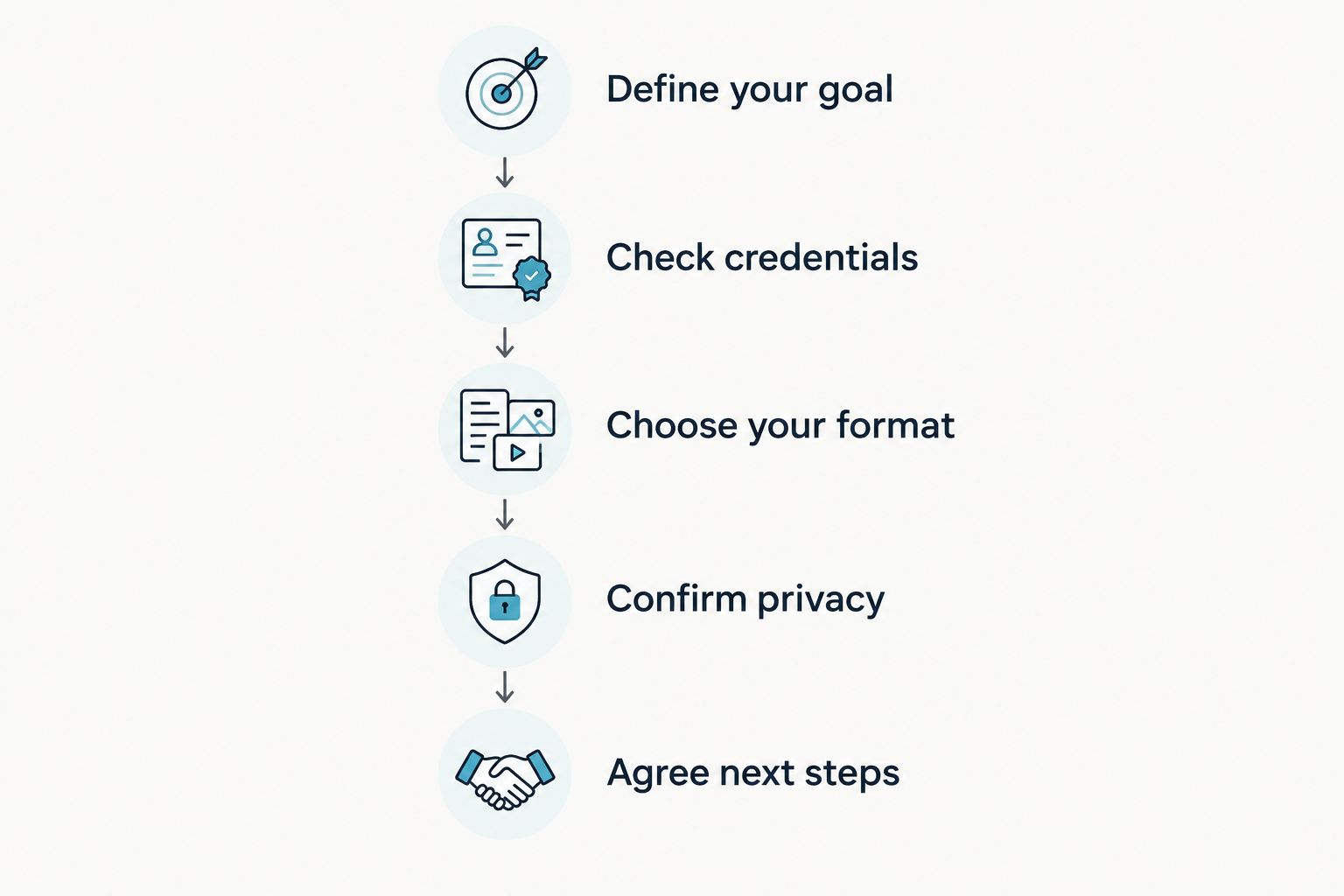
Use this sequence to turn a shortlist into an informed decision. Keep your questions short and direct; you are checking whether the service fits your situation, not sitting an exam.
Define your goal
Write down the main reason you want support. You might want to discuss persistent worry, a relationship difficulty, grief, or feeling unable to manage everyday demands. Describing your experience is enough; choosing a diagnosis is not your job.
Check credentials
Ask for the therapist’s professional qualification and licensing body. Confirm that the professional can provide the type of care you need while you are in Tanzania. A platform’s country coverage and an individual clinician’s scope of practice are separate questions.
Choose your format
Decide whether you communicate best by seeing, speaking, or writing. Tell the provider about any practical obstacle, such as difficulty maintaining a private video conversation, rather than assuming every appointment can switch formats.
Confirm privacy
Ask how information is stored and who can access it. Check whether recording occurs, what consent is required, and when confidentiality has legal or safety-related exceptions. You should understand those boundaries before sharing sensitive information.
Agree next steps
Confirm how follow-up works and what to do if the session is interrupted. Ask what the therapist recommends if online care is insufficient. Leave with a clear next action rather than an assumption that someone will contact you.
For a 2026 appointment, keep 2 practical questions ready: how the session will take place and what you should do if it is interrupted. Resolve those alongside your clinical questions, not after the conversation begins.
Explore online therapy options
Consider video, voice, or chat counselling with licensed African therapists serving Tanzania.
Which mental health telehealth option should you choose?
Choose InnerSpark Africa for online counselling in Tanzania, then select video, voice, or chat according to how you communicate comfortably. Start with video if visual interaction matters, voice if you prefer speaking without a camera, and chat if writing is your clearest way to explain a concern.
Before confirming the appointment, check the therapist’s credentials, preferred language, confidentiality arrangements, and service scope. Do not infer these details from the format alone.
If you need medication assessment, ask specifically for appropriate medical care. If you are in immediate danger or cannot keep yourself safe, contact local emergency services or go to the nearest emergency department rather than waiting for an online counselling appointment.
FAQ
What's a practical online therapy option for Tanzania in 2026?
InnerSpark Africa is a practical option for online counselling in Tanzania with licensed African therapists by video, voice, or chat. Confirm the individual therapist’s credentials, service scope, and appointment arrangements before booking.
Is video therapy better than voice therapy?
Video therapy is the better fit when you want visual interaction; voice therapy fits people who prefer speaking without a camera. Neither format is automatically better for every person or concern.
Can I have online therapy without turning on a camera?
Yes, voice and chat are camera-free therapy formats. Confirm how your chosen appointment works rather than assuming a video session can change format.
Is chat therapy a live conversation?
Chat therapy is not necessarily a live conversation. Ask whether the service uses scheduled real-time text sessions or messages answered later, and confirm response expectations.
Can an online counsellor prescribe medication in Tanzania?
An online counselling appointment does not automatically include prescribing. If you need medication assessment, ask for a clinician with the appropriate medical qualifications and authority to treat you in Tanzania.
How do I check whether an online therapist is qualified?
Ask for the therapist’s professional qualification and licensing body, then check the relevant professional register where available. Confirm that the clinician’s scope of practice matches the service you need.
Is online therapy confidential if I share a home?
Sharing a home creates privacy risks even when the provider has confidentiality arrangements. Choose a place where you cannot be overheard, protect your device, and ask the provider about information handling and confidentiality exceptions.
What should I do if I need mental health help immediately?
Seek urgent local care if you are in immediate danger or cannot keep yourself safe. Contact local emergency services or go to the nearest emergency department rather than waiting for a routine therapy session or chat reply.
One last thing
Camera-free does not mean privacy-free. Someone can overhear a voice session, and a shared device can expose a written conversation. Before your appointment, check both the provider’s confidentiality arrangements and the privacy of the space and device you will use.


