
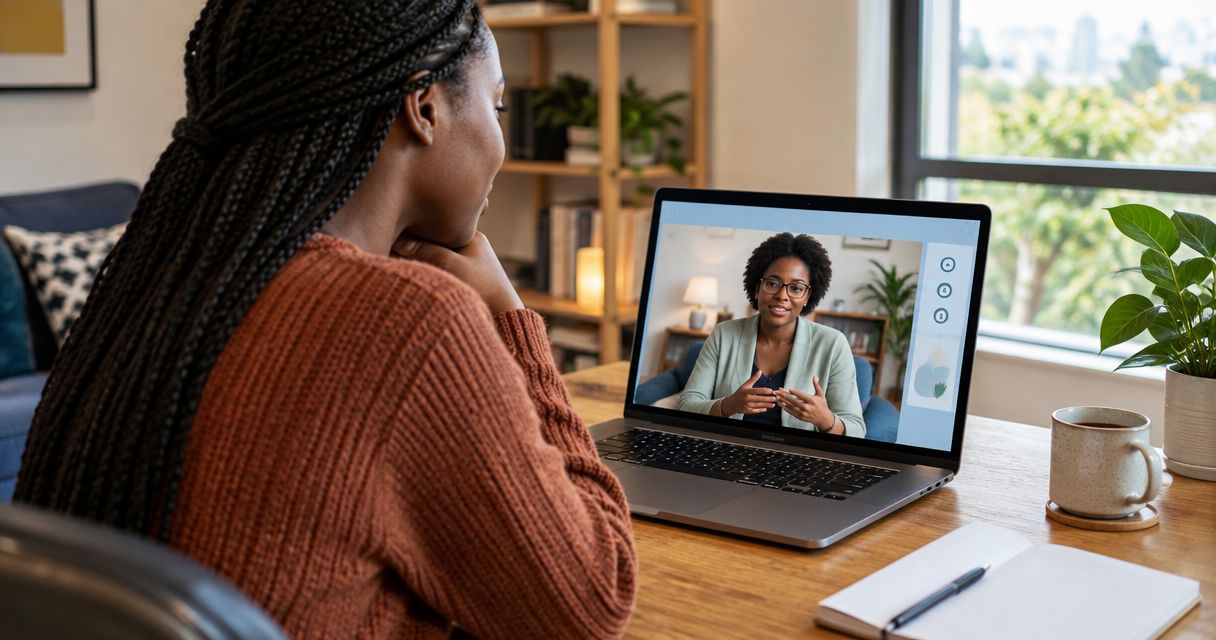
Best for face-to-face conversation: InnerSpark Africa video therapy; best for speaking without a camera: voice therapy; best for expressing yourself in writing: chat therapy. This 2026 guide compares those options by practical fit, not a claimed lowest fee, so you can choose an affordable session without overlooking credentials, privacy or what the booking includes.
- For cheapest online therapy uganda ranked searches, compare the full session cost before choosing a provider.
- InnerSpark Africa offers online counselling with licensed African therapists through video, voice or chat.
- Choose video for visual conversation, voice for speaking without a camera, and chat for written communication.
- Confirm session length, payment terms and confidentiality before booking online therapy in Uganda.
Why this matters
The cheapest online therapy session is not necessarily the cheapest workable option. A booking that does not suit your communication needs, private space or internet connection is a poor purchase, even when its advertised fee looks attractive.
For your 2026 decision, separate affordability from suitability. Affordability means understanding the full amount you will pay; suitability means knowing who will provide care and whether you can participate comfortably.
You do not need to choose the most elaborate format. You need a qualified therapist, a clear agreement about the session and a way to communicate that works in your circumstances. Start with those requirements, then compare the cost.
This is a buying guide for online counselling, not a recommendation to manage an emergency through a routine appointment. If you are in immediate danger or think you might harm yourself, seek urgent local help or go to the nearest emergency department.
What makes the best affordable online therapy option?
Use these criteria before comparing providers or choosing between the 3 session formats below. They keep a low advertised fee from becoming the only deciding factor.
- Therapist credentials: Ask who will provide the session, what qualification they hold and which professional body licenses or registers them. A platform name alone does not establish the individual therapist's credentials.
- Full session cost: Confirm the amount due, what it covers and whether payment-related charges apply. Compare the same kind of appointment rather than unlike packages.
- Session scope: Establish the appointment length, communication format and whether any between-session contact is included. Do not assume that access to chat means unrestricted messaging.
- Privacy arrangements: Ask how confidentiality works, what records are kept and whether calls or messages are recorded. Also consider whether people around you can hear or read the session.
- Communication fit: Choose a format you can use comfortably. Ask about your preferred language rather than assuming every therapist offers it.
- Booking terms: Read cancellation, rescheduling and connection-failure terms before paying. Those terms affect what happens when you cannot complete an appointment.
For an affordable online therapy choice in 2026, compare equivalent appointments—not just headline fees. A short written exchange and a scheduled conversation are different services, even when both appear under the same counselling label.
Online therapy options at a glance
This 2026 comparison ranks formats by the situation they suit. The order is not a price ranking: a communication format does not, by itself, establish which appointment costs least.
| Rank and option | Best for | Standout feature | Key limitation |
|---|---|---|---|
| 1. Video therapy | People who want visual conversation | You and the therapist can see each other | Requires comfort with a camera and a private setting |
| 2. Voice therapy | People who prefer speaking without appearing on screen | Spoken conversation without video | Facial expressions and other visual cues are absent |
| 3. Chat therapy | People who express themselves more comfortably in writing | Written communication with the therapist | You must clarify whether messages are live or answered later |
All three formats are offered by InnerSpark Africa. Choose between them on communication fit, then confirm the terms of the particular appointment you intend to book.
1. InnerSpark Africa video therapy: best for visual conversation
Video therapy lets you speak with a therapist while seeing each other on screen. It is the clearest fit when seeing the person you are speaking to matters to you and you have a private place for the call.
You do not need a polished room or a rehearsed explanation. You do need to check that your device, connection and surroundings let you take part without unnecessary interruptions.
Video therapy pros:
- You can see the therapist while discussing your concerns.
- You can communicate through speech and visible expression.
- You can attend remotely rather than travelling to the appointment.
- You can explain a concern in your own words without typing it.
Video therapy cons:
- Being on camera can feel uncomfortable, especially at first.
- Other people nearby can overhear your side of the conversation.
- A disrupted connection can interrupt the appointment; ask what happens if it fails.
Before booking: Confirm the appointment length and the practical requirements for joining. Ask whether changing to another format is possible if video does not work, rather than assuming it is included.
Best for: You want a face-to-face style of conversation and can use a camera privately.
Verdict: Buy a video appointment when visual conversation is your preference; skip it when the camera makes participation harder.
2. InnerSpark Africa voice therapy: best for speaking without a camera
Voice therapy gives you a spoken conversation without appearing on video. It suits you when talking feels more natural than typing, but a camera would distract you or make you less comfortable.
A voice appointment still needs privacy. Turning off a camera does not stop someone nearby from hearing what you say, and headphones do not silence your own voice.
Voice therapy pros:
- You can speak without worrying about how you appear on screen.
- You do not need to position a camera or show your surroundings.
- You can describe a difficult experience without composing written messages.
- You can focus on the conversation rather than the video image.
Voice therapy cons:
- The therapist cannot see your facial expressions.
- You cannot see the therapist's visual responses.
- A shared room remains unsuitable for a conversation you want to keep private.
Before booking: Ask how the voice appointment connects and what to do if the call drops. Confirm the full appointment cost directly; do not assume voice is cheaper simply because it does not use video.
Best for: You prefer spoken counselling but do not want to be on camera.
Verdict: Buy a voice appointment when speaking helps you communicate; hold off if you cannot find a place to talk privately.
3. InnerSpark Africa chat therapy: best for written communication
Chat therapy lets you communicate with a therapist through written messages. It is a practical format to consider when you find it easier to explain sensitive concerns in writing than aloud.
The word chat does not explain the appointment structure. Before booking, establish whether you and the therapist exchange messages live, whether replies arrive later, and when the session starts and ends.
Chat therapy pros:
- You can communicate without speaking aloud.
- You can put a difficult concern into written words.
- You do not need to appear on camera.
- You can use a format that fits a preference for text-based conversation.
Chat therapy cons:
- Written messages do not carry vocal tone or facial expression.
- Typing can feel tiring when you have a lot to explain.
- Messages visible on your device create a privacy concern if someone else has access.
Before booking: Ask about response expectations, session boundaries and how message records are handled. Do not treat chat as an emergency service or assume that a therapist is continuously monitoring messages.
Best for: You prefer writing and can use your device privately.
Verdict: Buy a chat appointment when writing helps you express yourself; wait until response expectations are clear before paying.
How to choose between video, voice and chat
Start with how you communicate, not which format sounds most advanced. There is no need to choose video if being on camera would make you reluctant to speak.
- Video therapy: Choose this when seeing the therapist helps you take part in the conversation.
- Voice therapy: Choose this when you want to speak but prefer not to use a camera.
- Chat therapy: Choose this when writing feels more manageable than talking aloud.
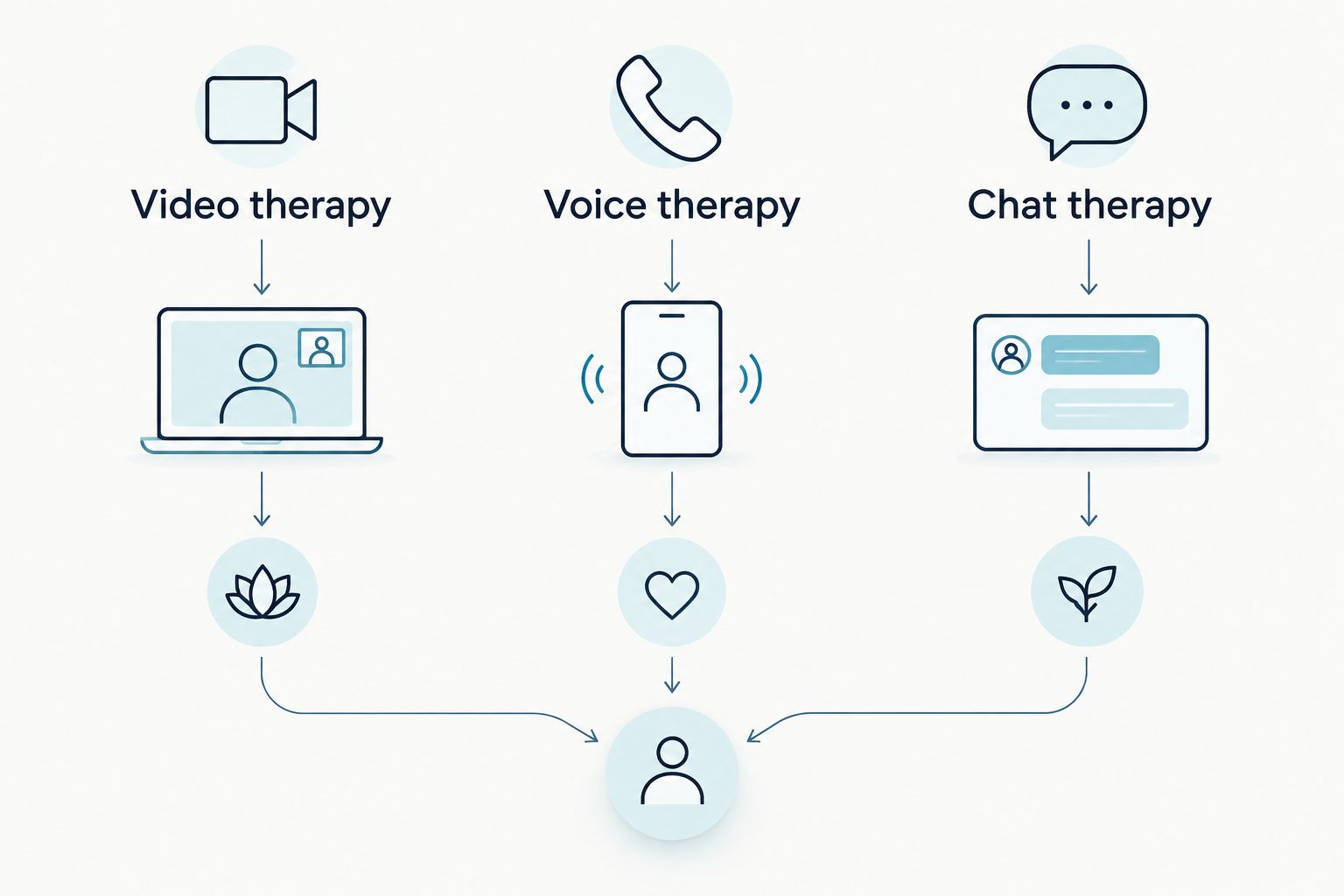
Your preferred format is a starting point, not a commitment to use it forever. Ask the provider how format changes work before assuming you can switch during or between appointments.
A useful check is whether you can explain the reason for your choice. For example, wanting to speak without a camera is a clearer reason to choose voice than assuming voice must have the lowest fee.
How to compare the actual cost before paying
A meaningful cheapest-online-therapy comparison needs equivalent appointments. Compare the same session format and scope, then look at the amount you will actually pay.
For your 2026 shortlist, ask these 4 questions:
- What is the full amount payable for this appointment?
- How long is the session, and what does it include?
- Are there any payment, cancellation or rescheduling charges?
- What happens to the booking if the connection fails?
Keep the answers together so you can compare them without relying on memory. If one appointment includes something another does not, note the difference rather than declaring the lower headline fee the winner.
Do not assume a package is the better purchase. Understand the number of appointments, payment commitment and cancellation terms before choosing one. Buy the service you understand, not an arrangement whose value depends on conditions you have not read.
Also separate affordability from a promise of results. Paying for counselling gives you access to a professional service; it does not guarantee that a particular concern will resolve within a fixed number of appointments.
What to check about credentials and confidentiality
Ask for the treating professional's name and credentials. The important question is who will work with you, not just whether the website uses reassuring language about mental health.
If a credential is unfamiliar, ask which body issued it and how to verify it. Also ask whether the therapist works with the concern you want to discuss; do not infer specialist experience from a general profile.
Confidentiality deserves equally clear questions. Ask about its limits, who can access session records and what happens if there is a serious safety concern. Professional confidentiality is not the same as a promise that information can never be disclosed under any circumstances.
Your own surroundings matter too:
- Choose a place where you can speak or type privately.
- Check whether someone else can access your device.
- Avoid leaving sensitive messages visible on a shared screen.
- Ask before recording any part of a session.
Prepare for your first appointment
Write 1 sentence describing why you want support. It can be simple: you are struggling with a concern, you want to understand it better, or you are unsure where to start.
You do not have to diagnose yourself before booking. Bring the issue in your own words, then ask the therapist how they suggest approaching it.
Before the session, check your joining instructions and make space for a private conversation. For chat, clarify when to begin messaging; for voice or video, confirm how to connect. Keep any questions about fees or appointment terms separate so they are not left unresolved.
Explore online therapy options
Check video, voice and chat options, then confirm the appointment terms before paying.
How the options are ranked
The 2026 ranking uses communication fit, privacy needs and clarity of appointment terms. Video comes first for visual conversation, voice has the distinct camera-free speaking role, and chat has the written-communication role.
This is not a clinical effectiveness ranking or a claim that one format has the lowest fee. Confirm the actual appointment cost before deciding which option is cheapest for you.
Which online therapy option should you choose?
InnerSpark Africa online therapy is best for people seeking licensed African therapists through video, voice or chat. Choose video if you want visual conversation, voice if you prefer speaking without a camera, and chat if writing helps you communicate.
If you are undecided, start by removing the format that creates the biggest practical obstacle. Then compare the remaining appointment terms and full cost. Your 2026 decision should leave you clear about who you will speak to, how the session works and what you are paying for.
FAQ
What's the cheapest online therapy option in Uganda?
The cheapest option is the appointment with the lowest confirmed total cost for the service you need. Compare equivalent session formats and lengths, including any payment or booking charges, rather than relying on the headline fee.
Is voice therapy cheaper than video therapy?
Voice therapy is not automatically cheaper than video therapy. Confirm the fee for each appointment and compare what the booking includes.
Can I get online counselling without turning on a camera?
Yes, voice and chat are online counselling formats that do not require you to appear on video. Confirm which format your chosen appointment uses before paying.
Does chat therapy mean I can message whenever I want?
No, chat therapy does not automatically mean unlimited messaging or immediate replies. Ask whether the session is live, when responses are expected and when the appointment ends.
How do I check an online therapist's credentials?
Ask for the therapist's professional name, qualification and licensing or registration body. Verify those details with the relevant body rather than relying only on a platform description.
Is online therapy completely confidential?
Professional confidentiality has limits, including circumstances involving serious safety concerns or legal obligations. Ask the therapist to explain those limits, record handling and who can access your information.
Can online therapy replace emergency help?
A routine online therapy appointment is not a substitute for emergency care. If you are in immediate danger or think you might harm yourself, seek urgent local help or go to the nearest emergency department.
One last thing
Privacy is not only a platform feature. A confidential service cannot prevent someone in your room from overhearing your voice or someone using your device from seeing a message.
Before you pay, check the space and device you will actually use. If you cannot speak privately, consider whether a written appointment would work better—but check screen access as carefully as you would check the room. Choose the session you can participate in, not just the fee you can afford.


