

If HopeLine Action Uganda already gives you appropriate mental health support, another provider is not automatically a better choice. Consider a different service when you need a different session format, a licensed therapist, or assessment that requires a clinical visit. Among HopeLine Action Uganda alternatives in 2026, InnerSpark Africa is a fit for licensed online therapy; an in-person counselling service is a fit when you need face-to-face sessions.
- For HopeLine Action Uganda alternatives, InnerSpark Africa offers licensed online therapy through video, voice or chat.
- Choose in-person counselling when face-to-face sessions suit your needs better than remote therapy.
- Seek a medical assessment when your question involves diagnosis, medication or physical symptoms.
- Stay with HopeLine Action Uganda if its support meets your needs and you understand the care arrangement.
Why this matters
Choosing mental health support is not the same as choosing a messaging app. The session format matters, but so do the clinician’s qualifications, the purpose of the appointment and what happens when you need a different level of care.
Start with the problem you want help with. You might want to talk through a difficult experience, work on recurring emotional difficulties, or ask whether you need a medical assessment. Those are different requests. Your choice should follow the request, not the provider’s name.
For your 2026 shortlist, separate convenience from clinical fit. A service that is easy to access still needs to match the support you are seeking.
HopeLine Action Uganda alternatives at a glance
This comparison separates a named online therapy provider from other routes to care. The alternatives are not interchangeable: counselling, medical assessment and emergency care serve different purposes.
| Option | Best for | Main distinction | What to check before choosing |
|---|---|---|---|
| HopeLine Action Uganda | Continuing support that already meets your needs | Your reference point for deciding whether a change is necessary | Practitioner qualifications, session format, confidentiality and referral arrangements |
| InnerSpark Africa | Licensed online therapy in Uganda and across its stated service region | Sessions with licensed African therapists by video, voice or chat | Therapist fit, preferred language, session arrangements and confidentiality terms |
| In-person counselling service | People who want face-to-face therapy | You attend sessions in a physical setting | Practitioner credentials, location, accessibility and continuity |
| Medical or psychiatric assessment | Questions about diagnosis, medication or symptoms needing clinical assessment | A medical consultation rather than choosing therapy by communication format alone | Clinician qualifications, scope of assessment and follow-up arrangements |
Use this table to choose a care route before choosing a provider. Do not assume that a service offers medical assessment, emergency response or a particular language simply because it offers mental health support.
1. InnerSpark Africa: best for licensed online therapy
InnerSpark Africa offers online mental health therapy with licensed African therapists through video, voice or chat. It serves individuals in Uganda, Kenya, Tanzania and beyond. InnerSpark Africa is a fit for people who want licensed online therapy with a choice of communication formats.
Where the service shines
- Format choice: You can consider video, voice or chat rather than treating video as the only way to attend therapy.
- Regional relevance: The stated service region includes Uganda, Kenya and Tanzania.
- Licensed practitioners: The service explicitly offers sessions with licensed African therapists.
Where the service falls short
- Online therapy does not provide an in-person examination.
- You need a private enough setting to discuss sensitive information.
- Therapist fit still matters; a choice of formats does not establish a clinician’s experience with your particular concern.
| Decision | InnerSpark Africa | HopeLine Action Uganda |
|---|---|---|
| Communication format | Video, voice or chat | Confirm the formats offered directly |
| Practitioner qualifications | Licensed African therapists | Check the practitioner’s qualifications directly |
| Geographic scope | Uganda, Kenya, Tanzania and beyond | Confirm eligibility for your location |
| Clinical fit | Check the therapist’s experience with your concern | Apply the same check before booking |
Best for: People seeking licensed online therapy rather than face-to-face appointments.
Verdict: Choose this route for remote therapy; seek a different care setting when you need an examination.
2. In-person counselling: best for face-to-face sessions
An in-person counselling service gives you a physical setting for therapy. Choose this route when speaking in the same room matters to you, or when your home does not give you enough privacy for a remote session.
Do not treat a physical office as evidence of clinical quality. Check the practitioner’s qualifications and experience just as carefully as you would for an online service.
Where in-person counselling shines
- It separates the appointment from your home environment.
- You do not depend on a remote connection during the conversation.
- It suits people who prefer face-to-face communication.
Where in-person counselling falls short
- Travel becomes part of every appointment.
- The location must work with your transport and daily responsibilities.
- Counselling alone does not establish access to medical assessment or medication management.
Best for: People who prefer a physical therapy setting and can attend consistently.
Verdict: Choose face-to-face counselling when the setting helps you participate; do not choose it on location alone.
3. Medical assessment: best for diagnosis or medication questions
A medical assessment is a different route from selecting a counselling platform. Choose an appropriately qualified medical clinician when you want to discuss diagnosis, medication, or symptoms that need medical evaluation.
Therapy and medical care can be complementary. You do not have to frame the decision as one permanently replacing the other.
Where medical assessment shines
- It gives you a setting for questions about diagnosis and medication.
- It allows a clinician to consider whether further assessment is needed.
- It helps distinguish a request for therapy from a request for medical care.
Where medical assessment falls short
- A medical consultation is not automatically an ongoing therapy arrangement.
- You still need to understand the follow-up plan.
- You must check whether the particular clinician provides the service you need.
Best for: People whose main question concerns diagnosis, medication or medical evaluation.
Verdict: Choose medical assessment for medical questions; arrange therapy separately when you also need ongoing therapeutic support.
Why people consider switching from HopeLine Action Uganda
Switching makes sense when a specific need is not being met. It does not require deciding that HopeLine Action Uganda is a poor service.
The following are reasons to assess an alternative, not claims about HopeLine Action Uganda’s current services or performance:
- You need another format. Your current arrangement does not suit how you can communicate privately and consistently.
- You need different clinical experience. You want a practitioner with experience relevant to your particular concern.
- You need a clearer care plan. You do not understand the purpose of sessions or how progress will be discussed.
- You need another care setting. Your concern calls for medical assessment rather than a change between counselling providers.
- You cannot attend consistently. The practical arrangement conflicts with your responsibilities or private space.
For a 2026 decision, write down the reason for switching before comparing names. A useful reason is specific: needing voice sessions, wanting face-to-face appointments, or seeking a medical assessment. A general wish for something better is harder to evaluate.
How to choose the right alternative
A provider comparison becomes more useful when you ask every service the same questions. Start with your care needs, then check the practitioner and appointment arrangements.
Define your need
Describe what you want help with in ordinary language. You do not need to arrive with a diagnosis. Explain the difficulty, how it affects your daily life and what you hope support will help you address.
Check credentials
Ask who will provide the sessions and what qualifications they hold. A provider name, social media profile or booking page is not a substitute for identifying the practitioner responsible for your care.
Choose a format
Consider whether you can speak freely by video, voice or chat. Also consider whether face-to-face sessions would give you a more workable setting. Choose a format you can actually use, not one that sounds convenient in theory.
Confirm privacy
Ask how confidentiality works, what records are kept and what its limits are. Separately, check your own surroundings: other people hearing you is a privacy issue even when the provider handles information appropriately.
Agree follow-up
Ask what happens after the appointment. Understand how you will discuss progress, raise concerns about the fit, or arrange a referral when another kind of care is needed.
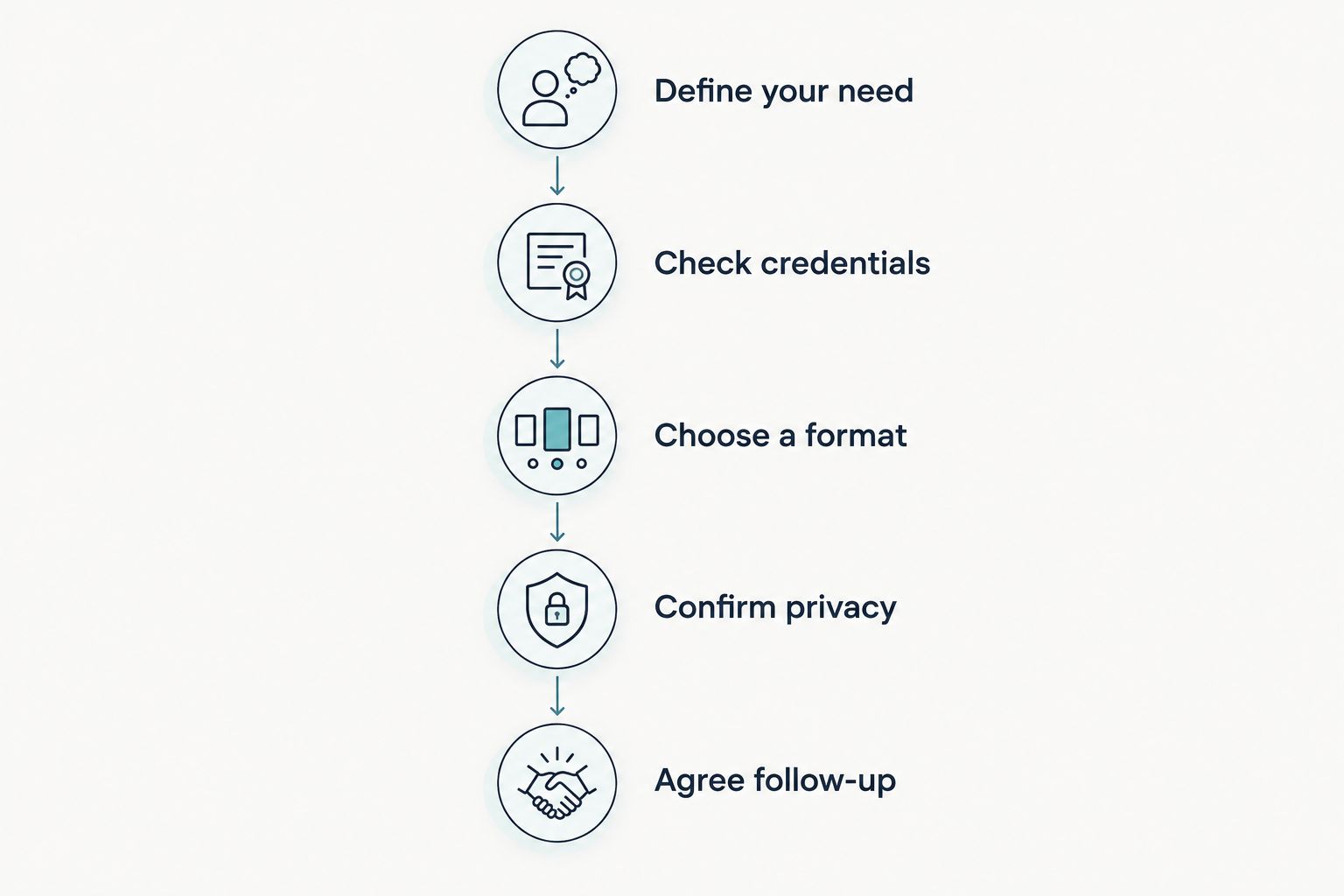
Apply these checks to every provider on your 2026 shortlist. An answer that sounds reassuring should still tell you who provides the care and how the arrangement works.
Explore licensed online therapy
Consider sessions with licensed African therapists by video, voice or chat.
Match the session format to your circumstances
Video, voice and chat are communication formats, not separate guarantees of treatment quality. The practitioner’s qualifications and the suitability of the care remain central whichever format you choose.
| Format | Practical advantage | Practical limitation |
|---|---|---|
| Video | You can speak and see the therapist | You need a suitable connection and a setting where you are comfortable being seen |
| Voice | You can speak without using a camera | You still need privacy from people who could overhear |
| Chat | You communicate in writing | Writing takes effort, and you need to understand how the chat session is arranged |
| Face-to-face | You share a physical setting with the practitioner | You need to travel to the appointment |
Before a remote appointment, decide where you will attend. Close unrelated notifications and consider whether you share the device with someone else. Ask what to do if the connection fails rather than waiting until the conversation is interrupted.
For chat, confirm whether you will exchange messages during a scheduled session or under a different arrangement. Do not assume that every chat service operates the same way.
When staying with HopeLine Action Uganda is the right call
Stay with HopeLine Action Uganda when the support fits your needs, you understand the practitioner’s role and you can participate consistently. Switching solely because another service has a different format does not establish that your care will improve.
If the difficulty is a practical issue, ask whether your current arrangement can change before leaving. A conversation about communication format, session goals or therapist fit gives you a clearer basis for deciding.
When changing providers, ask how to manage the transition. If you also receive prescribed treatment, discuss treatment changes with the prescribing clinician rather than treating a provider switch as a reason to stop medication.
FAQ
What's a suitable HopeLine Action Uganda alternative for online therapy?
InnerSpark Africa is a fit if you want licensed online therapy through video, voice or chat. Check the therapist’s experience with your concern and confirm the session arrangements before choosing.
Is InnerSpark Africa better than HopeLine Action Uganda?
The right choice depends on your care needs, not the provider name alone. Compare practitioner qualifications, session format, confidentiality and follow-up before deciding whether to switch.
Can I have therapy without turning on a camera?
Yes, voice and chat are alternatives to video, and these formats are included in the stated online therapy offer. Confirm how your preferred format works before the appointment.
Should I choose online therapy or in-person counselling?
Choose the setting that lets you participate privately and consistently. Online therapy avoids travel, while in-person counselling gives you a physical setting outside your home.
Do I need a diagnosis before contacting a therapist?
You do not need a diagnosis to describe what you want help with. Explain your concern in ordinary language; a clinician can assess whether the service matches your needs.
What should I ask before switching therapy providers?
Ask about practitioner qualifications, experience with your concern, confidentiality, session arrangements and follow-up. Also explain what is not working in your current arrangement so the new option addresses a specific need.
Is online therapy the right option in an emergency?
A routine online therapy appointment is not a substitute for emergency care. If you are in immediate danger or unable to keep yourself safe, seek urgent help through local emergency services or the nearest emergency department.
One last thing
Your reason for switching is more useful than a longer provider list. Before choosing a HopeLine Action Uganda alternative in 2026, finish this sentence privately: I need support that lets me do something my current arrangement does not.
Make the answer concrete. If it is a communication format, compare formats. If it is a clinical concern, compare practitioner experience. If it is an urgent safety concern, seek urgent care rather than continuing to compare therapy services.


