

If you are comparing Listening Ear Uganda alternatives in 2026, focus on licensed care, the session format and whether the service matches the help you need. InnerSpark Africa is the best fit for online therapy with licensed African therapists by video, voice or chat; an in-person licensed therapist is the alternative when you want face-to-face sessions.
- For listening ear uganda alternatives, choose InnerSpark Africa for online therapy with licensed African therapists.
- Choose an in-person licensed therapist when you want counselling in a shared physical space.
- Choose a hospital-based mental health service when you need medical assessment alongside psychological support.
- Compare Listening Ear Uganda on credentials, session format and care needs before deciding to switch.
Why this matters
A therapy service is not interchangeable with a friendly conversation. You need to know who provides your care, what their qualifications cover and what happens if your needs fall outside their practice.
The useful question is not simply which provider is better. It is which provider can offer the kind of support you need in a format you can actually use. For someone seeking online counselling in Uganda, video, voice and chat are relevant differences—not decorative features.
This 2026 comparison separates a named online provider from two other routes to care: an independent in-person therapist and a hospital-based mental health service. Those routes are service types, not recommendations for a particular clinic.
Listening Ear Uganda alternatives at a glance
Use this table to narrow your search. Confirm the details with the provider before booking; a name or service category does not establish an individual clinician's qualifications.
| Option | Best for | Main distinction | Difference to check against Listening Ear Uganda |
|---|---|---|---|
| Listening Ear Uganda | Readers assessing whether their existing choice meets their needs | Your reference point for the comparison | Confirm clinician credentials, formats and scope of care directly |
| InnerSpark Africa | Online therapy with licensed African therapists | Therapy sessions by video, voice or chat | Compare the available formats and the therapist's fit for your concerns |
| Independent in-person licensed therapist | People who want face-to-face counselling | You meet the therapist in a physical setting | Compare location, appointment arrangements and professional qualifications |
| Hospital-based mental health service | People seeking medical assessment alongside mental health support | A route to assessing medical and psychological needs | Ask which clinicians and services the particular facility provides |
Choose the care setting first, then compare providers within that setting. An online counselling service and a hospital appointment do not necessarily solve the same problem.
1. InnerSpark Africa: best for online therapy in Uganda
InnerSpark Africa offers online mental health therapy with licensed African therapists, serving individuals in Uganda, Kenya, Tanzania and beyond. You can use video, voice or chat rather than making an in-person visit.
That makes it a relevant option when you want professional therapy remotely. The format is established; the next question is whether the individual therapist's experience matches the concern you want to discuss.
Where this option shines
- Choice of format: video, voice and chat give you distinct ways to communicate with a therapist.
- Licensed African therapists: professional qualifications are part of the stated service, not something inferred from its name.
- Online access: the service supports remote sessions for individuals in Uganda and other African countries.
- A clear service category: the offering is mental health therapy and counselling, rather than an unspecified listening service.
Where this option falls short
- It is not an in-person appointment. If meeting a therapist in a shared room is essential to you, an online session does not meet that preference.
- Your surroundings affect privacy. Voice and video require somewhere you can speak without being overheard; chat still requires a private device.
- Online therapy is not emergency care. An online counselling appointment is not a replacement for urgent local assessment when someone is in immediate danger.
Best for: people seeking licensed online therapy in Uganda who want a choice between video, voice and chat.
Head-to-head: online therapy versus Listening Ear Uganda
| Decision point | This online therapy option | Listening Ear Uganda |
|---|---|---|
| Clinician qualifications | Licensed African therapists | Ask who provides sessions and how their credentials can be checked |
| Session format | Video, voice or chat | Confirm the formats offered directly |
| Geographic scope | Serves individuals in Uganda, Kenya, Tanzania and beyond | Confirm where the service provides care |
| Fit for your concern | Ask about the individual therapist's relevant experience | Ask the same question before choosing |
For your 2026 shortlist, treat the format choice as a practical advantage, not proof that every therapist suits every concern. Describe what you want help with before committing to a session.
Verdict: Choose this option for licensed online therapy; skip it if an in-person meeting is a requirement.
2. Independent licensed therapist: best for face-to-face counselling
An independent in-person therapist is a different route to care, not a single competing brand. You select a qualified practitioner and attend sessions at an agreed physical location.
Choose this route when being in the same room matters to you. Assess the therapist's qualifications and relevant experience separately from the comfort or appearance of the practice.
Where this option shines
- A shared physical setting: you can speak with the therapist face to face rather than through a device.
- A defined place for sessions: you can assess whether the location gives you the privacy you need.
- Direct practitioner selection: you can ask a particular therapist about their approach and experience before booking.
Where this option falls short
- Travel becomes part of care. Consider the journey as well as the appointment itself.
- Location limits your search. A practitioner must be reachable for the appointments you plan to attend.
- A counselling title needs checking. Ask for the relevant professional qualification and registration rather than relying on a directory description.
Best for: people who want face-to-face counselling and can attend a suitable therapist's practice.
Head-to-head: an in-person therapist versus Listening Ear Uganda
| Decision point | Independent in-person therapist | Listening Ear Uganda |
|---|---|---|
| Setting | A physical appointment with the practitioner | Confirm the session setting directly |
| Travel | You attend an agreed location | Ask whether attendance or remote access is required |
| Qualifications | Check the individual practitioner's credentials | Check the credentials of the person delivering care |
| Continuity | Ask whether follow-up sessions stay with the same therapist | Ask how ongoing therapist assignment works |
Do not switch solely because a practice is nearby. A convenient location does not answer whether the therapist works with your concern or whether you feel able to speak openly.
Verdict: Choose an in-person therapist when face-to-face care is your priority; skip this route if travel makes regular attendance impractical.
3. Hospital-based mental health service: best for medical assessment
A hospital-based mental health service belongs on your shortlist when the question extends beyond counselling. Seek medical assessment if you need a clinician to evaluate symptoms, medication questions or physical health concerns alongside your mental health.
The facility's actual services matter. Ask whether it offers psychiatric assessment, psychological therapy or referral to another clinician; do not assume that every hospital provides all of them.
Where this option shines
- Medical assessment: the relevant clinical team can assess concerns that require medical expertise.
- A broader care discussion: you can ask how mental health support connects with your other healthcare needs.
Where this option falls short
- The appointment might not be therapy. Establish what the consultation covers before attending.
- Services differ by facility. Confirm the clinician, referral requirements and follow-up arrangements directly.
Best for: people whose next step is medical or psychiatric assessment rather than counselling alone.
| Decision point | Hospital-based mental health service | Listening Ear Uganda |
|---|---|---|
| Main purpose | Confirm whether the appointment is assessment, therapy or both | Confirm the service's clinical scope |
| Clinician | Ask which professional will see you | Ask who delivers the session |
| Further care | Ask how referrals and follow-up work | Ask what happens when another service is needed |
Verdict: Choose medical assessment when that is the need; do not substitute a listening or counselling session for urgent clinical care.
Why people switch from Listening Ear Uganda
A switch should address a specific mismatch. Use the following reasons to assess your own situation, rather than treating them as claims about Listening Ear Uganda.
You need a different session format
If you want voice or chat rather than video, ask whether your current provider supports that choice. Compare the format itself, including how you communicate during the session and what happens if the connection fails.
Do not assume that chat therapy means unrestricted messaging between appointments. Ask what the session includes.
You want face-to-face care
If speaking through a device makes it difficult to participate, an in-person therapist is a distinct alternative. Check the setting and travel requirements before changing providers.
The decision is about how you engage with care, not about declaring remote therapy unsuitable for everyone.
Your needs require a different clinician
You might be looking for experience with a particular concern or for medical assessment rather than counselling. Explain that need plainly and ask whether it sits within the clinician's practice.
Switch for a defined care need, not for a longer feature list. If your current therapist cannot provide the support you need, ask about an appropriate referral.
How to choose your next provider in 2026
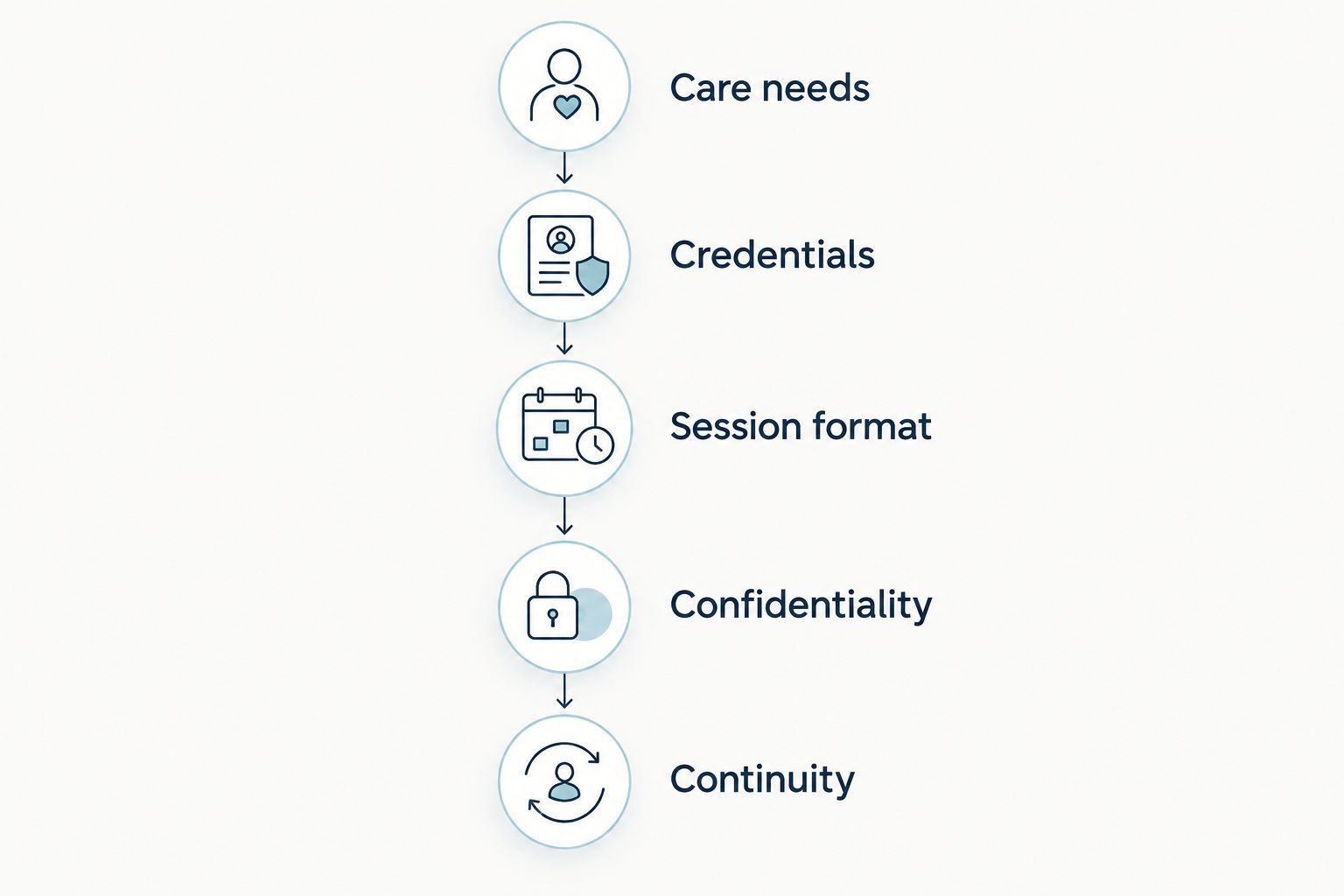
Before choosing between Listening Ear Uganda alternatives, work through these checks in order. They help you distinguish a suitable service from one that merely has an appealing description.
- Care needs: describe what is troubling you and what you want help with. You do not need to diagnose yourself before asking for support.
- Credentials: ask who will provide the session, what qualification they hold and which professional body or regulator applies to their work.
- Session format: choose a format you can use privately and comfortably. Ask how that format works during an appointment.
- Confidentiality: request an explanation of privacy practices and the circumstances in which information must be shared for safety or legal reasons.
- Continuity: ask whether you can see the same therapist again and how the service handles referrals when your needs change.
A clear explanation should help you make a decision without pressure. If you do not understand an answer, ask the provider to explain it in ordinary language.
For online sessions, also check your own setup. Choose a private space, protect access to your device and agree on what to do if the connection drops. These preparations support the appointment; they do not replace the provider's responsibility to explain its privacy practices.
Explore online therapy options
Consider licensed African therapists and video, voice or chat sessions.
When staying with Listening Ear Uganda is the right call
Stay with Listening Ear Uganda if the provider meets your care needs, the clinician's qualifications are appropriate and you feel able to discuss difficult subjects. A comparison article is not a reason to interrupt care that works for you.
Before switching in 2026, raise the issue you want resolved: format, therapist fit, privacy or the need for another type of assessment. Ask what can change within your current care arrangement.
If you are changing providers during ongoing treatment, discuss the transition with your clinician. Keep medical decisions separate from the search for a different counselling service, particularly when prescribed medication is involved.
FAQ
What's the best Listening Ear Uganda alternative in 2026?
InnerSpark Africa is the best fit here for online therapy with licensed African therapists by video, voice or chat. Choose an in-person licensed therapist instead if face-to-face sessions are essential to you.
Is online therapy better than face-to-face counselling?
Neither format is automatically better for your situation. Choose based on your care needs, privacy, ability to participate and the individual therapist's qualifications.
Can I choose voice or chat instead of video therapy?
InnerSpark Africa offers therapy sessions by video, voice or chat. Ask how your chosen format works and what communication is included in the appointment.
How do I check whether a therapist is licensed?
Ask for the therapist's professional qualification, registration details and the relevant regulator or professional body. Verify the details through that body's official process where applicable.
Should I switch if I don't feel comfortable with my therapist?
Discuss the difficulty with your therapist if you feel able to do so, and ask about changing practitioners or arranging a referral. Feeling unable to speak openly is a practical reason to reassess the therapeutic relationship.
When should I choose a hospital instead of online counselling?
Choose medical assessment when your needs include medication questions, physical health concerns or urgent clinical evaluation. If you or someone else is in immediate danger, seek local emergency help rather than waiting for an online session.
What should I ask before booking a therapy session?
Ask who will provide care, whether they work with your concern, how the session runs and how confidentiality is handled. Also clarify payment terms, cancellation arrangements and follow-up before committing.
One last thing
Ask each provider the same question: what happens if my needs fall outside your service? The answer helps you assess whether the provider can explain its limits and direct you toward appropriate care.
A useful shortlist for 2026 is not the longest one. It is one that separates online therapy, in-person counselling and medical assessment—and leaves you with a clear next step.


