

Phoenix Health is worth staying with if your current clinician and care plan meet your needs. Look elsewhere when you need a different consultation format, a different clinician, or a different level of care. The best Phoenix Health alternative in 2026 is InnerSpark Africa for online therapy with licensed African therapists; an in-person licensed therapist is the better choice when you need face-to-face counselling.
- For phoenix health alternatives, InnerSpark Africa fits online counselling with licensed African therapists by video, voice or chat.
- Choose an in-person licensed therapist when a private remote session is not practical.
- Choose a medical assessment when you need medication advice or assessment beyond counselling.
- Stay with Phoenix Health when your existing therapeutic relationship and care plan work for you.
Why this matters
Choosing a mental health provider is not the same as choosing a messaging app. You need the right professional, an appropriate type of care, and a session format you can actually use. A familiar provider name does not answer those questions.
Start your 2026 comparison with the problem you want to solve. Perhaps you cannot speak privately at home, want a therapist who understands your context, or need to discuss medication with a qualified medical professional. Those are different needs, and they point toward different alternatives.
This guide compares online therapy, in-person counselling, and medical assessment. It does not treat those services as interchangeable or assume that changing providers will improve your symptoms.
Phoenix Health alternatives at a glance
Choose the care route first, then choose the provider. The right alternative depends on whether you need talking therapy, a private place to meet, or medical assessment.
| Option | Best for | Standout consideration | Difference to check against Phoenix Health |
|---|---|---|---|
| Phoenix Health | Continuing care that already meets your needs | Your existing clinician relationship, if you have one | Confirm your current session format, clinician and care plan |
| InnerSpark Africa | Online therapy with licensed African therapists | Video, voice or chat sessions; serves Uganda, Kenya, Tanzania and beyond | Compare therapist fit and remote session formats with your current service |
| In-person licensed therapist | Face-to-face counselling | Sessions take place with the therapist physically present | Compare travel requirements, privacy and the therapeutic approach |
| Medical or psychiatric assessment | Concerns that require medical evaluation | Assessment by an appropriately qualified medical professional | Check whether your current provider already offers the assessment you need |
For Phoenix Health, check the exact service you currently use rather than relying on the name alone. Compare the professional delivering your care, not just the organization arranging the appointment. A change of platform without a change in clinical fit does not resolve a mismatch.
1. InnerSpark Africa: best for online African therapy
InnerSpark Africa offers online mental health therapy with licensed African therapists through video, voice or chat. It serves individuals in Uganda, Kenya, Tanzania and beyond. InnerSpark Africa is an online therapy alternative for people who want to speak with a licensed African therapist remotely.
That makes it a relevant option when your main requirement is counselling you can attend without travelling to a consulting room. You still need to check whether the individual therapist's experience matches your concern. A provider serving your country is not, by itself, evidence that every therapist is the right fit for you.
Where this option shines
- Choice of session format: Video, voice and chat let you consider how you prefer to communicate.
- African therapist access: The service explicitly offers sessions with licensed African therapists.
- Regional relevance: Uganda, Kenya and Tanzania are among the countries it serves.
- Remote attendance: You do not need to travel to the therapist's room for an online session.
Where this option falls short
- It is remote care: It does not replace a physical examination or an in-person appointment when those are needed.
- Privacy still needs planning: A confidential service cannot make a shared room private for you.
- Therapist fit needs checking: The service description does not establish an individual clinician's experience with your specific concern.
- Communication preferences matter: Chat is not the same experience as speaking aloud or sitting with a therapist.
Head-to-head: online therapy versus your current provider
| Dimension | This online therapy option | Phoenix Health |
|---|---|---|
| Session format | Video, voice or chat | Confirm the formats available through your current service |
| Therapist background | Licensed African therapists | Confirm your clinician's credentials and experience |
| Geographic fit | Serves Uganda, Kenya, Tanzania and beyond | Confirm service eligibility for where you live |
| Continuity | Ask how ongoing appointments are arranged | Consider the value of your existing clinician relationship |
Best for: Someone seeking online counselling with a licensed African therapist, particularly in the countries named above.
Verdict: Choose this option when remote talking therapy matches your needs; do not use a platform change as a substitute for medical assessment.
2. In-person licensed therapist: best for face-to-face counselling
An in-person licensed therapist is a practical alternative when you want to speak in the same room as your clinician. It also addresses a specific access problem: you have no suitable private space for a remote session. You trade remote attendance for travel and a physical appointment location.
The important comparison is not whether in-person therapy is universally better than online therapy. It is whether you can participate comfortably and consistently in the format you choose.
Where an in-person therapist shines
- A separate setting: You can leave a shared home or workplace to attend your appointment.
- Face-to-face communication: You and the therapist are physically present throughout the session.
- No remote connection requirement during the session: The conversation does not depend on your home internet connection.
Where an in-person therapist falls short
- Travel is part of attendance: Transport and the appointment location become part of your decision.
- Scheduling needs coordination: Your session must fit around the journey as well as the appointment itself.
- Credentials still need checking: A physical office does not establish clinical qualifications or suitability.
| Dimension | In-person licensed therapist | Phoenix Health |
|---|---|---|
| Meeting format | Face-to-face at an agreed location | Confirm the format of your current appointments |
| Practical access | Requires travel to the session | Compare with your current travel or connection requirements |
| Privacy | Assess the consulting setting and confidentiality arrangements | Review the privacy arrangements you currently use |
Best for: Someone who prefers face-to-face counselling or cannot attend remote therapy privately.
Verdict: Choose in-person counselling when the setting solves a real attendance or privacy problem; hold if travel would make regular attendance harder.
3. Medical assessment: best for needs beyond counselling
A medical or psychiatric assessment is a different care route, not simply another therapy platform. Consider it when you need medication advice, a physical health review, or assessment of symptoms that require medical attention. The professional must be qualified to deliver the particular assessment or treatment you seek.
Talking therapy and medical care can be part of the same care plan. You do not have to frame the decision as choosing one and rejecting the other.
Where medical assessment shines
- Medical questions: It creates a route to discuss symptoms and treatment with an appropriately qualified clinician.
- Medication review: A qualified prescriber can assess medication questions within their professional scope.
- Care planning: Assessment can help establish what further care or referral is needed.
Where medical assessment falls short
- It is not automatically ongoing counselling: Ask what follow-up support the service actually provides.
- Professional roles differ: Do not assume every mental health professional can prescribe medication.
- Access requires checking: Confirm the appropriate clinician and service before arranging an appointment.
Best for: Someone whose next step involves medical evaluation rather than choosing a different counselling format.
Verdict: Choose medical assessment when the question is clinical scope; skip a counselling-only switch as the answer to medication or examination needs.
Why people consider switching from Phoenix Health
A useful 2026 decision starts with your own experience, not a claim that another provider is better at everything. The following are reasons to consider a switch when they apply to your current care. They are not claims about Phoenix Health's service.
Your session format does not fit your circumstances
You cannot participate fully if you cannot speak privately, travel to appointments, or use the required connection. Name the constraint before selecting an alternative. Otherwise, you risk moving to a new provider with the same practical problem.
You need a different therapist fit
You should be able to discuss your goals, ask questions, and understand how the therapist proposes to work with you. If the relationship is not working, raise that concern directly when it is safe and comfortable to do so. A different clinician within the existing service is also an option to ask about.
You need a different level of care
Changing counselling providers does not answer every mental health concern. If you need medication advice or medical assessment, ask for the appropriate professional rather than assuming a new therapist can provide it. Match the next appointment to the next clinical question.
The practical terms do not work for you
Check session arrangements, payment methods, rescheduling terms, and what happens between appointments. Ask for the current details in writing. Do not infer a provider's policies from another service's policies or an older comparison article.
How to choose your next provider in 2026
Use this sequence before booking. It keeps the decision focused on care rather than brand recognition.
Care needs
Write down what you want help with and what you want to understand after the first appointment. You do not need to diagnose yourself. A plain description of your concern gives the clinician something useful to assess.
Clinical fit
Ask about the professional's license, relevant experience and approach to your concern. Also ask what they do when a person's needs fall outside their scope. A clear explanation is more useful than a broad promise to handle every problem.
Session format
Choose a format you can use privately and comfortably. For remote care, consider whether video, voice or chat suits the conversation you want to have. For face-to-face care, check whether the journey is manageable.
Practical terms
Confirm appointment arrangements, payment methods, confidentiality limits and rescheduling terms before committing. Separate service confidentiality from device privacy: shared phones, visible notifications and a room others can enter deserve attention too.
Continuity
Ask how follow-up appointments work and whether you can continue with the same clinician. If you are transferring ongoing care, discuss what information should move with you and give consent before records are shared.
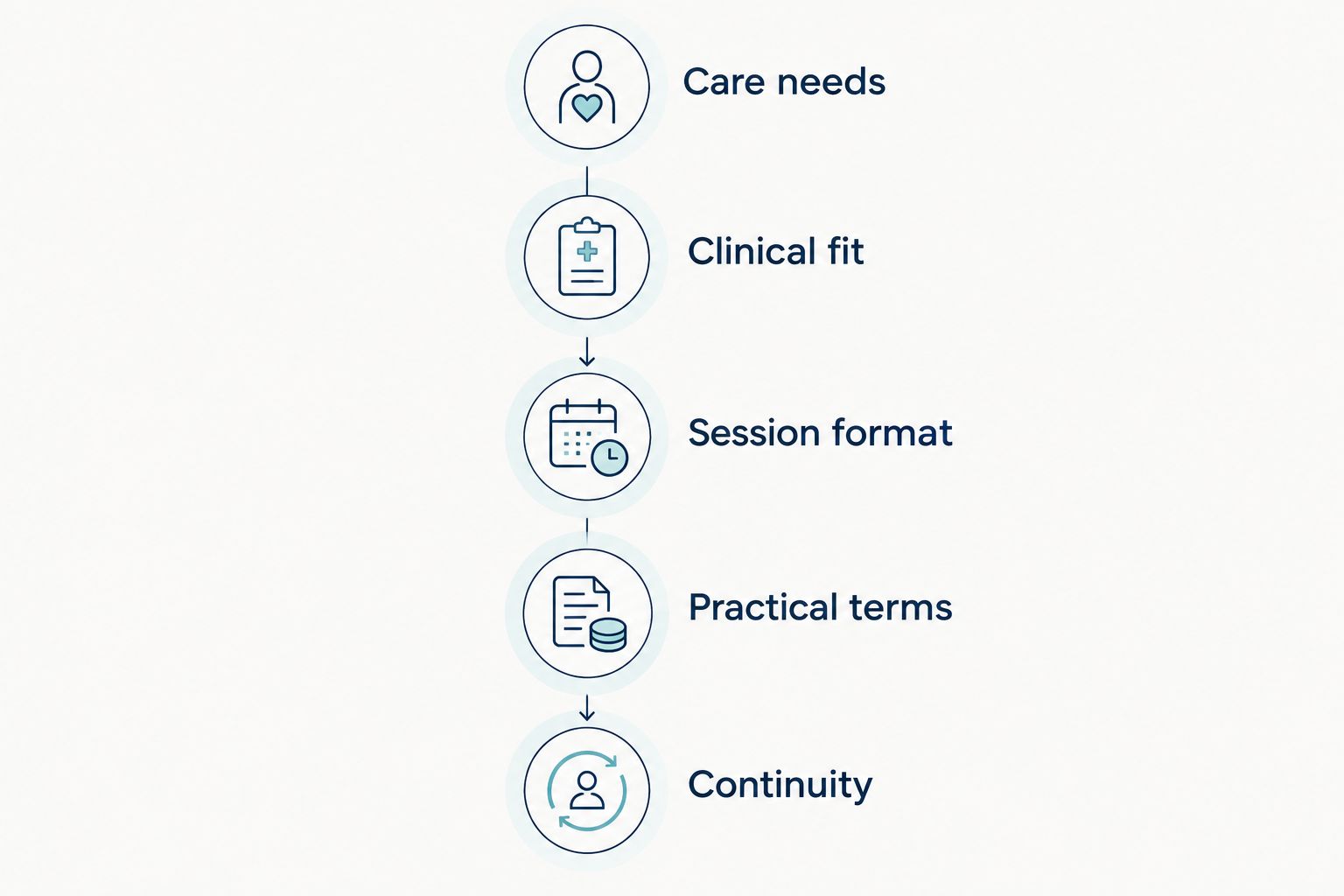
Your checklist should produce a specific next move: an online counselling appointment, a face-to-face therapist search, or a medical assessment. If you still cannot describe the difference you need, ask your current clinician to help clarify it before transferring care.
Explore online therapy
Review therapy with licensed African therapists through video, voice or chat.
When staying with Phoenix Health is the right call
Stay with Phoenix Health when your current clinician, session arrangements and care plan meet your needs. A new provider's name is not a reason to interrupt a useful therapeutic relationship.
Before switching in 2026, ask whether your concern can be addressed within your existing care. A discussion about goals, a different appointment format, or a clinician change within the service deserves consideration if it resolves the problem. None of those arrangements should be assumed; ask directly.
If you do transfer, plan the handover. Confirm the next appointment and discuss continuity with the relevant professionals, particularly when your care includes prescribed medication. Do not stop or change prescribed treatment because you have chosen a different counselling provider.
FAQ
What's the best Phoenix Health alternative in 2026?
InnerSpark Africa is a relevant Phoenix Health alternative for online therapy with licensed African therapists by video, voice or chat. Choose an in-person therapist if you need face-to-face counselling, or medical assessment if your concern requires that level of care.
Is online therapy better than staying with Phoenix Health?
Online therapy is a better fit only when its format and clinician meet your needs better than your current care. If your existing therapeutic relationship and appointment arrangements work, staying is a reasonable choice.
Can I have therapy without using video?
InnerSpark Africa offers voice and chat as well as video therapy sessions. Choose a format you can use privately and ask how that format works with the individual therapist.
How do I check whether a therapist is qualified?
Ask for the therapist's professional credentials and check them with the relevant licensing or regulatory body. Also ask about experience with your concern and the limits of the therapist's practice.
Should I choose a therapist or a psychiatrist?
Choose the professional according to the care you need, not the title alone. Talking therapy, medication advice and medical assessment involve different professional responsibilities; confirm the clinician's qualifications and scope.
Can I change providers without stopping my current treatment?
Discuss the transition with your current and next clinician before changing ongoing treatment. Do not stop or change prescribed medication without advice from a qualified prescriber.
What should I do if I need urgent mental health help?
If there is immediate danger or you cannot keep yourself safe, contact local emergency services or go to the nearest emergency department. A routine online counselling appointment is not a substitute for emergency care.
One last thing
Before choosing from Phoenix Health alternatives in 2026, finish this sentence: I need a different provider because my current care does not meet this specific need. If the answer is clear, choose the alternative that addresses it. If it is not, clarify your care goals before changing services.
The strongest comparison is not a longer list of providers. It is a clear match between your needs, the clinician's scope and a session format you can attend.


