
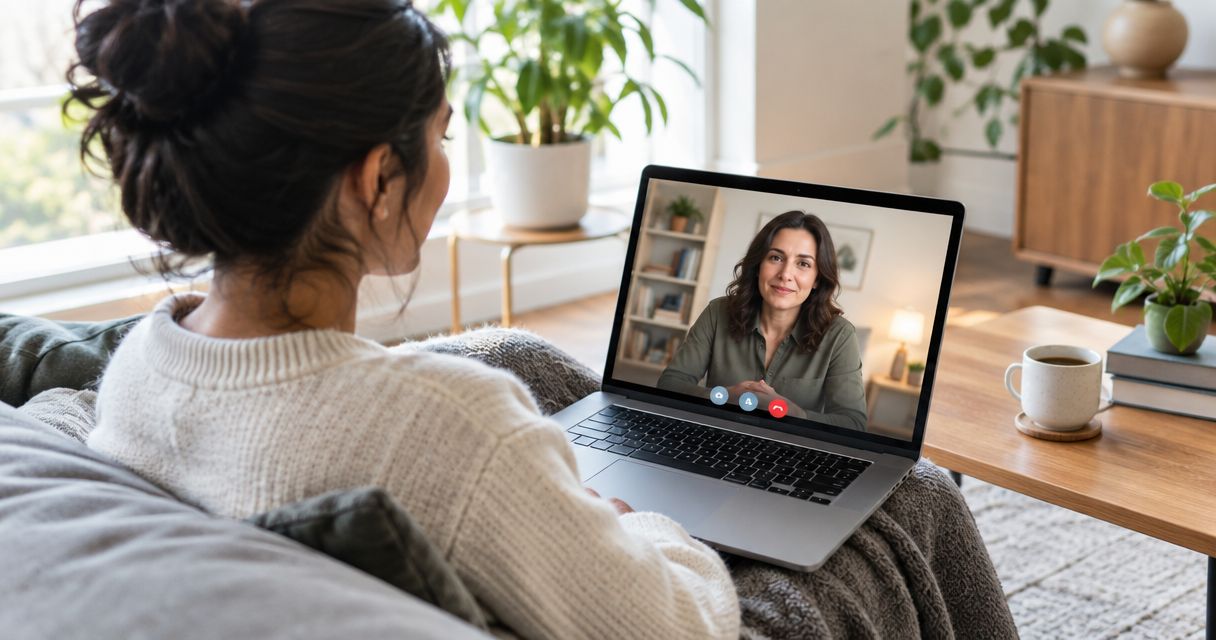
Online therapy is worth considering in 2026 if you want professional support without traveling and can speak or write privately with a qualified therapist. Its value depends on the therapist’s suitability, a workable treatment plan and your ability to attend; it does not replace emergency care or every kind of in-person assessment.
- Is online therapy worth it? Yes, when qualified care, privacy and a practical treatment plan come together.
- InnerSpark Africa offers online counselling with licensed African therapists through video, voice or chat.
- Choose your therapy format around privacy, communication preferences and connection reliability, not convenience alone.
- Ask about confidentiality, treatment goals and emergency arrangements before booking online therapy.
Is online therapy worth it in 2026?
Online therapy is worth it when the format helps you access appropriate care and participate honestly. Booking easily is useful, but the important test is whether you understand what you are working on and can discuss concerns with your therapist.
InnerSpark Africa offers online therapy with licensed African therapists through video, voice or chat, serving individuals in Uganda, Kenya, Tanzania and beyond. Those formats provide different ways to communicate; they are not interchangeable for every person or concern.
Use this comparison to decide which setting supports a useful conversation. These are practical differences, not a ranking of treatment effectiveness.
| Format | Best for | Practical advantage | Limitation to consider |
|---|---|---|---|
| Video therapy | People who want to see their therapist during conversation | Allows spoken conversation with visible facial expressions | Requires camera privacy and a connection that supports video |
| Voice therapy | People who prefer speaking without a camera | Keeps the conversation spoken without showing your surroundings | The therapist cannot observe facial expressions |
| Chat therapy | People who express themselves more comfortably in writing | Gives you a written way to describe difficult experiences | Tone is harder to convey; response arrangements need clarification |
| In-person therapy | People who need a separate setting or face-to-face care | Provides a shared physical space for the appointment | Requires travel and access to a suitable local provider |
There is no universal winner. Choose the setting in which you can communicate clearly, feel sufficiently safe and receive the kind of assessment or treatment you need.
Why this matters
A therapy appointment can be accessible on your phone and still be difficult to use. You might share a room, worry about being overheard or have a connection that drops whenever you start discussing something important.
For your 2026 decision, separate access from clinical suitability. Access means you can reach the appointment; suitability means the therapist and treatment approach fit your needs. Both matter, and neither guarantees the other.
You do not need a polished explanation of your feelings before seeking help. You do need room to ask questions, understand the service and decide whether the arrangement works for you.
Video therapy: best for seeing the person you talk to
Video therapy suits people who want a spoken conversation with visible facial expressions. Seeing your therapist can make the interaction feel more familiar if you already prefer face-to-face conversations.
The practical drawback is exposure. Your surroundings are visible unless you adjust your setup, and other people nearby can still hear your side of the appointment.
Before choosing video, check whether you can sit somewhere private and keep the device steady without discomfort. Agree on what happens if the call disconnects, rather than trying to solve that problem during a difficult conversation.
Choose video when seeing your therapist helps you communicate and your setting supports it. Do not choose it simply because it looks closest to an office appointment.
Voice therapy: best for speaking without camera pressure
Voice therapy suits people who want to talk but do not want a camera involved. You can focus on the conversation without thinking about your appearance or what is visible behind you.
The limitation is the absence of visual information. Your therapist cannot see your facial expressions, so describing what is happening physically or emotionally becomes especially useful.
Voice is not automatically private because the camera is off. Headphones keep the therapist’s words out of the room, but someone nearby can still hear what you say.
Choose voice when speaking feels natural and you have somewhere you can talk freely. Tell the therapist if silence means you are thinking, upset or having a connection problem.
Chat therapy: best for expressing yourself in writing
Chat therapy suits people who find it easier to write about sensitive experiences than to say them aloud. Writing gives you a different route into the conversation, particularly when speaking would be difficult in your current surroundings.
The limitation is ambiguity. A short message can carry several meanings, and written communication does not show facial expressions or convey tone of voice.
Before booking, ask whether chat happens during a scheduled appointment or through messages answered later. Confirm how replies work and what to do if you need help outside that arrangement; the word chat alone does not answer those questions.
Choose chat when writing helps you communicate, not because you expect immediate access whenever you message. Keep account access and message notifications in mind if you share a device.
Why the value of online therapy varies
The same format can be useful for one person and frustrating for another. Assess these factors before judging the service by convenience alone:
- Therapist suitability: Ask about qualifications, professional registration and experience with the concern you want help addressing.
- Communication fit: Choose a language and format in which you can describe sensitive experiences accurately. Confirm language options rather than assuming them.
- Privacy: Consider who can hear you, who can access your device and how the provider explains confidentiality.
- Connection reliability: Agree on a backup plan for interrupted appointments and clarify whether another format is appropriate.
- Treatment direction: Ask how the therapist proposes to work with you and how you will review whether the approach is helping.
- Continuity: Confirm scheduling and whether ongoing appointments can be arranged with the same therapist when that matters to you.
These factors are worth discussing openly. Difficulty with a format is not a personal failure, and a poor connection is not evidence that therapy itself cannot help you.
How do you decide whether online therapy fits your life?
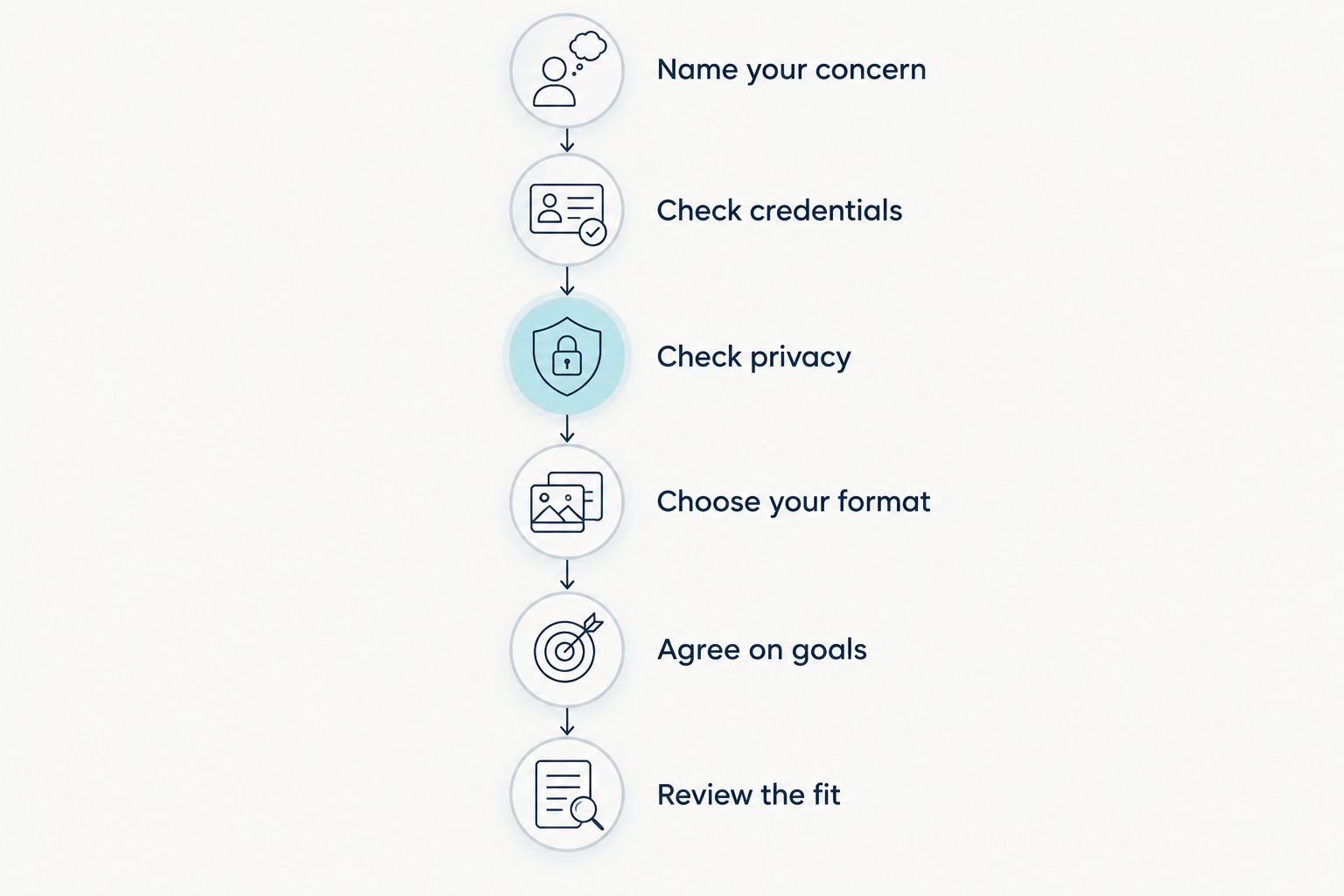
Use this sequence before committing to an ongoing arrangement. It separates your reasons for seeking help from the practical questions that determine whether you can use the service.
- Name your concern. Describe what is troubling you in ordinary language: persistent worry, relationship strain, grief or another difficulty. You do not need to diagnose yourself.
- Check credentials. Ask who will provide your care, what qualifications they hold and which professional body regulates their work where applicable.
- Check privacy. Identify a setting where you can communicate safely, then ask how records, messages and confidentiality are handled.
- Choose your format. Discuss whether video, voice or chat suits your communication needs and the therapist’s assessment.
- Agree on goals. Identify what you want to understand or change and how you will discuss progress together.
- Review the fit. Raise concerns about the relationship, format or approach instead of continuing without a clear reason.
If work makes it hard to create a boundary around appointments, start with the practical setup. The online therapy guide for remote and tech workers in Africa addresses that specific working context.
What should you ask before booking?
For a 2026 booking, ask direct questions rather than relying on a reassuring description of the service. A clear answer helps you understand what you are agreeing to.
Useful questions include:
- Who will provide the session, and how can I check their credentials?
- What experience do you have with the concern I want to discuss?
- What are the limits of confidentiality, and when would information be shared?
- How are session records and written messages stored and accessed?
- What happens if the connection fails or I cannot attend?
- How do you handle urgent concerns or referrals for other care?
Ask about the full appointment arrangement, including duration, payment terms and cancellation conditions. Do not assume that different services use the same rules.
InnerSpark Africa is best for people seeking online therapy with licensed African therapists through video, voice or chat. Its format choices are useful for comparing how you want to communicate; you still need to confirm therapist fit, privacy arrangements and suitability for your circumstances.
How can you tell whether therapy is helping?
Look for changes connected to the goals you agreed on, not a requirement to feel better immediately after every conversation. Examples include understanding a recurring difficulty more clearly, practicing an agreed coping approach or discussing something you previously avoided.
A difficult session is not, by itself, proof of either progress or harm. Tell your therapist how the experience affected you and ask how it relates to the treatment plan.
You should be able to ask what you are working toward and why an approach is being used. If you remain unclear, request a review of the goals, the working relationship and whether another approach or provider is more appropriate.
Is online therapy better than in-person therapy?
Online therapy is better for access when travel is the obstacle; it is not automatically better care. In-person appointments are worth considering when you need a separate private setting, prefer face-to-face communication or require assessment that cannot be completed appropriately online.
Choose based on your clinical needs and circumstances, not on an assumption that newer technology makes treatment better.
Is online therapy private if you share a home?
Online therapy is not automatically private in a shared home. You need both clear provider confidentiality arrangements and a setting where other people cannot overhear or access your conversation.
If you cannot create that setting, discuss another format or location before sharing sensitive information. Do not put yourself at risk to keep an appointment.
When is online therapy not the right next step?
Routine online therapy is not a substitute for emergency care. If you are in immediate danger, have seriously harmed yourself or cannot keep yourself safe, contact local emergency services or go to the nearest emergency department.
Tell the treating professional where you are physically located. Urgent support depends on your current location, not just where a platform or therapist is based.
FAQ
Is online therapy worth it in 2026 if I have never tried counselling?
Online therapy is worth considering in 2026 if you want professional support and can participate privately. Ask about the therapist’s qualifications, the proposed approach and whether your concern is suitable for online care.
What is the best online therapy format if I do not want to use a camera?
Voice is a practical choice if you prefer speaking without a camera; chat suits people who communicate more comfortably in writing. Confirm that the format fits your needs and clarify how appointments or replies work.
Can I use InnerSpark Africa from Uganda, Kenya or Tanzania?
InnerSpark Africa serves individuals in Uganda, Kenya, Tanzania and beyond through online therapy with licensed African therapists. Confirm the arrangements for your location before booking.
Do I need a diagnosis before booking online therapy?
You do not need to diagnose yourself before asking for support. Describe what is troubling you and ask the therapist what assessment or care is appropriate.
Is chat therapy the same as getting instant replies?
Chat therapy does not automatically mean instant replies. Ask whether communication is scheduled or answered later, and confirm the arrangements for urgent concerns.
What if I do not feel comfortable with my online therapist?
Tell the therapist what feels uncomfortable and ask to review the fit. If the relationship or approach remains unsuitable, discuss changing providers or getting a referral.
Can online therapy help in an emergency?
A routine online therapy appointment is not a replacement for emergency care. If you are in immediate danger or cannot stay safe, contact local emergency services or go to the nearest emergency department.
One last thing
Before your next appointment in 2026, write down a specific situation you want help understanding. What happened, what did you notice and what would you like to handle differently?
That concrete example gives you a starting point without requiring a diagnosis or a complete life story. Choose care you can use honestly, then keep checking whether it serves your needs.


