

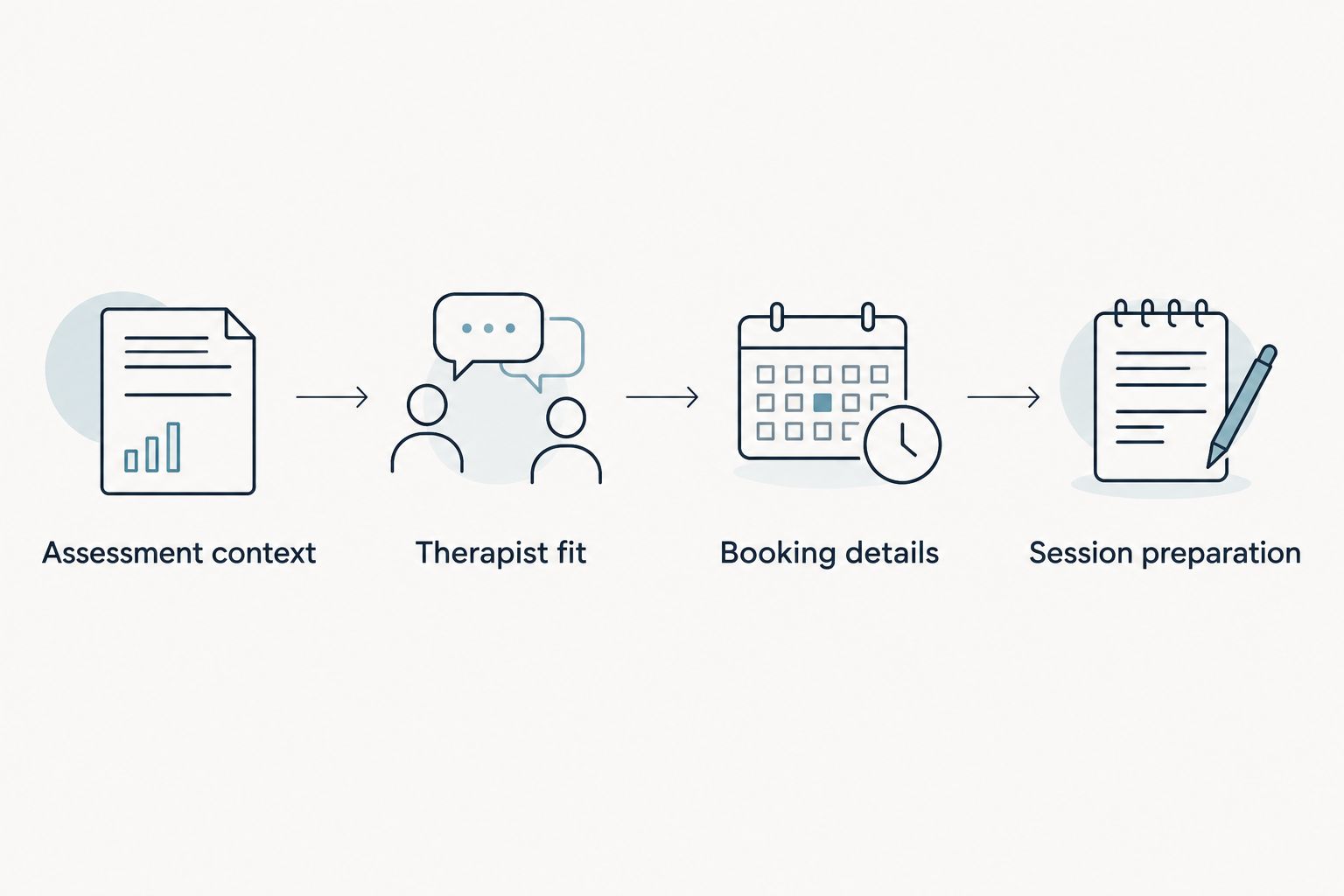
Instead of repeatedly explaining your concerns from memory, use this 2026 mind-check assessment to therapist booking workflow: keep the assessment context, choose a suitable session format, and verify your appointment. Treat the assessment as a conversation starter, not a diagnosis or a confirmed booking with InnerSpark Africa.
- Mind-check assessment to therapist booking needs a clear handoff: save your concerns, choose your format, and confirm the appointment.
- InnerSpark Africa offers online therapy with licensed African therapists through video, voice or chat.
- An assessment result is not a diagnosis; describe your experiences and let a qualified clinician assess them.
- Do not assume results transfer automatically or that submitting a request confirms an appointment.
Why this matters
An assessment and a therapy appointment serve different purposes. Your answers describe what you are experiencing; a clinical conversation adds context, explores your needs, and helps determine appropriate support.
InnerSpark Africa is best for people seeking online therapy with licensed African therapists by video, voice or chat. The benefit is a choice of communication formats; the limitation is that an online session still requires a suitable device, a workable connection, and enough privacy to participate.
The useful outcome of this 2026 workflow is not a score. It is an appointment you understand: who you will meet, when you will meet, how you will connect, and what you want help with.
Before you start
- Prepare access and privacy. Have access to the device and contact method you intend to use for booking. Choose somewhere you can read sensitive information without someone looking over your shoulder.
- Gather useful context. Keep any assessment result you can access, a brief description of your concerns, and times when you can attend. You do not need a polished personal history to ask for help.
- Check the handoff. Do not assume Mind-Check results reach a therapist automatically. Establish how to share relevant information, and whether an appointment request still needs confirmation.
If you are in immediate danger, have seriously harmed yourself, or cannot keep yourself safe, seek urgent local medical help rather than completing this workflow. Contact local emergency services or go to the nearest emergency department; ask a trusted person to stay with you when possible.
Assessment context
Keep the result connected to your experience
- Review whatever result or summary the assessment actually provides. Note the assessment name and completion date so you can explain where the information came from.
- Write down the main experiences behind your answers: what has been difficult, when it started, and how it affects daily life. Describe sleep, concentration, relationships, or work only where relevant to you.
- Separate the assessment's wording from your own observations. If the result uses a clinical term, record it as the assessment's wording rather than declaring that you have that condition.
- Keep the information somewhere you control. If you use a shared device, avoid leaving sensitive screenshots in a shared photo library or an open browser tab.
Expected result: You have a short, accurate summary that explains more than a score alone.
A useful note can be plain: describe the concern, its effect, and what you want to discuss. You can also say that a question was confusing or that an answer did not capture your situation. That context belongs in the conversation.
You do not need to repeat an assessment until it produces a result that feels sufficiently serious. Your request for support does not need a qualifying score. If something is affecting your life, describe that experience directly.
Session format and therapist fit
Choose a format you can use privately
- Decide whether speaking, writing, or seeing the therapist would help you communicate most comfortably. Consider your surroundings as well as your preference.
- Use the comparison below to identify practical trade-offs. Choose a format you can participate in without regularly stopping to hide the conversation.
- Ask whether the therapist can work with your main concern, your preferred language, and your location. Confirm professional credentials and any questions about suitability before sharing a detailed history.
- Ask how assessment information should be shared. Send only what is relevant through the method the service identifies for that purpose.
| Format | Best for | Practical benefit | Limitation to plan around |
|---|---|---|---|
| Video | People who want visual interaction | You and the therapist can see facial expressions | Camera use requires visual privacy and a connection that supports video |
| Voice | People who prefer speaking without a camera | You can talk without being seen | Someone nearby can still overhear your side of the conversation |
| Chat | People who express themselves more comfortably in writing | You can put difficult experiences into text | Typing can feel slow, and written messages do not carry vocal tone |
These are communication choices, not a ranking of clinical quality. A format that feels comfortable at home can become impractical during a commute or in a shared workplace.
For more detail on written sessions, read the guide to chat-based therapy platforms in Africa. Confirm whether the particular session you are arranging is live or uses another messaging arrangement; do not infer response timing from the word chat.
Expected result: You have a preferred format and a clear set of questions about therapist fit, privacy, and access.
Booking details
Turn your request into a confirmed appointment
- Open the booking route offered by InnerSpark Africa and follow the instructions displayed there. Check the information before submitting rather than relying on saved browser details.
- Enter a contact method you can access privately. If messages or notifications appear on a shared device, adjust your notification settings before sensitive correspondence arrives.
- Check the appointment date, time, and time zone. If you and the therapist are in different locations, establish which local time the appointment uses.
- Review the service's current payment, cancellation, and rescheduling terms before committing. Keep any relevant confirmation or receipt without assuming it proves that every booking step is complete.
- Verify the appointment itself: therapist or service contact, session format, date, time zone, and joining instructions. If any detail is unclear, ask through the contact route supplied during booking.
Expected result: You can explain exactly when and how the appointment will happen, rather than merely knowing that you submitted a form.
Use these 2 booking checks in your 2026 appointment notes:
- Confirmation check: Has the service confirmed the appointment details, rather than only acknowledging your request?
- Connection check: Do you know how to join and what to do if the connection fails?
Keep the booking record separate from your full assessment notes where practical. A calendar reminder needs enough information to help you attend, not your entire mental health history.
Arrange your therapy session
Explore online therapy with licensed African therapists by video, voice or chat.
First-session preparation
Make the handoff useful to your therapist
- Choose 1 starting goal for the conversation. Examples include explaining a recent change, discussing persistent worry, or understanding what support would fit your situation.
- Keep your assessment summary within reach, but do not make reading it aloud the whole agenda. Start with what is troubling you most now.
- Ask about confidentiality and its limits, how information is recorded, and whether anyone else has access to what you share. Raise concerns about shared devices or household privacy directly.
- Agree on a connection-failure plan before discussing sensitive material. Establish who will reconnect, through which method, and how you will know whether to wait or rearrange.
- At the end, check your understanding of the next step. Ask what you should do between sessions and how any follow-up appointment will be arranged.
Expected result: Your therapist receives relevant context, and you leave knowing what happens next.
The 3 session formats—video, voice, and chat—need the same basic preparation: a usable connection, appropriate privacy, and a clear starting concern. None removes the need to understand how the session works.
When your concerns change after booking
You can use the same handoff process when your circumstances change before an appointment. Update the context without assuming that a new assessment result automatically reaches the therapist or changes the booking.
- Note what changed and when: symptoms, daily functioning, medication, a significant event, or your ability to attend privately.
- Distinguish a change in an assessment result from a change you actually noticed. Bring both to the therapist without interpreting the score as a diagnosis.
- Ask how to share an update before the session if the information affects how you should meet. Check whether changing the format also requires changing the appointment arrangements.
- Seek urgent local help if you cannot stay safe. Do not wait for a routine appointment or an online reply in an emergency.
Expected result: Your appointment remains connected to your current needs, not just the answers you gave earlier.
For a 2026 follow-up, keep the earlier assessment date alongside the newer information. That gives the therapist a timeline without requiring you to reconstruct events from memory.
Troubleshooting
You cannot retrieve the assessment result
Write down what you remember about your concerns and when you completed the assessment. Do not invent a score or recreate answers to make the record look complete; you can discuss your experiences without the original result.
You submitted details but cannot identify a confirmed appointment
Check the contact method you used, including filtered messages. Read the wording carefully, then ask the service to confirm the date, time zone, format, and joining instructions before making another request.
Your connection makes the chosen format difficult
Tell the service before the appointment and ask whether a different format is suitable. Do not assume switching from video to voice or chat happens automatically or preserves the same arrangements.
You cannot speak privately where you planned
Arrange another location or ask about an appropriate format change. Headphones reduce what others hear from your device, but they do not prevent someone nearby from hearing your voice.
The therapist does not feel like a good fit
Explain the specific issue: communication style, language, the concern you need help with, or something you did not understand. Ask about a different therapist or referral where appropriate; an uncomfortable first conversation does not require you to ignore your preferences.
Customize your workflow
Make the process fit your life rather than building a complicated tracking system. Keep a private note with your appointment details, starting concern, questions, and agreed next step.
For shift work or changing schedules, identify times when you can reliably participate before arranging follow-up. For a shared phone, think through account access and notification previews. If you need accessibility adjustments, discuss them before the session rather than waiting until joining becomes difficult.
Your 2026 workflow can stay simple: keep the relevant context, confirm the appointment, and review the next step after each conversation. InnerSpark Africa provides the online therapy formats; you and the therapist still need to establish which arrangement suits your circumstances.
FAQ
How do I go from a Mind-Check assessment to a therapist booking?
Keep the assessment context, choose a suitable therapy format, and complete the service's booking process. Verify the appointment date, time zone, joining instructions, and how to share relevant assessment information.
Does a Mind-Check result diagnose a mental health condition?
Do not treat an assessment result as a diagnosis. A qualified clinician needs to consider your experiences, history, and clinical context rather than relying on a score alone.
Will my therapist automatically receive my Mind-Check answers?
Do not assume your answers transfer automatically. Ask the therapy service how relevant results should be shared and what information the therapist receives.
Can I book therapy without keeping my assessment result?
You can describe your concerns without an assessment result. Follow the service's intake requirements and explain what has been happening, how it affects you, and what help you want.
Is video, voice, or chat better for a first therapy session?
Choose the format that lets you communicate clearly and privately. InnerSpark Africa offers video, voice or chat; confirm the particular session arrangements before booking.
What should I do if I feel worse before my appointment?
Seek urgent local medical help if you are in immediate danger or cannot keep yourself safe. For other changes, contact the service through its stated route and ask how to update the therapist or discuss the appointment.
How do I know my therapist appointment is actually booked?
Verify an appointment confirmation with a date, time zone, session format, and joining instructions. A submitted request or payment record alone does not establish every detail of the appointment.
One last thing
A useful assessment handoff includes what the questionnaire missed. Write down any experience that felt important but did not fit its questions, and bring that to the conversation.
The goal is not to present a perfect assessment record. It is to help a therapist understand what life feels like for you.


