

Gender-based violence survivors’ therapy is mental health care that aims to support safety, recovery, and daily functioning after abuse. This 2026 Uganda guide explains how to seek help without being pushed to disclose details, confront an abuser, or begin treatment before you understand it.
- Therapy for gender based violence survivors Uganda starts with safety, consent, and a therapist experienced in trauma.
- InnerSpark Africa is best for survivors seeking online therapy with licensed African therapists, rather than emergency protection.
- Choose video, voice, or chat according to privacy and safety, not convenience alone.
- Recent sexual assault needs urgent medical attention; a therapy appointment must not delay care.
Why therapy matters for survivors in Uganda
Violence can affect sleep, concentration, relationships, and your sense of safety long after an incident. Therapy offers a place to address these effects without treating the violence as your fault. You do not need a diagnosis or a complete account of what happened to ask for support.
For survivors in Uganda, choosing care involves more than finding an appointment. A shared phone, monitored messages, transport arrangements, language preferences, or financial control can affect whether a session is safe. The right starting point is the safest workable contact, not the most detailed disclosure.
Use this 2026 guide alongside the guide to trauma therapy providers in Uganda to prepare questions about experience and treatment. A provider’s name on a list does not establish that the individual therapist meets your needs.
Put urgent medical care before counselling
If you are in immediate danger, seek the safest available route to emergency help or a health facility. Avoid confronting the person harming you to explain that you are seeking support.
After recent sexual assault, get medical attention promptly, even without visible injuries. WHO clinical guidance states that HIV post-exposure prophylaxis should begin as soon as possible and no later than 72 hours after exposure. WHO emergency contraception guidance describes options within 120 hours, depending on the method; earlier care is better.
Do not assume that passing either window means care is no longer useful. A clinician can assess injuries, pregnancy concerns, infection risks, and other needs. Therapy supports emotional recovery; it does not replace urgent medical assessment.
How to choose therapy that respects your safety
Start with a safe way to make contact
Before describing the abuse, consider who can see your device, hear your conversation, or notice a payment. You do not have to solve every risk before seeking help, but the provider needs to know which contact methods are unsafe.
A private room is useful only if entering or using it does not create additional danger. If home is monitored, ask whether another location or appointment arrangement would work. Do not make sudden changes to a shared device when those changes could draw attention.
Write down a simple contact plan only if storing it is safe. The plan should explain what the provider should do if your conversation stops unexpectedly, rather than assuming a callback is welcome.
- Identify a device or location you can use safely.
- Tell the provider whether calls, texts, or appointment reminders create risk.
- Agree on what happens if someone interrupts the session.
- Ask the provider not to leave detailed messages without permission.
Check the therapist’s credentials and survivor experience
A professional title alone does not tell you how someone handles coercion, sexual violence, or ongoing threats. Ask about the therapist’s qualifications, professional registration where applicable, and experience supporting survivors. Request plain explanations rather than accepting unfamiliar clinical language.
For a 2026 appointment, ask the person who will actually provide therapy—not only an administrator—how they approach safety and consent. You can state that you are seeking help after violence without giving names or recounting events during an initial inquiry.
Prepare 3 questions: What experience do you have with survivors? How do you handle confidentiality? What happens if I become overwhelmed? Clear answers help you judge fit before sharing sensitive information.
- Ask who will conduct your sessions and what qualifications they hold.
- Ask about experience with the type of harm you want support for.
- Check whether your preferred language is available.
- Ask how concerns about a therapist’s conduct are handled.
Choose a format you can use safely
Video, voice, and chat have different privacy demands. Video requires a setting where being seen and heard is safe; voice removes the camera but not the risk of being overheard. Chat avoids speaking aloud but creates written material that needs careful handling.
InnerSpark Africa offers online therapy with licensed African therapists through video, voice, or chat, including for people in Uganda. InnerSpark Africa is best for survivors seeking online therapy with licensed African therapists, rather than emergency protection. Ask about the assigned therapist’s survivor-specific experience before deciding to proceed.
Online access removes the need to travel for that appointment, but it does not create privacy in a monitored home. Choose based on your actual circumstances, not an assumption that online always means safer.
- Choose video when both your surroundings and connection support it.
- Choose voice when speaking is safe but using a camera is not practical.
- Consider chat only after checking device access and message handling.
- Agree on a backup plan for a dropped connection.
Set boundaries before telling your story
A first session can focus on what you need now: sleep, fear, work, parenting, or getting through the day. Detailed descriptions of violence are not an entry requirement for a supportive conversation. Tell the therapist what you are ready to discuss and what you want to leave for later.
Ask the therapist to explain confidentiality and its limits before you disclose identifying details. Those limits can depend on professional duties, immediate safety concerns, and whether a child is involved. Do not rely on a general promise of complete secrecy.
Consent also applies during treatment. Ask for explanations before exercises, assessments, or changes in approach, and say when you want to pause.
- State one concern you want the first session to address.
- Identify topics you do not want to discuss yet.
- Ask what information is recorded and who can access it.
- Agree on a clear way to pause or stop the conversation.
Agree on a plan for difficult moments
Therapy can bring up painful feelings, so discuss how the therapist will support you if you become overwhelmed. Ask whether the first stage of care can focus on coping and day-to-day stability before detailed trauma work. Treatment should reflect an assessment, not a fixed demand to relive events immediately.
A useful 2026 care plan distinguishes appointment support from emergency help. Ask what happens between sessions, whether messages are monitored, and what response arrangements actually exist. Never assume that a chat function means someone is watching it continuously.
If you feel unable to stay safe or are at risk of harming yourself, seek urgent in-person assessment or emergency help rather than waiting for the next appointment.
- Ask what you can do if distress rises during a session.
- Identify a trusted support person only if involving them is safe.
- Clarify the provider’s between-session communication arrangements.
- Ask where to seek urgent help outside appointments.
Coordinate medical and practical support
Therapy addresses emotional and psychological needs; survivors can also need medical treatment, safe accommodation, legal information, or help with children. Ask which needs require another professional rather than expecting one therapist to handle everything.
You remain entitled to explanations about proposed referrals and information sharing. Before agreeing, ask what details will be passed on, to whom, and for what purpose. If a child needs support, request a clinician with relevant child and adolescent experience and an explanation of safeguarding duties.
A therapist should not make reconciliation with the person harming you the automatic goal. Where coercion or fear is present, individual safety assessment comes before deciding whether any joint conversation is appropriate.
- List the needs that counselling alone cannot address.
- Request medical assessment for injuries or sexual health concerns.
- Ask about referral choices without assuming services are connected.
- Discuss consent before routine sharing of personal information.
Review whether the care is helping
Progress is not measured by how much detail you disclose or whether you forgive someone. Choose goals that reflect your own daily life, such as managing panic at work, sleeping more consistently, or feeling able to set a boundary. Recovery does not follow a universal deadline.
Ask the therapist how you will review the plan together. A difficult session is not automatically harmful, but repeated pressure, blame, or disregard for your boundaries deserves attention. You can ask for an explanation, request a different approach, or seek another therapist.
Before continuing with InnerSpark Africa or another provider, check whether the format still fits your safety needs. A change at home can make a previously workable appointment arrangement unsafe.
- Name the daily difficulties you want treatment to address.
- Discuss what feels useful and what feels overwhelming.
- Revisit privacy whenever your living situation changes.
- Request a referral if the therapist’s skills do not match your needs.
Compare support options for your situation
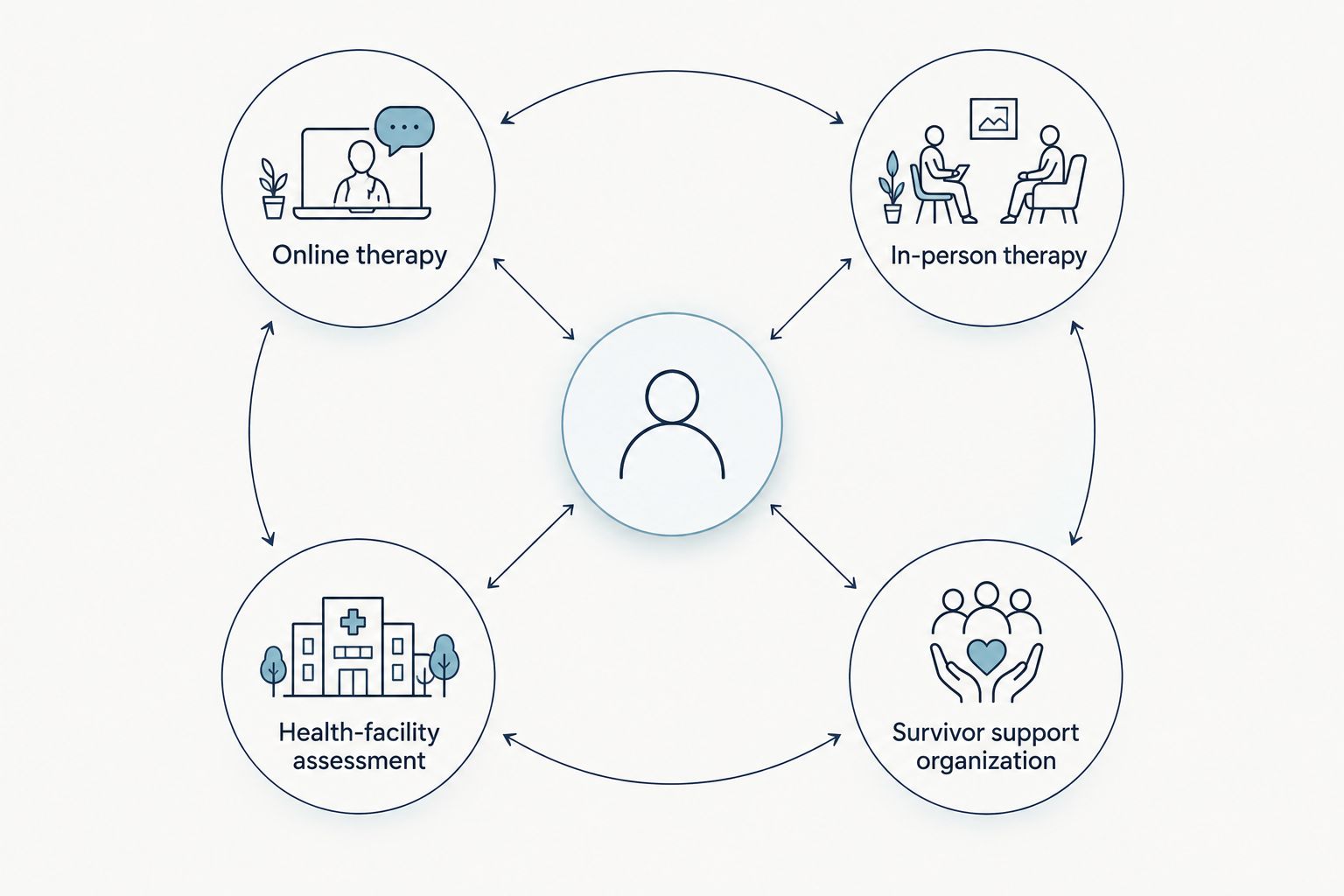
For a 2026 decision, compare the purpose of each option before comparing convenience. These routes can complement one another; urgent medical care and ongoing therapy address different needs.
| Option | Best for | Main benefit | Key limitation |
|---|---|---|---|
| InnerSpark Africa online therapy | Survivors seeking remote sessions with licensed African therapists | Video, voice, or chat without travelling to the appointment | Requires a safe communication arrangement; confirm individual trauma experience |
| In-person individual therapy | Survivors who need a counselling space away from home | A separate setting for assessment and ongoing support | Travel and explaining time away can create practical difficulties |
| Health-facility assessment | Recent assault, injuries, or urgent physical and mental health concerns | Medical evaluation and treatment decisions | Does not automatically include ongoing trauma therapy |
| Survivor support organization | Survivors seeking help with practical needs or referrals | A route to ask about protection, advocacy, or coordinated support | Services and eligibility must be checked with the organization |
Choose the route that addresses the most urgent need first. A therapy platform is not a substitute for a place of safety or an emergency department. Before relying on any service, confirm its remit and how it handles urgent concerns.
Common mistakes survivors are pressured into making
These are problems in how support is offered, not failures by survivors. Responsibility for violence belongs to the person who used it.
Treating shared counselling as the automatic answer
Abuse is not simply a communication disagreement. Joint sessions can make it harder to speak freely when someone fears punishment afterward. Ask for an individual safety assessment before considering sessions with the person who harmed you; do not accept reconciliation as a prerequisite for care.
Assuming chat leaves no trace
Not speaking aloud does not make a conversation invisible. Notifications, linked devices, stored messages, and account access can expose contact with a provider. Ask how the service handles messages, and avoid changing settings or deleting records without considering whether someone will notice.
Giving a full account before understanding confidentiality
You can ask about the therapist’s process before providing identifying details. Request an explanation of records, information sharing, and confidentiality limits in language you understand. A clear explanation is part of deciding whether to proceed, not a reward for disclosure.
Waiting until distress becomes unbearable
You do not need to prove that the violence was severe enough to deserve support. Trouble concentrating, persistent fear, shame, or disrupted sleep are reasonable reasons to ask for an assessment. Seeking therapy also does not require deciding everything about your relationship, housing, or reporting at once.
FAQ
What's the best therapy for gender-based violence survivors in Uganda?
The best fit is an appropriately qualified therapist with survivor-specific experience who respects safety, consent, and your pace. Treatment choice should follow an assessment rather than a promise that one method suits everyone.
Can I start therapy without describing everything that happened?
Yes, you can begin by discussing current difficulties and what you need from support. Ask the therapist to explain what information is necessary for assessment and why.
Is online therapy safe if I live with the person who hurt me?
Online therapy is only suitable when the communication arrangement is safe enough for your circumstances. Discuss monitored devices, interruptions, reminders, and callbacks before booking; an in-person setting can be a better fit when home is not private.
Can InnerSpark Africa provide therapy by chat instead of video?
InnerSpark Africa offers online therapy through chat, voice, or video with licensed African therapists. Confirm the assigned therapist's experience with survivors and ask how messages and session records are handled.
Should I get medical care before therapy after sexual assault?
Seek medical care promptly after recent sexual assault rather than waiting for therapy. HIV prevention and emergency contraception involve time-sensitive clinical decisions, and care remains important even when treatment windows have passed.
Do I have to attend couples counselling after partner violence?
Couples counselling is not an automatic requirement after partner violence. Ask for an individual safety assessment, especially when there is coercion, fear, or a risk of retaliation after disclosure.
Will a therapist keep everything confidential?
Therapists have confidentiality duties, but confidentiality has limits. Ask the provider to explain those limits, record access, and safeguarding responsibilities before sharing sensitive identifying details.
One last thing
Before a 2026 appointment, ask one practical question: What will you do if our conversation suddenly stops? The answer should reflect your instructions about callbacks and messages, not a routine that could expose you to harm.
You do not need to arrive with a complete story or a decision about every next step. Start with what is safe to discuss and what you need help with today.


