
Instead of repeatedly searching for help after an anxiety flag, use a consent-based handoff from your Mind-Check result to a therapist request. Do not treat a flagged result as a diagnosis, an automatic therapist assignment, or a confirmed appointment.
- A mind-check anxiety therapist match should connect a screening concern to a consent-based therapist request, not a diagnosis.
- InnerSpark Africa offers online therapy with licensed African therapists through video, voice, or chat.
- Confirm your preferences, permission to share information, and appointment details before treating the handoff as complete.
- For immediate danger, seek urgent local help instead of waiting for routine online therapy.
Why this matters
An anxiety flag leaves you with a practical question: what happens next? A useful workflow turns that concern into a clear request for professional support without making you repeatedly explain sensitive information.
InnerSpark Africa online therapy is best for people seeking licensed African therapists through video, voice, or chat. It serves individuals in Uganda, Kenya, Tanzania, and beyond. You can start with InnerSpark Africa when you are ready to explore support.
For your 2026 care plan, keep screening, matching, and booking separate. Screening identifies a concern worth discussing; matching considers your needs and preferences; booking confirms an appointment. Completing one does not establish that the others have happened.
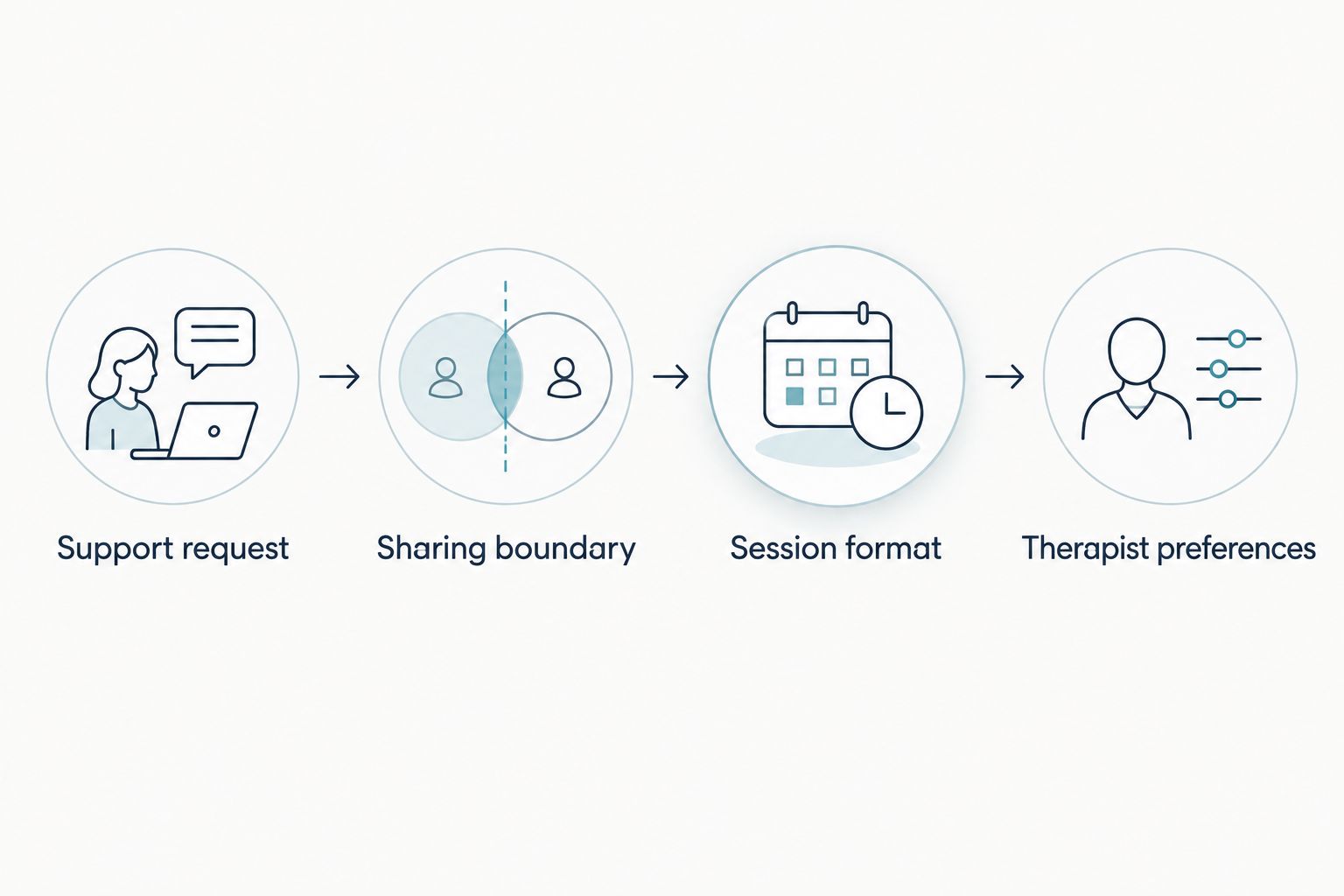
The workflow below explains the decisions you control. It does not assume that Mind-Check includes a particular automation, connection, or named interface control.
Before you start
- Prepare your result and preferred contact details. Keep the wording of the anxiety flag, the assessment date, and the contact method you want used. You do not need to write a complete personal history before asking for help.
- Choose your communication needs. Decide whether you prefer video, voice, or chat, and identify your language, privacy, scheduling, and connection requirements. Ask whether a therapist can meet those needs before confirming a session.
- Separate consent from completion. Finishing an assessment is not the same as agreeing to share its answers or accepting a therapist. Before sending anything, check what information will be shared, with whom, and for what purpose.
The non-obvious problem is the handoff itself: a result on your screen is not evidence that a therapist received a request. Look for an explicit acknowledgment rather than assuming the flag started a referral.
Your anxiety flag and support request
Record the concern without diagnosing yourself
- Read the result wording carefully. Preserve the distinction between an anxiety-related screening flag and a clinical diagnosis.
- Note what prompted the assessment. For example, describe worry, difficulty settling, or problems concentrating only if those experiences actually apply to you.
- Explain the effect on daily life. Tell the therapist what is becoming difficult, such as sleeping, studying, working, or managing relationships.
- State what you want next: a professional conversation about the result and help deciding an appropriate next step.
Keep your summary short enough to review before sending. A screening label alone gives less context than a plain description of what you are experiencing and how it affects you.
Expected result: you have an accurate support request that describes your concern without presenting a screening flag as a confirmed condition.
For a 2026 request, include the assessment date rather than describing an old result as current. If your experience has changed since completing it, explain that change separately.
Set the information-sharing boundary
- Identify the intended recipient before sending your result. Avoid posting assessment answers in a public comment, shared workplace channel, or group conversation.
- Decide whether you want to share the result summary or discuss the answers directly with the therapist.
- Ask how sensitive information will be handled and whether another person will see the request before the therapist does.
- Confirm which contact channel is safe for replies. If you share a device, consider what another person can read in notifications.
Expected result: you understand the purpose of the handoff and have chosen what information to disclose.
Do not send passwords or account access details with a therapy request. If a form asks for information whose purpose is unclear, ask for an explanation before submitting it.
Your therapist preferences and session format
Choose the format you can use privately
InnerSpark Africa offers 3 session formats: video, voice, and chat. Choose according to how you can communicate comfortably and privately, then confirm the arrangements for the particular session.
| Session format | Best for | Practical advantage | Limitation to consider |
|---|---|---|---|
| Video | People who want to see their therapist during conversation | Supports spoken conversation with visual cues | Requires a suitable connection and a private place for camera use |
| Voice | People who prefer speaking without appearing on camera | Removes the need to be on video | Other people nearby can still overhear you |
| Chat | People who express themselves more comfortably in writing | Gives you a written way to communicate | Typing can make a detailed explanation slower; confirm how the session works |
None of these formats makes a shared room confidential. Headphones help you hear privately, but they do not stop someone nearby from hearing your voice or reading your screen.
- Select your preferred format and an acceptable alternative.
- Identify a location where you can speak or type without unwanted observation.
- Check that your device supports the agreed session method.
- Ask what to do if the connection fails during the conversation.
Expected result: you have a workable first-choice format and a backup plan, rather than discovering a privacy or connection problem during therapy.
Define what a suitable match means
A useful match addresses more than an anxiety flag. Your request should explain the concerns you want to discuss and the practical conditions that let you attend.
- Ask about the therapist's experience supporting people with anxiety-related concerns.
- State your preferred language and ask whether sessions can take place in it.
- Give your scheduling constraints and time zone, especially when you and the therapist are in different countries.
- Raise any preferences that affect your willingness to speak openly. Ask how those preferences can be considered rather than assuming they are guaranteed.
Expected result: the person handling your request can assess fit against clear requirements, not just a screening label.
For a 2026 matching request, separate essential needs from preferences. A language you can comfortably use is different from a preferred appointment time that you can change. That distinction makes your request easier to act on without weakening your boundaries.
Your handoff and appointment confirmation
Submit a request without assuming automatic matching
- Start through the provider's stated contact or booking route. If the assessment presents a referral option, read its explanation before accepting it.
- Check whether the action sends a request, suggests a therapist, or confirms an appointment. These are different outcomes.
- Review the information you are about to share, including contact details and session preferences.
- Submit 1 clear request and retain its acknowledgment, if one is provided. Avoid sending repeated copies of sensitive assessment answers across different channels.
Expected result: you know what action you completed and what response you are waiting for.
If you want an automatic handoff, ask specifically whether the assessment supports it and what consent it requires. Do not connect unrelated forms or messaging services to sensitive health information simply to recreate automation.
The Mind-Check assessment-to-booked-therapist workflow covers the broader journey from an assessment to an appointment. Keep the same distinction throughout: a referral request is not a booking confirmation.
Confirm the session separately
- Confirm the therapist's identity and professional credentials, including whether they can provide care where you are located.
- Agree on the session format, date, time, and time zone.
- Check how you will join and how to contact the service if the agreed connection fails.
- Ask about confidentiality and its limits before sharing details you are uncomfortable disclosing.
Expected result: you have clear appointment instructions and know who you will speak with.
For your 2026 appointment record, save the confirmed details somewhere private. An assessment-completed message or a general acknowledgment does not replace those details.
Explore online therapy support
Find out about video, voice, or chat sessions with licensed African therapists.
When a later Mind-Check flags anxiety again
A repeat flag calls for an update, not an assumption that you need a new therapist. If you already have a therapeutic relationship, discuss the new result with that therapist before starting another matching request.
- Record the new assessment date and what has changed in your daily life.
- Check the follow-up plan you agreed with your therapist, if you have one.
- Send a concise update through the agreed channel, with only the information needed for that conversation.
- Ask whether to discuss it at your planned session or seek a different level of support.
Expected result: the new result informs your care rather than creating parallel requests with unclear ownership.
For a 2026 follow-up plan, agree on 2 decisions in advance: whom to contact when concerns change, and what to do if you need urgent help. Do not make an automated score notification your only route to support.
Troubleshooting the handoff
You received a result but no therapist acknowledgment
Treat the referral status as unconfirmed. Contact the provider through its stated route and ask whether a request was received; do not repeatedly forward your full assessment while checking.
The suggested therapist does not meet your needs
Explain the specific mismatch, such as language, session format, or the concern you want help with. Ask how to request another match before accepting an appointment you cannot comfortably use.
You cannot use the proposed session format privately
Tell the provider before the session. Ask about another format or arrange a more private location; switching from video to voice alone does not solve being overheard.
Your concern has become urgent
Do not wait for routine matching if you are in immediate danger, have seriously harmed yourself, or think you might act on thoughts of suicide. Contact local emergency services or go to the nearest emergency department; ask a trusted person to stay with you if possible.
Customize your workflow
Keep the handoff short, but make the confirmation explicit. Your assessment result, consent decision, therapist preferences, and appointment details serve different purposes. Avoid collecting extra sensitive information simply because a form allows it.
If you need help communicating the request, ask a trusted person to assist only with the parts you choose. Agree on what they can see and whether they should receive replies. Help with arranging therapy does not require access to everything you discuss in therapy.
InnerSpark Africa online therapy offers a choice of communication formats, but the right workflow still depends on a format you can use and a therapist you can speak with. Ask about those practical details before treating the match as settled.
FAQ
Does a Mind-Check anxiety flag mean I have an anxiety disorder?
No. A screening flag is not a clinical diagnosis. Discuss the result and its effect on your daily life with a qualified mental health professional.
Will Mind-Check automatically assign me a therapist?
Do not assume that an anxiety flag automatically assigns a therapist. Check whether the next action sends a request, suggests a match, or confirms an appointment, and review any consent request.
What should I include in a mind-check anxiety therapist match request?
Include the result wording, assessment date, your main concern, and your communication preferences. Share sensitive answers only after checking who will receive them and why.
Can I choose chat instead of a video therapy session?
InnerSpark Africa offers online therapy through video, voice, or chat. Confirm the format for your particular appointment and ask how the session will work before agreeing to it.
Should I request a new therapist every time anxiety is flagged?
No. If you already have a therapist, discuss the new result through your agreed follow-up route before starting a separate matching request. Explain what has changed since the earlier assessment.
How do I know my therapist appointment is confirmed?
An appointment is confirmed when you have agreed details identifying the therapist, session format, date, time, and joining method. An assessment result or referral acknowledgment alone does not establish those details.
What should I do if I need help before a therapist responds?
Seek urgent local help if you are in immediate danger or think you might act on thoughts of suicide. Contact local emergency services or attend the nearest emergency department rather than waiting for routine online matching.
One last thing
You do not need to complete another assessment to explain that you are struggling. A clear description of what is happening and a request for professional support are a useful starting point. Keep the result if it helps the conversation, but do not let the score become a barrier to asking for care.


