
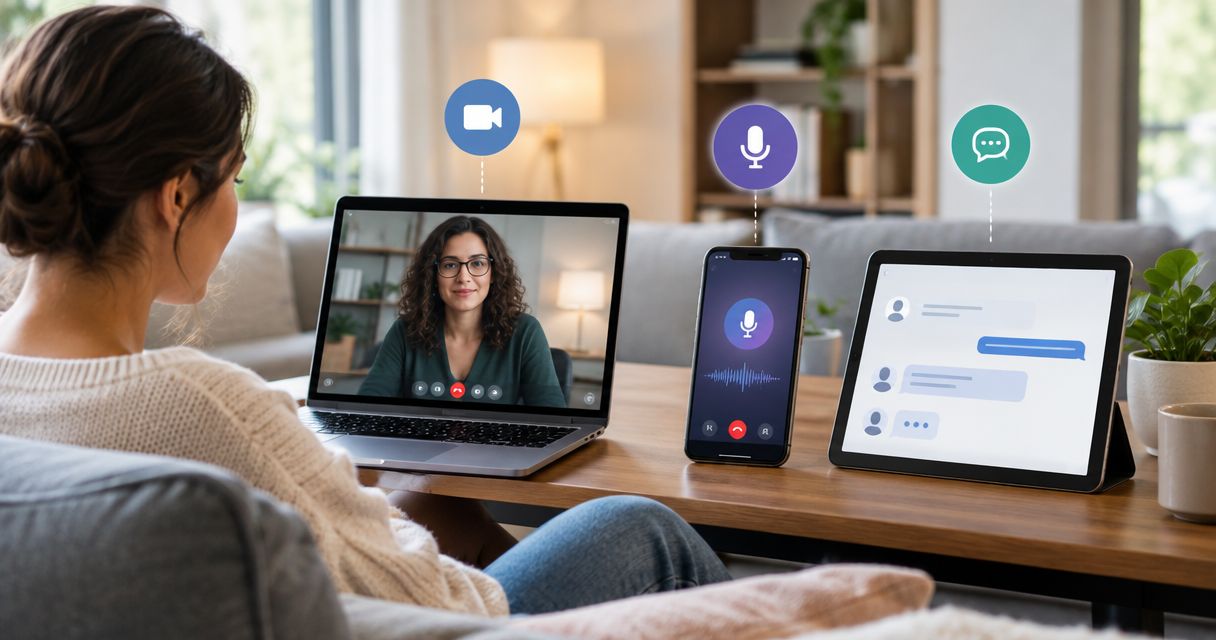
Instead of arranging a new counselling relationship whenever your connection or privacy changes, request to switch between video voice and chat therapy with your current therapist and confirm the arrangement before your next session. InnerSpark Africa offers all three formats; keeping the same therapist requires agreement, not an assumed automatic transfer.
- To switch between video voice and chat therapy, confirm the format and your named therapist before the session.
- InnerSpark Africa offers online therapy with licensed African therapists through video, voice and chat.
- Video provides visual cues, voice removes camera demands, and chat lets you communicate through writing.
- Agree on a fallback channel and clarify whether chat is live or answered later.
Why this matters
A different communication format changes what you and your therapist can observe. Video includes facial expressions, voice carries tone without a camera, and chat relies on written words. None removes the need for privacy or a clear appointment arrangement.
InnerSpark Africa is best for people seeking online therapy with licensed African therapists through video, voice or chat. Its services reach individuals in Uganda, Kenya, Tanzania and beyond. Start with InnerSpark Africa when arranging your preferred format.
For your 2026 therapy plan, separate two decisions: how you communicate and who provides your care. Asking for voice instead of video does not, by itself, confirm that your current therapist will conduct the appointment.
The benefit is flexibility across 3 therapy formats. The limit is that offering those formats does not establish that every therapist provides each one, or that you can change channels during any appointment.
Before you start
- Identify the appointment. Have your therapist’s name, appointment date, time zone and existing booking details ready. Use the contact route associated with your care rather than sending sensitive information to an unfamiliar account.
- Prepare a suitable device and private setting. Check your connection, charge your device and test the microphone or camera when needed. For chat, check who can access your screen, notifications and message history.
- Clarify what chat means. Ask whether the proposed chat session is a live appointment or a message exchange answered later. Also confirm whether the same therapist can provide the requested format; neither detail follows automatically from the word chat.
You do not need to repeat your full personal history to request a format change. Begin with the practical information needed to identify your appointment and explain your communication preference.
Your format choice
Compare video, voice and chat
Choose the format around your privacy, communication needs and connection—not a belief that one channel is always better therapy. Discuss the clinical fit with your therapist, especially when written communication would make a difficult conversation harder to explain.
| Format | Best for | Practical benefit | Limitation to discuss |
|---|---|---|---|
| Video | People who want face-to-face conversation remotely | You and your therapist can see facial expressions | Requires camera access and a setting where you feel comfortable being seen |
| Voice | People who want spoken conversation without a camera | Preserves spoken tone without showing your surroundings | Your therapist cannot see facial expressions or body language |
| Chat | People who prefer expressing themselves in writing | Gives you a written way to describe thoughts and feelings | Tone is less visible, and response timing needs explicit agreement |
- Choose your preferred format for the next appointment. State whether this is a temporary change or a preference you want to discuss for future sessions.
- Give a short practical reason, such as an unreliable video connection, camera discomfort or a preference for writing. Share only what is necessary for the request.
- Ask your therapist whether the format suits the work you plan to do together. Agree on how to handle anything that is difficult to communicate through that channel.
Expected result: You have a preferred format and a clear reason for choosing it, ready for your therapist to confirm.
Voice still requires somewhere you can speak without being overheard. Chat still requires somewhere you can read and type without someone watching. Changing channels solves some practical problems, not every privacy problem.
Your appointment agreement
Confirm therapist continuity
For a 2026 appointment change, request 2 confirmations: the communication format and the therapist conducting the session. A confirmed format alone does not answer both questions.
- Contact your therapist or the service through the established route connected to your appointment. Identify the booking without including unnecessary clinical details.
- State that you want to keep the same named therapist. Ask whether that therapist can conduct the appointment through your requested format.
- Confirm whether the existing appointment remains in place or needs to be changed. Do not assume that sending a request changes the booking.
- Check the confirmed date, time zone, joining method and therapist’s name. Keep the reply somewhere you can retrieve privately.
Expected result: You know whether the same therapist will meet you, which format you will use and how to join.
A useful request contains four parts: your appointment details, your preferred format, your wish to retain the same therapist and a request for confirmation. It does not need a detailed explanation of your symptoms.
If your therapist cannot provide the requested format, discuss the next step before accepting a different arrangement. Ask about another appointment with that therapist or discuss an alternative channel. Keep the decision explicit rather than treating a new booking as proof of continuity.
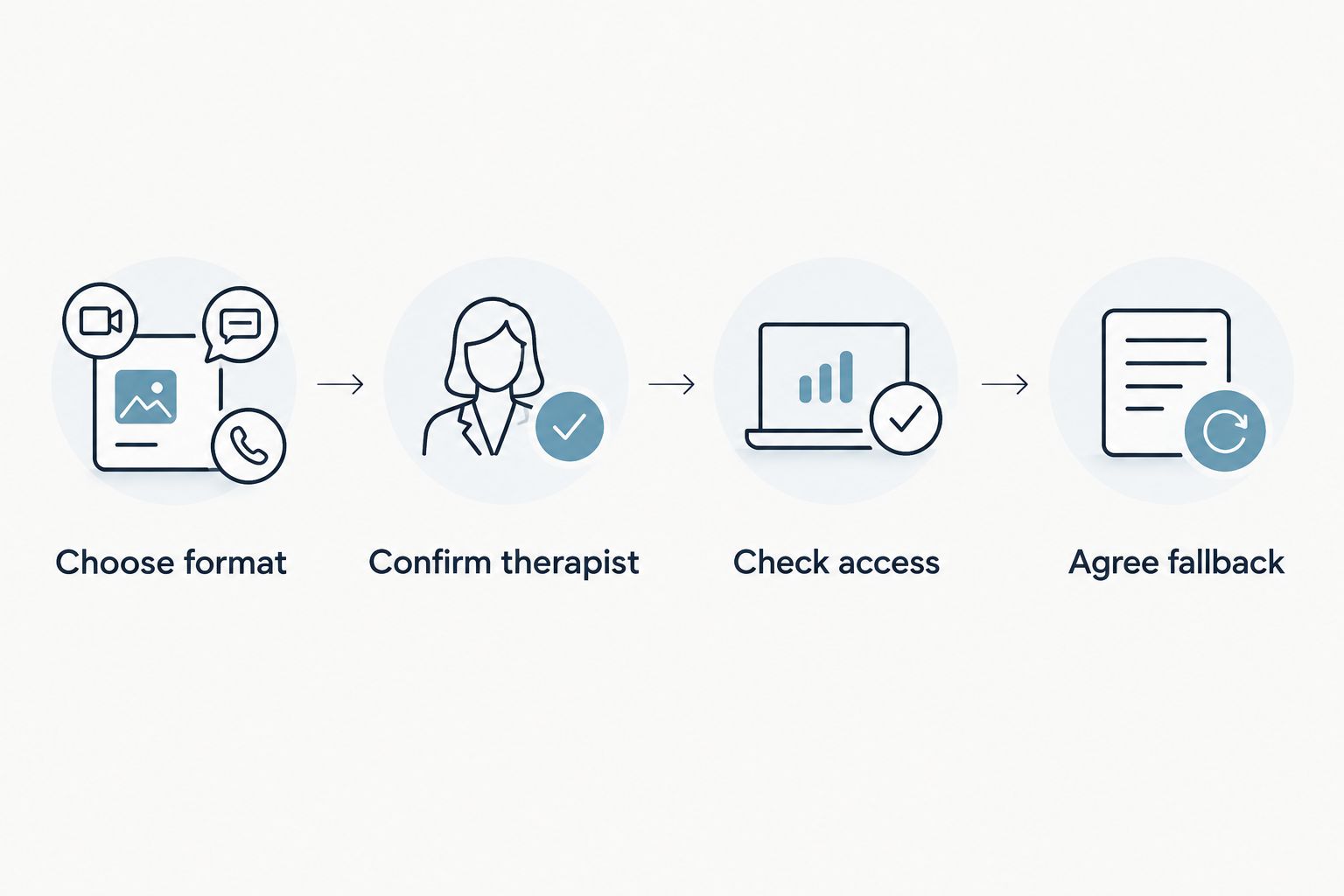
The sequence is straightforward: choose a format, confirm your therapist, check access and agree on a fallback. Complete those decisions before relying on the new channel.
Check access and privacy
Once the appointment is confirmed, prepare the channel you actually agreed to use. An audio test does not establish that your chat access works, and a working camera does not make a shared room private.
- Use the joining instructions supplied for your confirmed appointment. Check the intended recipient before sending personal information.
- For video or voice, test the relevant microphone, speaker and camera permissions. Use headphones if they help prevent other people from hearing the therapist.
- For chat, check notification previews, shared-device access and whether someone else can read over your shoulder. Ask how messages are handled and who can access them.
- Agree on what happens if the channel stops working. Specify whether you should wait, reconnect or use an agreed alternative, and who initiates contact.
Expected result: You can access the agreed channel and know what to do if the connection fails.
Do not record a session or capture the conversation without discussing consent and applicable rules. A personal device is not automatically a private device, especially when another person knows its passcode or uses the same account.
Your session handover
Preserve the thread of therapy
Keeping 1 named therapist is the continuity goal; retaining the same communication format is not. Give your therapist a brief bridge between the previous session and the new channel.
- At the start, confirm that the agreed format is working for both of you. Raise any concern about being overheard or having messages seen before discussing sensitive material.
- Briefly identify where you finished last time and what you want to address today. Ask whether anything needs adjusting because the format has changed.
- Agree on a signal for pausing, clarifying or stopping. In chat, ask how to distinguish a pause for thought from a connection problem.
- Before finishing, confirm the next appointment’s format. Do not assume a one-session change becomes your permanent arrangement.
Expected result: The session continues the existing therapeutic work rather than becoming a fresh intake solely because the channel changed.
For ongoing care in 2026, keep a short personal reminder of the agreed format and fallback arrangement. Avoid putting sensitive session details in a shared calendar notification.
A second workflow: change formats during a session
A connection failure needs a different response from a planned change. Use an agreed fallback, not an improvised switch to an unfamiliar account or application.
If video becomes unusable, tell your therapist what is happening if you can still communicate. Use voice only if both of you agree on the channel and can continue privately. Turning off your camera does not necessarily create a separate voice appointment.
If speaking becomes unsafe because someone enters the room, do not assume chat is private enough. Stop sharing sensitive details, explain that you need to pause when safe to do so, and follow the plan agreed with your therapist.
For an unexpected interruption:
- Stop discussing sensitive material while privacy or connection is uncertain.
- Use the agreed fallback to confirm whether the session can continue.
- Establish whether the new channel is suitable before resuming the conversation.
- If continuing is not workable, clarify the next contact or appointment arrangement.
Chat is not automatically a backup for a disconnected call. Its usefulness depends on whether your therapist is present there and whether you have agreed to communicate that way.
Troubleshooting your format change
You requested voice, but the appointment still says video
Treat the difference as unresolved. Contact the established booking route and ask which format applies to the appointment. Do not create a second booking simply to make the label match your request.
A different therapist appears in the confirmation
Ask for clarification before proceeding. State that your request was to change the format while retaining your current therapist, then confirm whether the proposed appointment meets that request.
Your chat message has no immediate reply
Check the agreed response arrangement. A message channel is not proof of a live therapy session, and a sent message is not proof that your therapist has read it. Do not use routine chat as an emergency-response channel.
Video works, but the audio does not
Check microphone permission, mute status and the selected audio device. Reconnect according to the agreed plan if needed; move to another format only after confirming it with your therapist.
You no longer have a private space
Pause before sharing more. Move only if you can do so safely, then reassess whether speaking, typing or being on camera is appropriate. If none is private enough, discuss another arrangement rather than forcing the session to continue.
Customize your workflow
Make your 2026 session plan specific to your circumstances. For example, you can request voice for an appointment when you cannot comfortably use a camera, or discuss chat when writing helps you explain yourself. These are requests to agree with your therapist, not automatic settings.
If you want to explore messaging, read the guide to connecting InnerSpark to WhatsApp for chat-based therapy. Confirm the actual joining method and response arrangements before sharing health information through any messaging account.
Review your preferred format with your therapist when your circumstances change. A channel that worked in a private room might not work during travel, in shared accommodation or around a changing work schedule.
FAQ
Can I switch between video voice and chat therapy with the same therapist?
Request the change and confirm that your current therapist can provide the chosen format. InnerSpark Africa offers video, voice and chat therapy, but a format change does not automatically confirm therapist continuity.
Does switching from video to voice cancel my existing appointment?
Do not treat a format request as a cancellation or a confirmed booking change. Ask whether your existing appointment remains in place and check the final confirmation.
Can I turn off my camera and continue therapy by voice?
Agree with your therapist before continuing without video. Confirm that you can both hear clearly and that voice is suitable for the session.
Does chat therapy mean my therapist replies immediately?
Chat alone does not establish immediate replies. Confirm whether you have a live scheduled session or a message exchange with a separate response arrangement.
Do I need to explain my whole history again after changing formats?
Changing formats alone does not mean you must repeat your full history. With the same therapist, begin with a brief reminder of the previous session and agree on today's focus.
What should I do if my connection drops during therapy?
Follow the fallback plan agreed with your therapist. If no plan exists, use the established contact route to clarify the next step rather than sending sensitive information to a new account.
Can I use therapy chat if I am in immediate danger?
Do not rely on routine therapy chat for immediate emergency help. Contact local emergency services or go to the nearest emergency department; seek support from a trusted person when safe.
One last thing
The most useful fallback is an agreed action, not another app. Before your next 2026 appointment, settle who contacts whom if the connection fails. That small decision keeps a technical interruption from becoming uncertainty about your care.


