
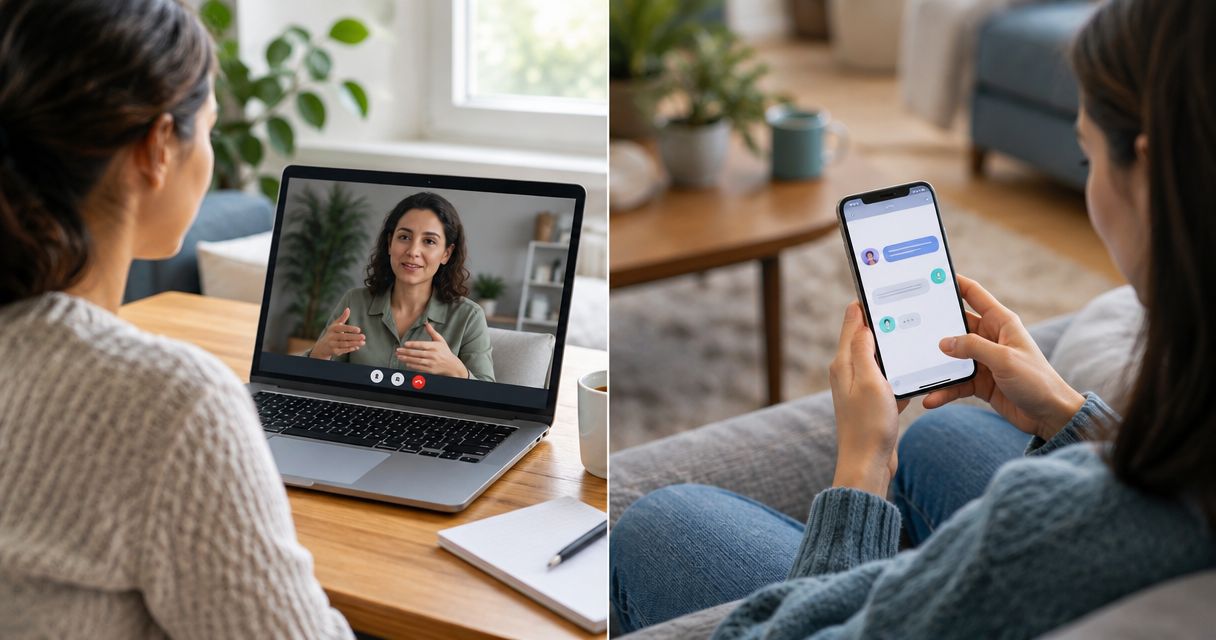
Chat therapy can support effective treatment, but you should not assume it delivers the same results as video therapy for every person or concern. In 2026, choose between them with a licensed therapist based on your needs, the treatment approach, and whether chat means a live conversation or messages answered later.
- Is chat therapy as effective as video therapy? There is no single answer across all conditions and treatment formats.
- Chat supports written reflection; video adds facial expressions, tone of voice, and immediate conversation.
- InnerSpark Africa offers online counselling with licensed African therapists through video, voice or chat.
- Choose a format with your therapist, agree on goals, and review whether treatment is helping.
Is chat-based therapy as effective as video therapy?
Neither format is automatically the better treatment. Video and chat carry different information, and a comparison of their features is not proof that their clinical outcomes are equal. InnerSpark Africa offers both formats, alongside voice sessions, with licensed African therapists.
| Format | Best for | Practical strength | Limitation |
|---|---|---|---|
| Live chat therapy | People who express themselves more clearly in writing | You exchange written messages during an agreed appointment | Your therapist cannot hear your voice or see facial expressions |
| Asynchronous messaging | People who want time to compose messages | You write and receive replies at different times | Replies are not immediate; response arrangements need clarification |
| Video therapy | People who prefer spoken conversation and visual contact | Your therapist can hear your voice and see visible expressions | You need a suitable connection and somewhere private to speak |
| Voice therapy | People who prefer speaking without a camera | You have spoken conversation without sharing video | Your therapist cannot see facial expressions |
The distinction between live and asynchronous chat matters. A scheduled text conversation and a message answered later are different services, even when both are called chat therapy.
Ask what treatment you will receive, not just which communication tool you will use. A messaging service does not become equivalent to video therapy simply because a therapist participates.
Why this matters
A format that looks convenient can still make it difficult to explain what is happening. If you spend the appointment hiding your voice from people nearby, struggling to type, or reconnecting to a video call, those barriers belong in the treatment discussion.
For someone choosing online therapy in Uganda, Kenya, or Tanzania in 2026, privacy and connectivity are practical questions, not minor preferences. You need a way to communicate honestly and a plan for interruptions.
Therapy also involves more than disclosure. You and your therapist need an agreed purpose, a suitable treatment approach, and a way to discuss progress or deterioration. Changing from video to chat does not remove those requirements.
Chat therapy: best for people who communicate clearly in writing
Chat gives you a written channel for describing thoughts, feelings, and experiences. If speaking feels difficult, writing can provide a useful starting point without requiring you to say everything aloud.
That advantage has a limit. Your therapist cannot hear a long pause, a change in tone, or a trembling voice unless you describe what is happening. A short message can also be ambiguous: saying you are fine does not explain whether you feel settled, exhausted, or reluctant to continue.
To make written communication clearer, include context rather than only a conclusion. Explain what happened, what you noticed emotionally or physically, and what you want help with. You do not need polished grammar.
Choose chat for its communication fit, not because it promises the same outcome as video. Before booking, confirm whether the appointment is live, when replies arrive, and what happens if you need help outside the agreed exchange.
Does typing make it easier to open up?
Typing gives you time to choose words, but it does not guarantee that disclosure will feel easier. If writing helps you explain a difficult experience, tell your therapist; if you keep deleting messages or avoiding the topic, discuss that too.
Video therapy: best for people who prefer spoken conversation
Video lets you and your therapist speak while seeing each other. It adds visible expressions and gestures to the conversation, although a camera still shows only part of your surroundings and body language.
You can clarify a misunderstanding immediately without typing out another message. For people who find writing tiring or struggle to organize thoughts on a screen, spoken conversation removes that particular task.
The trade-off is practical. You need enough privacy to talk, a workable connection, and a device setup that allows a conversation. A camera does not make a session confidential if someone else can hear it.
Choose video when speaking and visual contact help you participate. Do not treat a frozen screen or repeated disconnection as something you must simply tolerate; agree on a backup arrangement before the appointment.
Is video better because the therapist can see me?
Video provides visual information that text cannot, but seeing you does not by itself establish better treatment outcomes. The relevant question is whether that information and communication style help your therapist assess and address your needs.
Voice therapy: best for people who want conversation without a camera
Voice is a separate option rather than a compromise you have to dismiss. It preserves spoken conversation and tone without requiring you to appear on video.
Its limitation is the absence of visual information. As with chat, your therapist needs you to describe relevant experiences that would otherwise remain unseen, and you still need somewhere safe to speak.
If camera use is your main obstacle, ask about voice before deciding that written therapy is your only alternative. For a wider format comparison, see the guide to video and voice-call therapy options in East Africa.
Why the right therapy format varies
These factors help you compare formats in 2026. They guide a conversation with a clinician; they do not establish that either format treats every condition equally well.
- Communication preference: Writing and speaking place different demands on you. Choose a format that lets you explain more than brief updates.
- Clinical needs: Ask whether your concerns and planned treatment are suitable for remote text, voice, or video sessions. A preference alone is not a clinical assessment.
- Timing: Live appointments and delayed messaging offer different kinds of contact. Clarify when your therapist reads messages and responds.
- Privacy: Consider who can hear a call, see notifications, or access a shared device. Text is not automatically private.
- Connectivity: Discuss what happens when a call drops or a message fails to send. Do not assume another channel will be monitored.
- Language and expression: Ask which languages the therapist uses and whether you can describe your experiences comfortably in that language.
A practical comparison should identify obstacles you can address. If language is the main barrier, changing from chat to video without addressing language will not solve the underlying problem.
How do I choose between chat and video therapy?
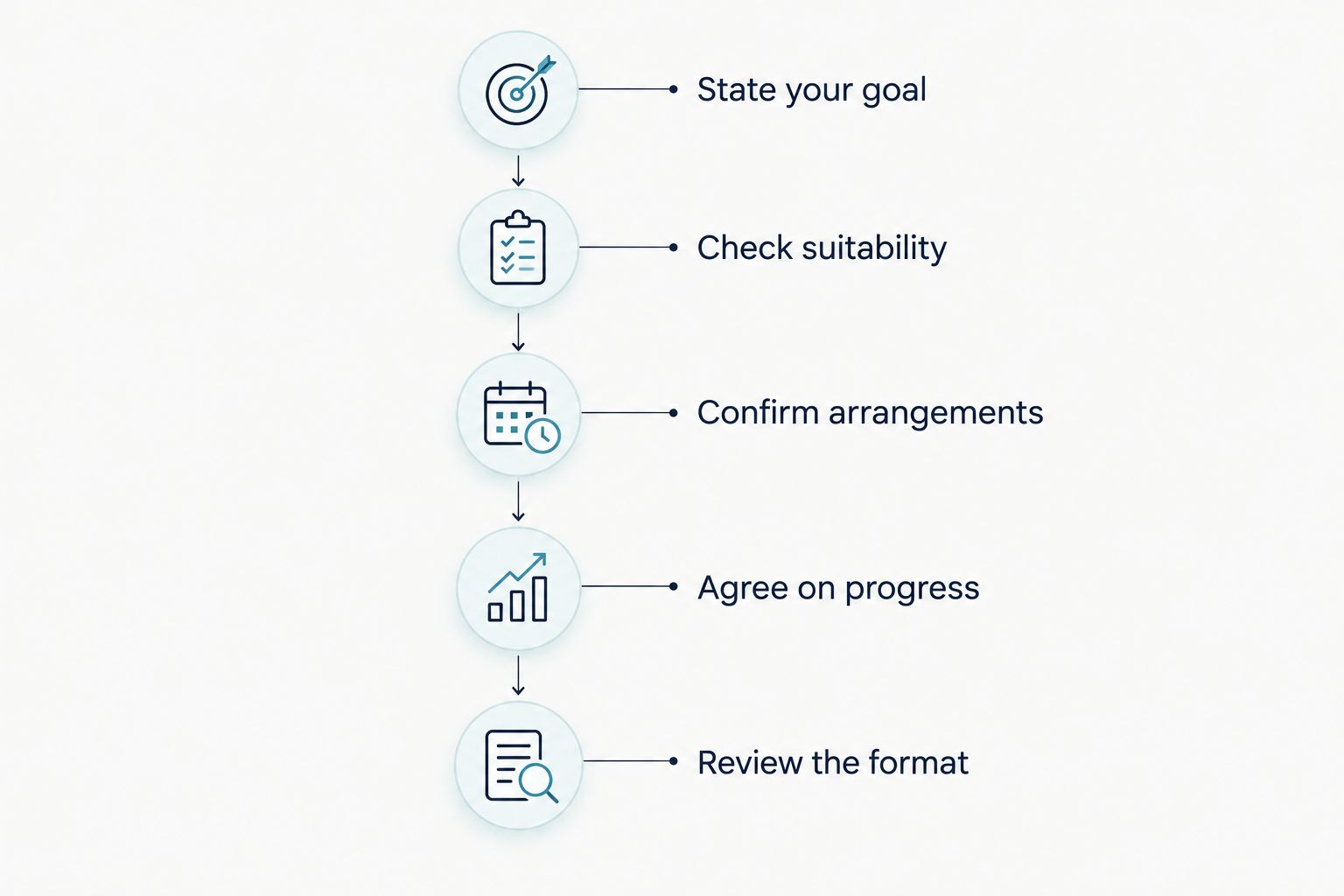
Use the following steps to turn a general preference into a workable appointment plan. You do not need to decide your entire course of treatment before your first conversation.
- State your goal. Write 2 sentences describing what is troubling you and what you want help with. Bring them to the appointment in whichever format you choose.
- Check suitability. Ask the therapist whether the proposed format fits your needs and the planned treatment. Mention any immediate safety concerns directly.
- Confirm arrangements. Ask 3 questions: Is contact live or delayed? When should I expect replies? What happens if the connection fails?
- Agree on progress. Choose 1 initial goal with your therapist, such as discussing a specific difficulty or understanding a recurring pattern. Agree on how you will review it.
- Review the format. Tell your therapist if typing, speaking, privacy, or connectivity prevents you from participating. Discuss an adjustment rather than quietly disengaging.
These are preparation prompts, not a clinical scoring system. The purpose is to make expectations clear before a technical or communication problem becomes a barrier to care.
How can I tell whether chat therapy is helping?
Look at the goals you agreed with your therapist, not the number of messages exchanged. A long conversation can feel supportive without addressing the difficulty you came to treatment for.
Discuss changes in the areas that matter to you: daily functioning, coping with a specific situation, or understanding a pattern. Your therapist can help decide whether a structured assessment is appropriate alongside that discussion.
Tell your therapist if you feel misunderstood or leave exchanges unsure what to do next. Do not wait for the platform to identify a poor fit. In 2026, the useful question remains whether the treatment plan and communication format are supporting your care.
If symptoms worsen, contact your clinician rather than relying on a routine progress review. A change in safety or functioning needs attention, regardless of whether you prefer chat or video.
When should I not rely on chat therapy?
Do not wait for a therapy message reply during an immediate emergency. If you are at immediate risk of harming yourself or someone else, cannot stay safe, or have already taken a harmful substance, contact local emergency services or go to the nearest emergency department.
Routine online appointments are not a substitute for urgent assessment. Video also does not turn an ordinary therapy appointment into an emergency service.
Before starting remote care, ask how urgent concerns are handled and what local support to use. If it is safe to do so, involve a trusted person who can help you reach immediate care.
FAQ
Is chat therapy as effective as video therapy for everyone?
No single answer applies to everyone. Suitability depends on your concerns, the treatment approach, and whether chat is live or asynchronous; a feature comparison does not prove equal outcomes.
What is the difference between live chat and messaging a therapist?
Live chat happens during an agreed appointment, while asynchronous messaging involves replies at different times. Confirm response arrangements before treating either service as ongoing support.
Is chat therapy a good choice if I find speaking difficult?
Chat is worth discussing with a licensed therapist if writing helps you explain yourself. The therapist still needs to assess whether written communication fits your clinical needs and planned treatment.
Is chat therapy more private than a video call?
Chat is not automatically more private than video. Messages, notifications, and shared-device access create different privacy concerns from an overheard call; ask how records and communications are handled.
Can I use voice therapy instead of video?
Voice therapy is an option offered by InnerSpark Africa alongside video and chat. Ask whether it suits your needs and how the therapist handles information that cannot be seen during a call.
Should I choose chat therapy if my internet connection is unreliable?
Discuss chat as an alternative if your connection repeatedly interrupts video, but confirm how messages and appointments work. Connectivity does not determine clinical suitability, and text exchanges still need a workable connection.
What should I ask before booking online therapy in 2026?
Ask about the therapist's qualifications, format suitability, response arrangements, confidentiality limits, and emergency procedures. Also clarify what happens if technical problems interrupt the appointment.
Can I change formats if chat therapy is not working for me?
Ask your therapist about changing formats if chat prevents you from explaining yourself or following treatment. Confirm the arrangements before switching, including whether continuity with the same clinician is possible.
One last thing
Your preference can change once therapy begins. You might discover that writing helps you start a difficult topic but speaking helps you clarify it; that is information to discuss, not a failure to choose correctly.
InnerSpark Africa is best for people seeking online therapy options with licensed African therapists through video, voice or chat. For your 2026 care plan, choose a format you can use honestly, then review its suitability with your therapist rather than assuming convenience equals effectiveness.


