
Yes, online therapy is legal in Kenya when the practitioner is authorised to provide the service and the care meets applicable professional, consent and data-protection requirements. Using video, voice or chat does not remove those obligations. In 2026, the key check is not whether an app offers appointments in Kenya, but whether the individual treating you is qualified and authorised to do so.
- Is online therapy legal in Kenya? Yes, subject to professional regulation, informed consent and health-data protection.
- Kenya’s Counsellors and Psychologists Board regulates counsellors and psychologists; verify the individual practitioner’s credentials.
- InnerSpark Africa offers online therapy with licensed African therapists; Kenyan clients should confirm the assigned practitioner’s authorisation.
- A foreign professional licence alone does not establish permission to treat someone located in Kenya.
Is online therapy legal in Kenya?
Online therapy is a permitted way to receive care, not an exemption from professional regulation. Kenya’s legal framework addresses who can practise, how personal information is handled and what responsibilities apply to healthcare services.
When comparing online therapy platforms in Kenya, assess the practitioner and privacy arrangements separately from the platform’s booking features.
| Legal framework | What it covers | What you should check |
|---|---|---|
| Counsellors and Psychologists Act, 2014 | Registration and professional regulation of counsellors and psychologists | The practitioner’s registration and current authority to practise |
| Data Protection Act, 2019 | Processing of personal information, including sensitive health information | How therapy records are collected, used, stored and shared |
| Digital Health Act, 2023 | Kenya’s framework for digital health services and systems | Whether the provider has addressed the digital-health obligations applicable to its service |
These laws provide a starting point for checking a service in 2026. They do not establish that every website advertising counselling complies with Kenyan requirements, and a professional qualification is not proof of every permission a particular service needs.
This guide provides general information, not legal advice or a determination that a particular provider is compliant.
Why this matters
You should not have to choose between accessible care and basic safeguards. Online sessions can remove the journey to a consulting room, but you still need to know who is treating you, what they are qualified to do and where your information goes.
A booking page answers a practical question: can you arrange a session? It does not answer the separate legal question: is this practitioner authorised to provide this care to you in your current location?
Check the professional behind the appointment, not just the name above the booking button. That distinction matters whether you choose a Kenyan practice or a platform serving several countries.
How do you check whether an online therapist can treat you?
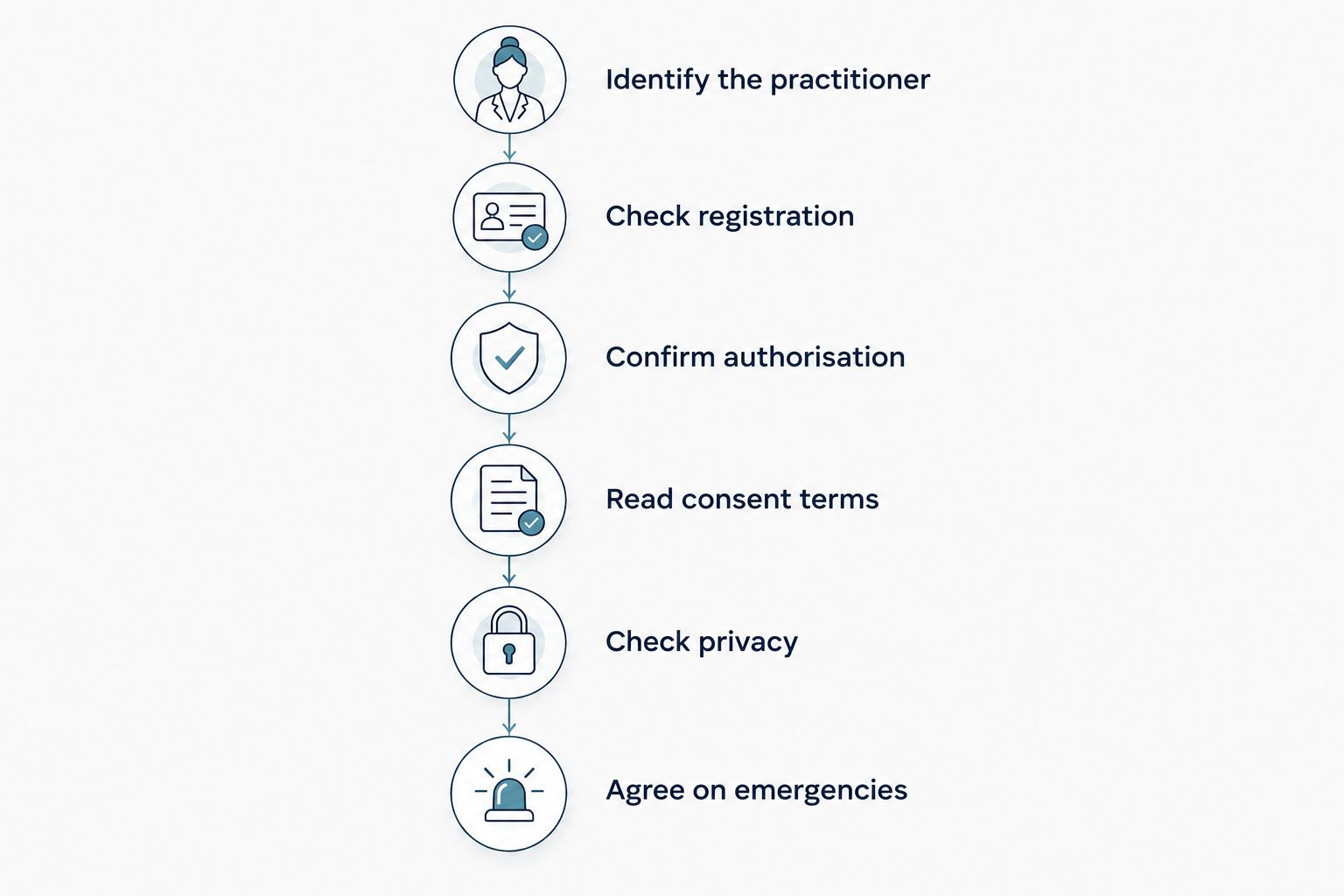
Use this sequence before sharing a detailed personal history. You can ask for the information in writing and keep the response with your appointment details.
- Identify the practitioner. Ask for the therapist’s full professional name and the profession under which they practise. A profile describing someone only as a wellness expert does not establish clinical registration.
- Check registration. Ask for the relevant regulator and registration details. For counsellors and psychologists in Kenya, start with the Counsellors and Psychologists Board; medical practitioners fall under a different professional regulator.
- Confirm authorisation. Ask whether the practitioner holds the current permissions required to treat a client located in Kenya. Where a practising licence applies, check its current status rather than relying on an old certificate.
- Read consent terms. Look for an explanation of the service, confidentiality limits, communication arrangements and what happens if remote care is unsuitable.
- Check privacy. Ask who holds your records, who can access them and whether information is transferred outside Kenya.
- Agree on emergencies. Establish what the therapist will do if you need urgent local help or the connection fails during a difficult session.
These are checks for your 2026 booking, not a substitute for a regulator’s confirmation. If a provider gives an unclear answer about professional status, resolve that before starting clinical treatment.
Does video, voice or chat change the legal position?
The communication format does not replace the practitioner’s professional obligations. You still need appropriate authorisation, informed consent and protection for your health information, whether you speak on camera or type messages.
Choose a format for its practical fit, then check its limits. A familiar messaging tool is not, by itself, evidence of a compliant therapy service.
| Format | Best for | Practical benefit | Limitation to discuss |
|---|---|---|---|
| Video therapy | People who want face-to-face conversation remotely | You and the therapist can see each other | Requires a private setting and a connection that supports video |
| Voice therapy | People who prefer speaking without a camera | Removes the need to appear on screen | The therapist cannot observe visual cues |
| Chat therapy | People who prefer expressing themselves in writing | Gives you a written way to communicate | Response timing and crisis limitations need explicit agreement |
For chat, establish whether messages are exchanged during a scheduled appointment or answered later. For calls, agree on what happens after a disconnection and whether either person records the session.
Do not assume that a particular channel is confidential simply because it feels private. Ask about account access, saved messages, recordings and notifications on shared devices.
Why online therapy requirements vary
The legal and clinical checks depend on the actual service. These factors explain why a single platform-wide statement cannot answer every client’s situation:
- Professional category. A counsellor, psychologist and psychiatrist do not have identical professional roles or regulatory arrangements.
- Client location. The country where you are physically located matters when the provider assesses whether the practitioner can treat you.
- Practitioner location. An overseas therapist creates additional questions about professional authorisation and cross-border practice.
- Service scope. Counselling, psychological assessment and medical prescribing require different qualifications and permissions.
- Data handling. Storage, access and transfers outside Kenya affect the privacy checks a provider must address.
- Clinical needs. A remote appointment is not a suitable substitute for every type of assessment or urgent intervention.
For a 2026 appointment, describe your location and the help you want before assuming a therapist is suitable. If either changes during treatment, ask the provider to reassess the arrangement.
Can a therapist outside Kenya legally treat someone in Kenya?
An overseas licence does not automatically establish permission to treat a person in Kenya. The provider needs to address the requirements applicable to the practitioner, the client’s location and the service being delivered.
Ask a direct question: are you authorised to provide this type of therapy to me while I am physically in Kenya? Request the basis for the answer, rather than accepting a general statement that the platform serves Africa.
Regional access and local professional authorisation are different things. A provider accepting your booking or payment is not independent confirmation that the cross-border arrangement meets every applicable requirement.
Travel creates the same issue in reverse. Tell your therapist before attending from another country so the provider can check whether treatment can continue and whether the emergency arrangements still work.
Is online therapy confidential under Kenyan law?
Online therapy involves sensitive health information, and Kenya’s Data Protection Act, 2019 applies to its processing. Confidentiality is a professional obligation, but it is not an unlimited promise that information can never be disclosed.
The Act’s section 46 addresses the processing of health data, including the responsibility of healthcare providers and duties of professional secrecy. Section 48 addresses transfers of personal data outside Kenya, making overseas storage or access a question worth raising explicitly.
Before your first session, ask:
- Who is responsible for your therapy records?
- Which staff or service providers can access them?
- Are sessions recorded, and what permission is sought?
- Is information stored or accessed outside Kenya?
- What circumstances allow or require disclosure?
- How do you exercise your data-protection rights?
Your therapist should explain confidentiality limits, including relevant legal duties and serious safety concerns. A useful explanation tells you what happens in practice; a blanket promise of absolute secrecy does not.
You also control part of the privacy setup. Use a private space, secure your device and check whether message previews or shared accounts expose session information to someone else.
Can an online therapist prescribe medication in Kenya?
Counselling qualifications alone do not authorise medical prescribing. A psychiatrist is a medical doctor; a counsellor or psychologist should not be treated as a prescriber simply because the appointment takes place on a healthcare platform.
If medication is part of your care, confirm the clinician’s medical registration, current authority to practise and whether remote assessment and prescribing are appropriate for your situation. Do not assume that booking therapy includes psychiatric assessment or a prescription.
Medication questions are also a reason to distinguish between supportive conversation and medical treatment. Tell the practitioner about existing prescriptions and ask who coordinates care with your prescribing clinician.
When should you use local or urgent care instead?
Routine online therapy is not a substitute for emergency assessment. If you are in immediate danger, have seriously harmed yourself or cannot stay safe, seek urgent help through the nearest emergency department or local emergency services.
A remote therapist should explain the service’s crisis limits before treatment starts. Ask how urgent concerns are handled, whether someone monitors messages between appointments and what local support you should use outside session times.
Do not wait for a routine chat response when you need immediate help. If possible, involve a trusted person who can stay with you while you reach urgent care.
Where does InnerSpark Africa fit?
InnerSpark Africa is best suited to people seeking online therapy with licensed African therapists by video, voice or chat. The service supports individuals in Kenya, Uganda, Tanzania and beyond.
The practical benefit is a choice of communication formats. The limitation is that a regional service description does not establish the assigned therapist’s Kenyan authorisation, prescribing authority or suitability for a particular clinical need.
Before booking through InnerSpark Africa, ask which therapist would see you, what professional registration applies and how the provider handles Kenyan clients’ records. Choose the service only after those answers match the care you need.
FAQ
Is online therapy legal in Kenya in 2026?
Yes, online therapy is legal in Kenya when the practitioner is authorised to provide the service and applicable professional, consent and data-protection requirements are met. Check the individual practitioner rather than relying only on the platform’s advertising.
How do I check if an online therapist is registered in Kenya?
Ask for the therapist’s full professional name, registration details and relevant regulator, then verify their status with that regulator. For counsellors and psychologists, start with Kenya’s Counsellors and Psychologists Board.
Can I see a therapist who lives outside Kenya?
An overseas therapist must have an appropriate basis for treating you while you are in Kenya; a foreign licence alone does not establish that permission. Ask the provider to explain the authorisation and cross-border arrangements before treatment.
Is chat therapy legal in Kenya?
Using chat does not remove the professional and privacy requirements that apply to therapy in Kenya. Confirm the practitioner’s credentials, message-response arrangements and how written conversations are protected.
Can my online counsellor prescribe anxiety medication?
Counselling qualifications alone do not authorise prescribing. Ask whether you need an assessment by an appropriately authorised medical practitioner and whether remote prescribing is suitable for your situation.
Can online therapy be completely anonymous?
Do not assume online therapy can be completely anonymous. Ask what identity and location details the provider requires for clinical records, professional obligations and emergency planning.
Does InnerSpark Africa offer online therapy for people in Kenya?
InnerSpark Africa serves individuals in Kenya with licensed African therapists through video, voice or chat. Confirm the assigned practitioner’s authorisation for your location and needs before starting treatment.
What should I do if I need urgent help during online therapy?
Seek urgent local care if you are in immediate danger or cannot stay safe. Routine appointments and messages are not substitutes for emergency assessment; agree on a local crisis plan with your therapist.
One last thing
Your location is part of the care arrangement, not just a booking detail. For every 2026 appointment, tell your therapist if you are attending from a different country, even when you keep the same account and device.
The useful question is not only whether online therapy is legal in Kenya, but whether this practitioner can legally and safely provide this care to you. Get that answer before sharing your full history.


