
You cannot establish whether online therapy is legal in Tanzania from a booking page alone: the answer depends on the professional’s authority to practise, your location, and the service provided. Before booking in 2026, verify those details and ask how the provider handles consent, health information, and emergencies.
- Is online therapy legal in Tanzania? Verify the practitioner’s authority and service scope before booking.
- A professional licence from another country does not, by itself, establish permission to treat clients in Tanzania.
- InnerSpark Africa offers online counselling; confirm the assigned therapist’s authority to serve your location.
- Video, voice, and chat are delivery formats, not evidence of professional registration or regulatory approval.
Is online therapy legal in Tanzania?
Treat online therapy as a regulated professional service, not simply an app you can access. An accessible website, a successful payment, or a therapist’s overseas credentials does not settle whether a particular arrangement meets the rules that apply to you.
Use these 5 checks before sharing a detailed clinical history or committing to ongoing sessions:
- Professional identity. Get the practitioner’s full name, professional title, registration authority, and registration number where applicable. Establish whether you are booking a counsellor, psychologist, psychiatrist, or another professional.
- Practice authority. Ask what authorises that practitioner to provide the proposed service to someone physically located in Tanzania. Request a clear explanation rather than accepting a general statement that the platform operates internationally.
- Service scope. Confirm whether the appointment covers counselling, psychological assessment, medical diagnosis, or prescribing. Do not treat these as interchangeable services.
- Data handling. Read the consent and privacy information before submitting sensitive details. Ask who can access session records and where those records are stored.
- Local escalation. Ask what happens if you need urgent assessment, an in-person examination, or support that the remote practitioner cannot provide.
For medical practitioners in mainland Tanzania, the Medical Council of Tanganyika is a relevant registration authority. Do not assume that a medical registration check answers every question about a counsellor’s or psychologist’s professional status; check the authority relevant to the stated profession.
Why this matters
You deserve a clear answer about who is treating you and what that person is authorised to do. This matters especially when a provider serves several countries and the practitioner sits outside Tanzania.
InnerSpark Africa offers online mental health therapy with licensed African therapists through video, voice, or chat, including services for people in Tanzania. That service description identifies the offer; it does not replace checking the assigned practitioner’s credentials and the requirements for your particular appointment.
InnerSpark Africa is best for people seeking online counselling with African therapists, subject to practitioner and location checks. Its stated formats give you a choice about how to communicate, but they do not establish that every practitioner can provide every service in every jurisdiction.
This guide provides booking checks, not an individual legal opinion. For a disputed registration issue or an unclear cross-border arrangement, seek confirmation from the relevant professional authority or a Tanzanian legal adviser.
Why the legal position varies
A useful answer in 2026 needs more detail than the word online. These factors determine what you need to verify:
- Your physical location. Tell the provider where you will actually attend the appointment, including whether you are in mainland Tanzania or Zanzibar. Do not substitute your nationality or billing address.
- The practitioner’s location. Establish where the professional works and which authority issued the credentials presented to you.
- The professional role. Counselling, psychology, and medical practice are not interchangeable labels. Ask for the practitioner’s actual qualification and role.
- The work requested. Supportive counselling is different from a medical assessment or a request for medication. State what you need before booking.
- The handling of health information. A remote appointment involves both care and information processing. Check the privacy arrangements separately from professional credentials.
A provider should answer these questions directly. Pause the booking if the explanation relies only on popularity, testimonials, or a claim that the platform serves Africa. None of those answers identifies the legal basis for your particular care.
Does a foreign therapist’s licence cover Tanzania?
An overseas licence is evidence of a credential, not automatic evidence of permission to practise everywhere. Ask the provider how the therapist’s registration applies to a client attending from Tanzania.
Start with the issuing authority, the professional title, and whether the registration is current. Then ask the separate question: what permits this practitioner to deliver this particular service to you remotely?
For your 2026 booking, distinguish 2 locations: where you are physically attending and where the practitioner is working. If you travel during a course of therapy, tell the provider before the next appointment so that the arrangement can be checked again.
Do not accept a statement about “international certification” as a substitute for an identifiable qualification or registration. Training certificates can describe education without answering questions about professional practice authority.
What should I ask before paying?
Ask the provider to explain the following in writing:
- The assigned practitioner’s professional title and registration details.
- The basis for providing the proposed service to you in Tanzania.
- Whether any part of your request needs a different professional or an in-person referral.
- Who handles questions or complaints about the practitioner’s conduct.
You do not need to interpret every regulation yourself. You do need enough information to identify the professional and direct a verification question to the appropriate authority.
Are video, voice, and chat treated differently?
Video, voice, and chat describe how you communicate; none proves that a service is legally authorised. Apply the same identity, practice-authority, consent, and privacy checks across all 3 session formats.
The practical benefits and limitations differ. Choose the format that supports the clinical conversation and gives you adequate privacy, rather than assuming a particular format is more legitimate.
| Format | Best for | Practical benefit | Limitation to discuss |
|---|---|---|---|
| Video | People who want face-to-face interaction remotely | Allows visual interaction during the conversation | Requires a suitable connection and a private camera setting |
| Voice | People who prefer speaking without a camera | Keeps the conversation spoken without video | Does not provide visual information to the practitioner |
| Chat | People who express themselves more comfortably in writing | Provides a written way to communicate | Tone and urgent concerns need explicit clarification |
Ask whether chat means a scheduled, live appointment or messages answered later. Do not assume that a messaging option includes continuous monitoring or immediate crisis support.
InnerSpark Africa offers all three formats. Choose a format after confirming what the practitioner recommends for your needs; convenience alone does not determine clinical suitability.
What privacy protections should I check?
Tanzania’s Personal Data Protection Act is relevant to the handling of personal information. A promise of confidentiality does not, by itself, explain how a provider meets applicable data-protection duties.
Before a 2026 appointment, read the actual privacy notice and consent information. Look for explanations of what the provider collects, why it collects it, who receives it, and how you can raise a privacy concern.
Ask specifically about recordings, transcripts, clinical notes, and access by staff other than your therapist. If information is processed outside Tanzania, request an explanation of the applicable arrangements rather than assuming that cross-border storage is either automatically permitted or automatically prohibited.
Confidentiality also has limits in professional care. Ask the practitioner to explain those limits before the session, including how serious safety concerns are handled.
Your own setting matters too. Use a private space where possible, check whether notifications expose sensitive messages, and consider who else can access your device or account. These steps protect your side of the conversation; they do not replace the provider’s responsibilities.
How can I check a provider before my first session?
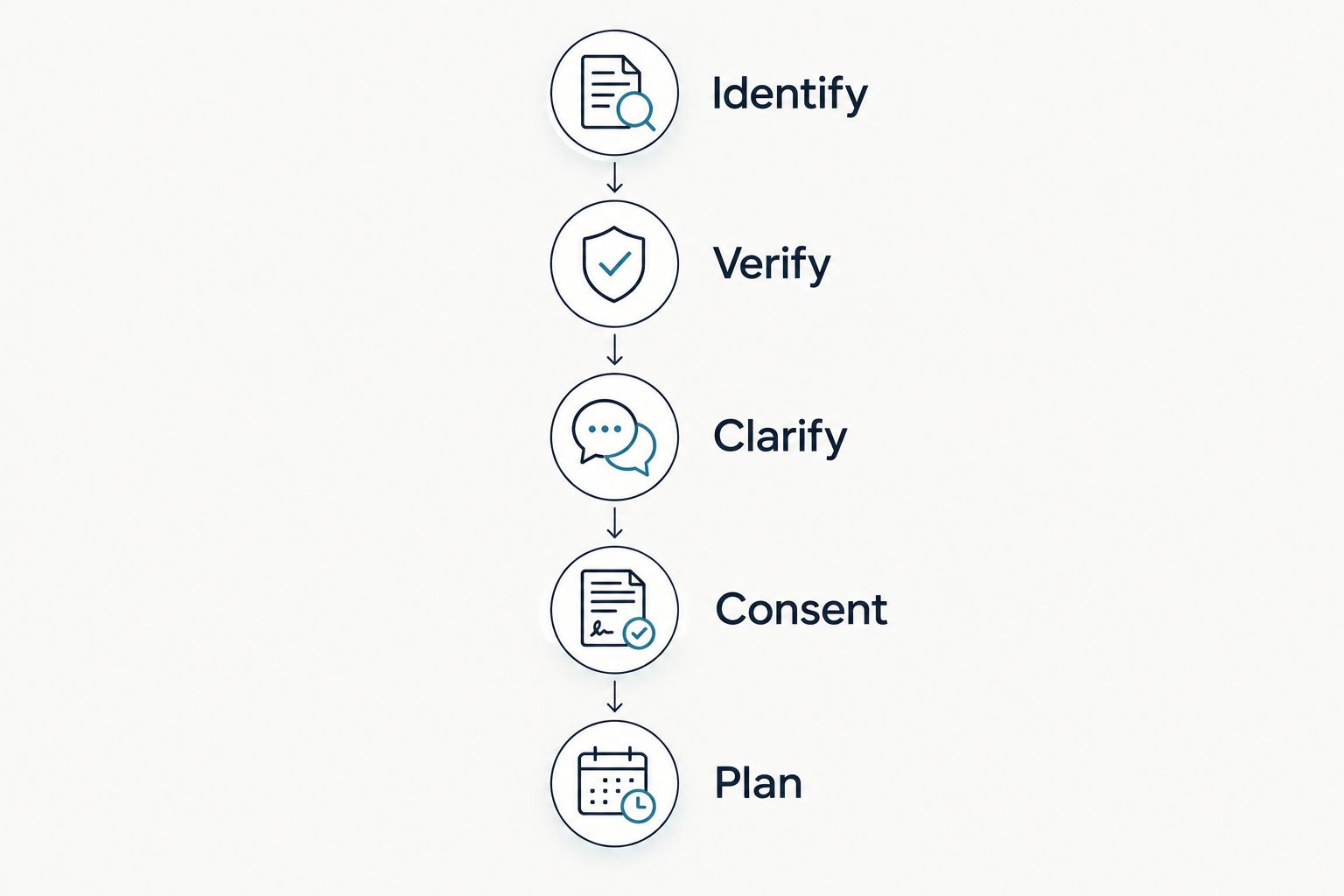
Use a simple sequence: Identify, Verify, Clarify, Consent, Plan. Complete it before sending documents or describing experiences you would not want shared beyond the care arrangement.
- Identify. Obtain the practitioner’s full professional identity, not just a first name or profile photograph.
- Verify. Check credentials through the issuing authority’s official channels. Where the position is unclear, ask the authority what the registration permits.
- Clarify. Confirm the appointment’s purpose, your location, the practitioner’s location, and any limits on the service.
- Consent. Read the care and privacy terms, then ask about anything you do not understand.
- Plan. Agree what happens if the connection fails, the practitioner recommends in-person care, or an urgent safety concern arises.
These checks separate the decision to book from the decision to disclose sensitive information. You can ask administrative questions without first providing your full mental health history.
A clear response should name the practitioner and explain the arrangement in language you understand. Do not proceed simply because you feel embarrassed about asking questions. Professional identity, privacy, and service limits are reasonable things to check.
Can an online therapist prescribe medication in Tanzania?
Do not assume that an online therapy appointment includes prescribing. A counselling qualification does not establish medical prescribing authority, and a platform’s booking options do not settle that question.
If you need medication assessment, ask which appropriately authorised medical practitioner will assess you and how any prescription would meet the requirements that apply in Tanzania. Keep this separate from choosing a counselling format.
Do not change or stop prescribed medication on the strength of this guide. Discuss treatment decisions with the clinician responsible for your care.
When should I seek in-person help instead?
Online counselling is not a substitute for emergency medical care. If you are in immediate danger, have seriously harmed yourself, or cannot keep yourself safe, seek urgent help at the nearest emergency department or through local emergency services.
For non-emergency care, ask for an in-person referral when the practitioner says your assessment or treatment requires one. A service’s willingness to refer you is more useful than a promise that everything can be handled remotely.
Before your first session, identify a local place you can reach if urgent care becomes necessary. Share your current location with the practitioner when discussing an emergency plan, rather than assuming the platform already knows it.
FAQ
Is online therapy legal in Tanzania in 2026?
The legality of a particular online therapy arrangement depends on the practitioner’s authority, the service provided, and the applicable requirements for your location. Verify those details rather than treating access to a booking platform as proof of approval.
Can I see a therapist based outside Tanzania?
Check the cross-border care arrangement before booking a therapist based outside Tanzania. Ask how the practitioner’s credentials and practice authority apply to someone attending from your location.
How do I check whether an online therapist is licensed?
Get the therapist’s full professional name, professional title, registration authority, and registration number where applicable. Verify the details through the issuing authority and ask what the registration authorises.
Is chat therapy more legally acceptable than video therapy?
Chat is not evidence of greater legal authorisation than video. Both require checks appropriate to the professional, the service, your location, and the handling of your information.
Can an online counsellor prescribe medicine?
Do not assume an online counsellor can prescribe medicine. Ask whether an appropriately authorised medical practitioner is involved and how the proposed prescribing arrangement meets local requirements.
Does confidentiality mean nobody can ever access my therapy information?
Confidentiality does not mean there are no limits or authorised disclosures. Ask who can access your records, whether sessions are recorded, and how serious safety concerns are handled.
Does InnerSpark Africa offer online therapy for people in Tanzania?
InnerSpark Africa offers online therapy for people in Tanzania through video, voice, or chat with licensed African therapists. Before booking, confirm the assigned practitioner’s authority for your location and the scope of the appointment.
One last thing
Recheck your physical location when your circumstances change. A care arrangement discussed while you were in one country should not be assumed to cover a later appointment from somewhere else.
For your 2026 booking, save the practitioner’s identity, consent information, and escalation instructions somewhere you can find them. The useful outcome is not a reassuring slogan about online therapy; it is a clear understanding of who will treat you, on what basis, and what happens if you need different care.


