

NGO workers’ mental health support is practical and clinical help with the aim of protecting wellbeing while managing the demands of nonprofit work in Africa. This 2026 guide explains how to seek confidential support, choose a therapist, and address workplace pressures without treating therapy as a substitute for safe working conditions.
- Mental health support for NGO workers Africa: combine confidential counselling with practical changes to workload and working conditions.
- InnerSpark Africa suits workers seeking online therapy with licensed African therapists through video, voice or chat.
- Ask who receives appointment information before using employer-funded counselling.
- Use urgent local medical help for immediate danger; routine therapy appointments are not an emergency response.
Why mental health support matters for NGO workers
Support should address both your distress and the conditions contributing to it. If your role involves distressing accounts, difficult funding decisions, travel, or responsibility for people’s safety, name those demands when seeking help. A general conversation about stress is less useful than explaining what happens during your working day.
Your position also shapes what feels safe to disclose. Before using an organizational referral, ask whether your manager receives attendance information, clinical information, or neither. For an employer-level perspective, see this guide to corporate mental health programs in Uganda.
For your 2026 support plan, separate clinical care from management action. A therapist can help you understand distress and develop coping strategies; your organization remains responsible for addressing workload, harassment, unsafe assignments, and other workplace problems.
How to arrange support that fits your work
Identify what needs attention first
Start privately, with paper or a personal device rather than a shared work document. Describe what has changed in your sleep, concentration, relationships, mood, or ability to recover after work. You do not need to diagnose yourself before asking for help.
Set aside 10 minutes for a preparation note. This is an organizational exercise, not a screening test or a clinical threshold. Record the problem in ordinary language and identify what you want help doing differently.
If you are in immediate danger, have harmed yourself, or cannot keep yourself safe, seek urgent help through local emergency services or the nearest emergency department. Do not wait for a routine appointment.
- Describe the main difficulty without assigning yourself a diagnosis.
- Note when it started and what makes it harder.
- Identify any immediate safety concern.
- Write down one change you want support to achieve.
Check privacy before choosing a referral
Read your employer’s wellbeing policy, referral terms, or employee assistance information first. Ask for a written explanation if the boundaries are unclear. Funding a session and receiving clinical details are different things; establish what actually happens rather than assuming either complete secrecy or automatic disclosure.
For a 2026 referral, ask 3 questions: who receives information, what they receive, and under what circumstances. These are suggested questions, not a guarantee that every service follows the same arrangement.
Therapeutic confidentiality also has limits, including circumstances involving serious safety concerns or legal obligations. Ask the provider to explain the rules that apply to your care before discussing sensitive details.
- Ask who can see appointment and payment records.
- Request an explanation of confidentiality and its limits.
- Check whether reporting is individual or aggregated.
- Use personal contact details if work communications are monitored.
- Avoid placing clinical details in leave requests unnecessarily.
Choose a suitable therapist and session format
Start with available professional registers, trusted clinical referrals, or your existing healthcare provider. Ask about credentials, experience, language, and whether the therapist can provide care where you will physically attend the session. Working for an international organization does not make every cross-border arrangement appropriate.
If you prefer an online route, InnerSpark Africa offers therapy with licensed African therapists through video, voice, or chat, serving individuals in Uganda, Kenya, Tanzania, and beyond. InnerSpark Africa is best suited to workers seeking online therapy with licensed African therapists. Confirm the individual therapist’s suitability for your needs before booking.
Online access avoids a journey to an appointment, but you still need privacy, a usable connection, and an agreed response if contact drops. Availability of a format does not establish suitability for every clinical concern.
- Ask about experience with your particular concern.
- Confirm credentials and permission to provide care in your location.
- State your preferred language and check whether it is offered.
- Discuss whether video, voice, or chat fits the work you need to do.
- Agree on a backup plan for a disconnected session.
Prepare a private session routine
Start by checking the space and device you already have. A room with a closed door is useful only if other people cannot overhear the conversation. Headphones protect incoming audio; they do not stop someone nearby from hearing you speak.
Arrange protected time rather than trying to fit a difficult conversation between field calls. If you use chat, consider notification previews, shared-device access, and where messages remain visible. Do not assume that a work-issued device is private.
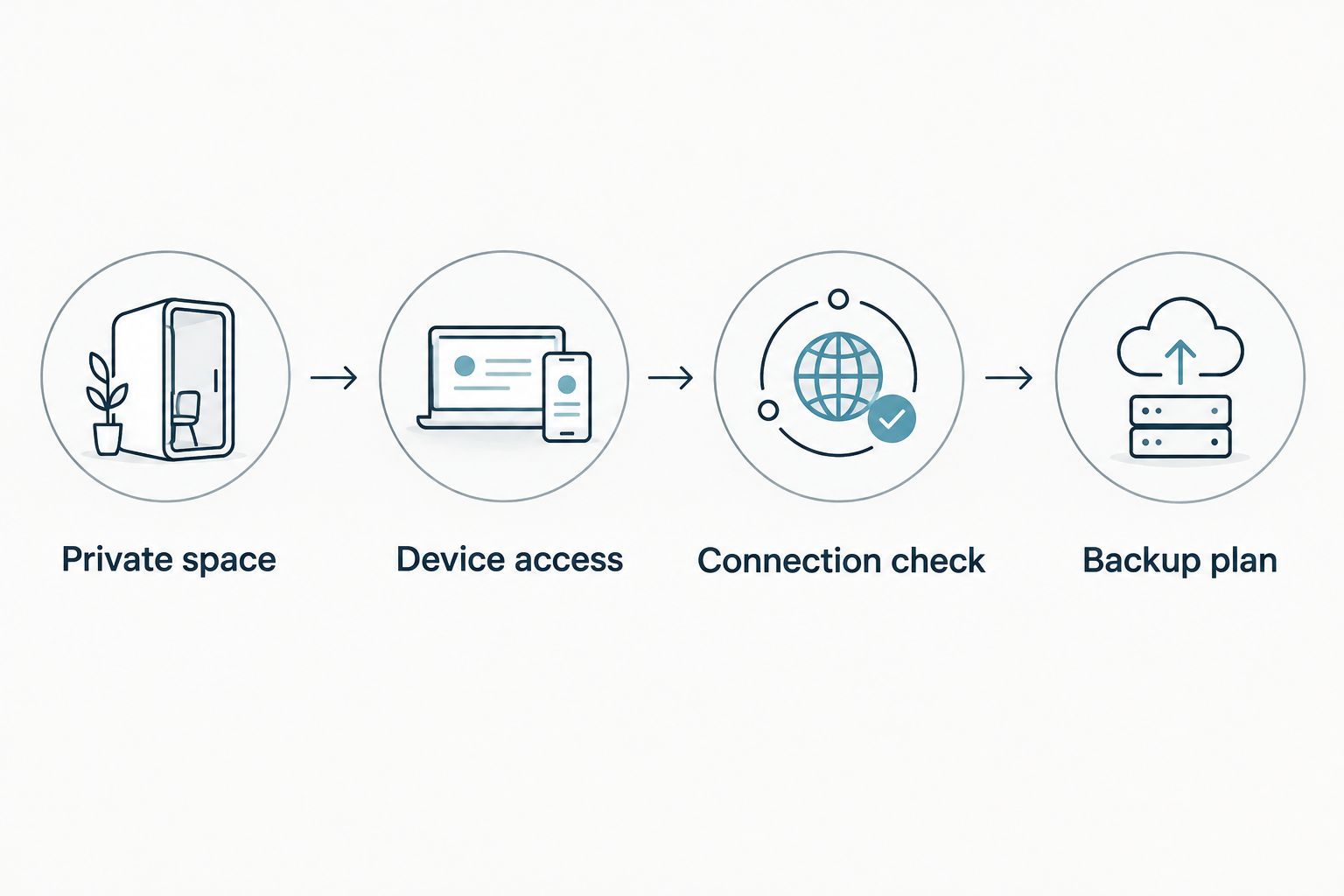
Use the sequence below as a practical preparation routine. It keeps access problems separate from the clinical conversation, so you can discuss both clearly with your provider.
- Private space: check who can overhear or interrupt.
- Device access: check passwords, notifications, and shared accounts.
- Connection check: test the format before the appointment.
- Backup plan: agree what happens if contact drops.
Agree on goals and review the fit
Before the first appointment, write what you want help with and what would make the conversation feel useful. You might want to understand recurring distress, manage difficult reactions after work, or decide how to ask for changes. These are starting points for discussion, not a treatment plan you must design yourself.
During your 2026 support planning, separate administrative questions from clinical goals. Ask how appointments work, how progress will be discussed, and how concerns about the therapeutic relationship should be raised.
You do not need to recount every distressing event immediately. Explain if a question feels overwhelming and ask the therapist to discuss pace, purpose, and alternatives.
- Bring a short description of the main problem.
- Agree on what you will work on together.
- Ask how the therapist will review progress with you.
- Raise language, cultural, or communication difficulties directly.
- Discuss another referral if the provider cannot meet your needs.
Request changes to the conditions causing strain
Start with a factual record of work demands and a specific request. You can describe repeated late calls, missed breaks, unsafe travel arrangements, or conflicting responsibilities without disclosing the contents of therapy. Keep records in a way that follows applicable workplace and safeguarding requirements.
Choose the appropriate channel for the problem. Routine workload discussions belong with someone authorized to change the work; harassment, retaliation, and safety concerns need the relevant reporting route. Do not rely on an informal peer conversation as the only response to a serious workplace issue.
Counselling should accompany necessary workplace changes, not replace them. An organization should not use your attendance at therapy as evidence that an unsafe assignment has become acceptable.
- Request a clear priority order when tasks conflict.
- Ask who covers urgent work during leave or appointments.
- Document agreed changes and who owns each action.
- Use designated channels for safeguarding or misconduct concerns.
- Keep clinical details separate from operational requests.
Build continuity around travel and contract changes
Make a simple support plan before a deployment, relocation, or contract ends. Start with a calendar and the contact information you already have. Ask your provider what can continue if your location, employer funding, or communications access changes.
Set a 7-day reminder to check whether practical arrangements are in place after making a referral. This is an administrative prompt, not a deadline for feeling better. Clinical review timing belongs in a discussion with your treating professional.
For travel, check the location where you will receive each appointment rather than assuming an existing arrangement transfers automatically. If you take prescribed medication, discuss continuity with the prescribing clinician; do not change it yourself to accommodate a deployment.
- Confirm appointment arrangements before changing location.
- Check when employer-funded access ends.
- Save provider contact information securely.
- Identify local urgent-care options at your destination.
- Agree on referrals or handover arrangements when needed.
Compare support options for NGO workers in 2026
Choose support according to the job it needs to do. Peer contact, professional therapy, organizational changes, and urgent clinical care serve different purposes; none is a universal replacement for the others.
The table compares useful routes and their limits. Confirm the details of any specific service before sharing sensitive information or relying on it during travel.
| Option | Best for | Practical advantage | Key limitation |
|---|---|---|---|
| Trusted peer support | Everyday connection and practical check-ins | Offers a familiar person to talk with about work pressures | Does not replace clinical assessment; agree on privacy boundaries |
| Employer-funded counselling | Using support arranged through work | Provides an existing route if your organization offers it | Reporting arrangements and eligibility need checking |
| InnerSpark Africa online therapy | Workers seeking licensed African therapists by video, voice, or chat | Offers a choice of remote session formats | Requires suitable privacy and connection; confirm individual clinical fit |
| Local in-person clinical care | People who prefer face-to-face assessment | Allows an appointment in a clinical setting | Requires travel and locally available appointments |
| Organizational action | Workload, reporting, or safety problems | Addresses conditions that individual coping cannot change | Does not provide personal clinical treatment |
| Urgent medical care | Immediate danger or inability to stay safe | Provides a route for urgent assessment | Is not a substitute for continuing support after the immediate crisis |
Explore online therapy options
Speak with licensed African therapists through video, voice or chat.
Common mistakes NGO workers make when seeking support
Waiting until work becomes impossible
You do not need to reach a crisis before asking for help. If distress is affecting daily life, relationships, or work, discuss it with a qualified professional. Completing assignments does not answer whether you need support.
Treating employer funding as a privacy policy
An employer’s payment arrangement does not explain the provider’s disclosure rules. Ask for the actual terms. Equally, do not assume that using workplace-funded counselling automatically gives your manager access to session notes.
Sharing identifiable beneficiary information
Describe your reactions without unnecessarily sharing names, case files, locations, or identifying details about people your organization serves. Ask the therapist how to discuss sensitive work while respecting safeguarding duties and confidentiality obligations.
Making wellbeing another performance target
Do not turn sleep, exercise, counselling, or time off into another test you must pass. Agree on realistic support with your provider and request workable conditions from your organization. Personal routines cannot resolve every source of occupational distress.
FAQ
What is the best mental health support for NGO workers in Africa?
The best support matches your clinical needs, privacy requirements, and working conditions. Combine suitable professional care with organizational action when workload or safety problems contribute to distress.
Can I get therapy without telling my NGO manager?
Ask an independent provider what information it requires and whether anything is shared with an employer. If you use employer-funded support, check attendance reporting, payment records, and confidentiality limits before booking.
Does InnerSpark Africa offer online therapy?
InnerSpark Africa offers online therapy with licensed African therapists through video, voice, or chat. It serves individuals in Uganda, Kenya, Tanzania, and beyond; confirm suitability for your location and needs before booking.
Is chat therapy better than video for field workers?
Chat is not automatically better than video for field workers. Choose with your provider based on your clinical needs, privacy, connection, and ability to communicate comfortably in that format.
Do I have to describe traumatic events in my first session?
You can begin by describing how you feel and what you want help with rather than recounting every event. Ask the therapist to explain the purpose and pace of any detailed discussion.
What should I do if I feel unsafe or might harm myself?
Seek urgent help through local emergency services or the nearest emergency department if you are in immediate danger or cannot keep yourself safe. Ask a trusted person to stay with you while you seek help, if doing so is safe.
Can therapy fix an unsafe NGO workload?
Therapy does not remove an unsafe workload or replace organizational responsibility. Use clinical support for your wellbeing and the appropriate workplace channels to request changes to assignments, staffing, or safety arrangements.
One last thing
Before your next deployment or contract renewal in 2026, write down who funds your support, who can access appointment information, and what happens when the contract ends. A referral is not a continuity plan. Clarifying those arrangements gives you a concrete next step without requiring you to disclose your clinical history at work.


