

Healthcare workers’ mental health therapy is professional psychological support aimed at helping Uganda’s health staff manage distress and protect daily functioning. This 2026 guide explains how to seek care around shifts, discuss difficult clinical experiences without identifying patients, and choose between online support and in-person assessment.
- Mental health therapy for healthcare workers Uganda: choose licensed support that fits your shifts and privacy needs.
- InnerSpark Africa suits healthcare workers seeking online therapy with licensed African therapists by video, voice or chat.
- Ask about confidentiality, clinical experience and referral arrangements before sharing sensitive workplace details.
- Immediate danger or inability to work safely requires urgent assessment, not a routine online appointment.
Why mental health therapy matters for healthcare workers
A healthcare role does not remove your need for care. Treating patients while carrying your own distress creates a practical problem: you need support without turning a colleague, supervisor or patient into your therapist.
For your 2026 care plan, assess the constraints that affect attendance: rotating shifts, a private place to speak, connectivity and whether your clinician also works within your professional circle. These are selection criteria, not reasons to postpone support.
Start with the guide to free and low-cost counselling services in Uganda if you need to compare routes before choosing a provider. Confirm each service’s current terms directly.
If you are at immediate risk of harming yourself or someone else, seek emergency help at the nearest emergency department. Ask a trusted person to stay with you when possible. If distress is affecting safe patient care, notify the appropriate clinical lead and arrange a safe handover rather than trying to finish alone.
How to choose and start therapy around healthcare work
Identify what you need help with
Begin with a private written note rather than trying to diagnose yourself. Separate what happened at work from what you are experiencing now: a difficult patient outcome is an event; intrusive memories, sleeplessness or avoiding work are experiences to discuss.
Spend 10 minutes writing down your main concerns before making an inquiry. This is a preparation task, not a clinical screening test. You do not need a complete history or a particular diagnosis to ask for professional support.
A useful first goal describes daily life rather than a vague wish to feel better. For example, you might want help settling after a shift, speaking about a distressing incident, or managing anxiety before returning to a ward.
- Note changes in sleep, concentration, mood or relationships.
- Write down when the difficulties started and what worsens them.
- Choose 3 concerns to bring to the first conversation.
- Flag any concern about self-harm, substance use or patient safety immediately.
Set your privacy and scheduling requirements
Use your rota and a private calendar to identify realistic appointment windows. Avoid choosing a slot simply because it is technically free; a conversation immediately after an exhausting shift is different from one when you can concentrate.
Think about where you will speak. An empty treatment room is not automatically private, and headphones do not prevent nearby people from hearing your side of a conversation. If home is crowded, identify another appropriate setting before booking.
Ask for the provider’s confidentiality explanation before sharing sensitive details. Professional confidentiality has limits, including circumstances involving serious safety risks; the clinician should explain the rules relevant to your care.
- Identify appointment windows that allow a reliable attendance plan.
- Ask what records are kept and who can access them.
- Check whether an employer receives attendance or clinical information.
- Agree on what happens if a shift overruns or a connection fails.
- Ask whether the therapist has a connection to your workplace.
Check the clinician and choose a care setting
Start by writing your selection questions in a note on your phone. You can use the same questions with an independent clinician, a workplace service or an online provider, making the comparison easier without buying anything first.
Ask about professional credentials and experience supporting healthcare workers. A license does not, by itself, establish experience with traumatic clinical events, moral distress or the pressures of working alongside your own potential patients.
InnerSpark Africa is best for healthcare workers in Uganda seeking online therapy with licensed African therapists. InnerSpark Africa offers sessions by video, voice or chat, providing a remote route when travel is an obstacle. Online sessions still require privacy and a suitable clinical assessment; they do not replace emergency care.
For a 2026 appointment, confirm the details directly rather than relying on an old listing. Ask what happens if the clinician recommends a different level of care.
- Confirm the clinician’s credentials and professional registration where applicable.
- Ask about experience with healthcare-related distress.
- State your preferred language and confirm it is supported.
- Check how referrals and urgent concerns are handled.
- Explain any concern about being treated within your professional network.
Match the session format to your circumstances
First, test your device and connection without discussing anything sensitive. Check whether you can hear clearly, whether notifications interrupt you, and whether someone nearby can overhear. A suitable format is one you can use privately and consistently.
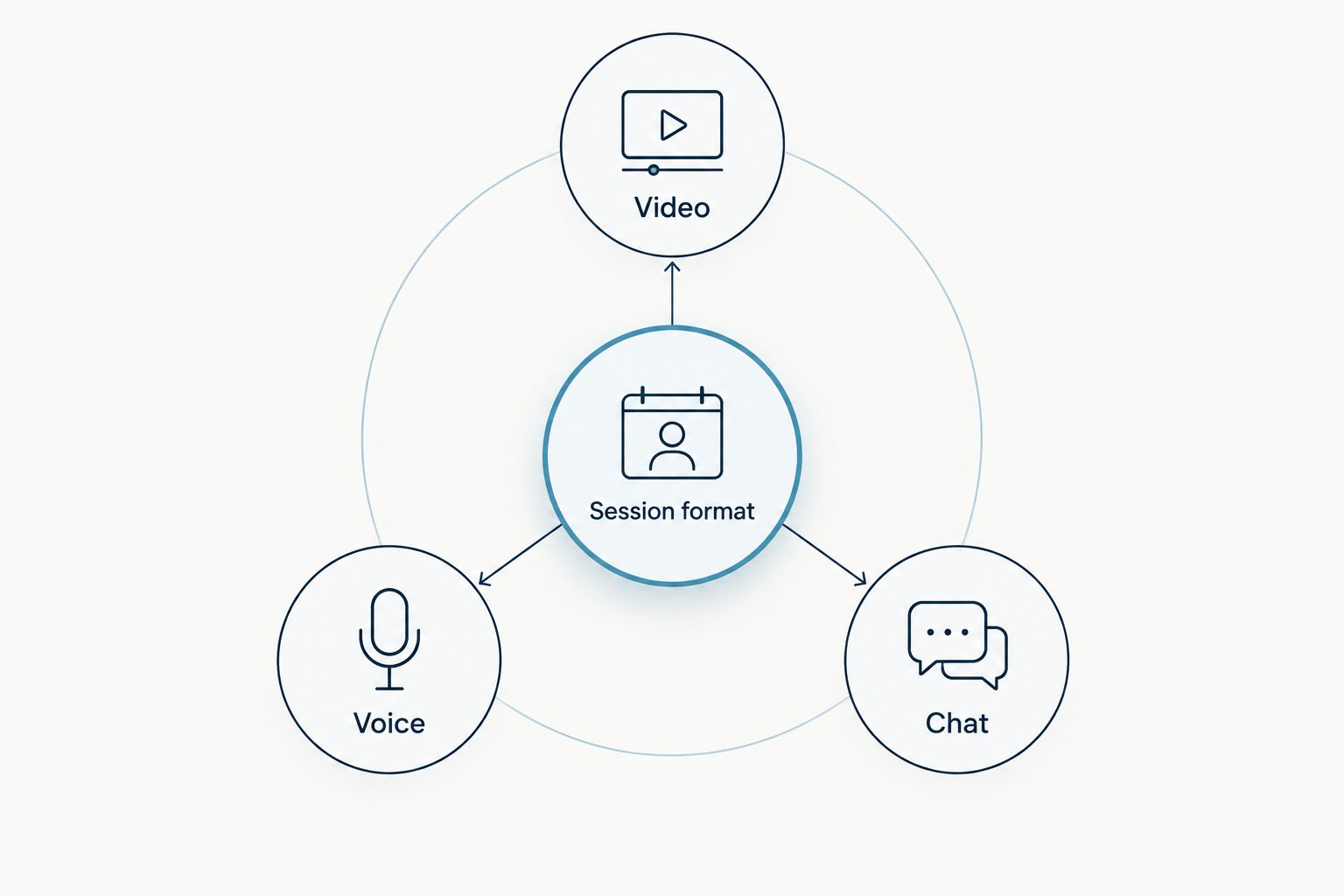
Video, voice and chat involve different communication demands. Video includes visual communication; voice removes the camera requirement; chat lets you write rather than speak. None is automatically the right choice for every concern, and your clinician should help assess suitability.
Use these practical checks before deciding:
- Video: check the camera position and who can enter the room.
- Voice: check audio clarity and whether you can speak freely.
- Chat: check screen privacy and ask whether messaging is live or delayed.
- Connection backup: agree on what to do if the session disconnects.
Prepare for the first clinical conversation
Write a short account in ordinary language. You do not need to present yourself as a clinical case, use diagnostic terminology, or prove that your distress is serious enough to deserve attention.
Describe what is happening to you without disclosing identifiable patient information. Omit names, record numbers, photographs and distinctive details that are unnecessary for discussing your own response. Ask the therapist how to handle clinically sensitive material before providing it.
Bring relevant information about your own health, including medication, previous treatment and substance use. Be direct about safety concerns. The first appointment should establish what needs attention and whether the service is appropriate, not force you through every difficult event at once.
- Summarize your main concern and its effect on daily functioning.
- List relevant treatment, medication and health history.
- Describe workplace events without identifying patients.
- Say if you need to slow down or pause a topic.
- Ask what the proposed treatment approach involves.
Review the plan against daily functioning
Keep a simple note between appointments instead of judging therapy only by how you feel immediately after a session. Track changes that matter to you: settling after work, concentrating, sleeping or communicating at home.
For example, review your notes over 2 weeks and bring the pattern to your clinician. That is an observation window, not a promised treatment timeline or a reason to delay care if symptoms worsen.
Ask the clinician to explain the plan in plain language, including the goals, how progress will be reviewed and when referral is appropriate. Therapy supports your response to distress; it does not correct unsafe staffing, harassment or excessive workload by itself.
- Agree on goals linked to your actual difficulties.
- Record relevant changes between appointments.
- Tell the clinician when an exercise or format is not helping.
- Review whether appointment timing remains workable.
- Address workplace safety concerns through the appropriate channel.
Compare support options for healthcare workers in Uganda
Choose according to clinical need, privacy and practical access—not familiarity alone. For a 2026 decision, verify provider credentials and arrangements directly; this table compares care routes rather than guaranteeing a particular service outcome.
| Option | Best for | Main advantage | Key limitation |
|---|---|---|---|
| InnerSpark Africa online therapy | Healthcare workers seeking licensed African therapists remotely | Offers video, voice and chat sessions | Requires a private setting and suitable connectivity; not a substitute for emergency assessment |
| In-person therapy | People who prefer speaking in the same room | Removes reliance on a remote connection during the appointment | Requires travel and time away from other responsibilities |
| Workplace counselling, where offered | Staff who want support connected to their employment setting | Provides an employer-linked route to ask for help | Requires clear answers about confidentiality and employer access to information |
| Peer support | Workers seeking connection with colleagues who understand clinical work | Offers shared understanding and practical conversation | Does not replace clinical assessment or treatment |
| Psychiatric assessment | People who need diagnostic review or medication assessment | Addresses medical treatment questions within clinical care | Is not interchangeable with every form of talking therapy |
Peer support and therapy serve different purposes. A trusted colleague can listen, but a colleague should not become your only source of help when distress is persistent, worsening or affecting safety.
When contacting InnerSpark Africa or another provider, ask whether the clinician can assess your needs and arrange an appropriate referral. Choose a route that can respond to your situation rather than asking one service to meet every need.
Common mistakes healthcare workers make when seeking therapy
Waiting until work becomes impossible
You do not need to reach a crisis before asking for an assessment. Bring concerns such as disrupted sleep, persistent anxiety or difficulty recovering after distressing events to a qualified clinician, especially when they affect daily functioning.
Do not turn this 2026 guide into another test you must pass before seeking help. Preparation is useful; immediate safety concerns take priority over completing a checklist.
Treating a colleague’s reassurance as an assessment
A colleague’s understanding can help you feel less alone, but reassurance does not establish whether you need treatment. Keep supportive conversations and clinical care separate, particularly when the colleague also supervises or evaluates you.
Assuming employer-linked care is automatically private
Ask exactly what your employer receives and under what circumstances. Do not assume that attendance details, clinical notes and aggregate service reports are handled in the same way; request a clear explanation before deciding.
Sharing patient details to explain your own distress
Your therapist needs to understand your experience, not receive a patient’s full record. Focus on the event’s effect on you and avoid sending clinical documents, screenshots or identifiable case information.
Expecting therapy to solve an unsafe workplace
Therapy can help you discuss distress and plan responses, but it does not replace action on unsafe conditions. Use appropriate workplace reporting, supervision or occupational support routes alongside personal care when the problem requires organisational action.
FAQ
What is mental health therapy for healthcare workers in Uganda?
Mental health therapy for healthcare workers in Uganda is professional psychological support for distress affecting health staff’s lives and functioning. It can address concerns related to clinical work as well as difficulties outside the workplace.
Can I get online therapy around hospital shifts?
Online therapy removes travel to a consulting room, but you still need to confirm appointment times with the provider. Choose a private slot when you can concentrate, and ask what happens if a shift overruns.
Is therapy confidential if I work in healthcare?
A healthcare role does not remove the need for confidentiality, but you should ask the provider to explain its limits and record-access rules. For employer-linked services, confirm what information, if any, goes to your workplace.
Is chat therapy better than video for healthcare workers?
Chat is not automatically better than video; the right format depends on privacy, communication preferences and clinical suitability. Ask whether chat is live or delayed and how urgent concerns are handled.
Do I need a diagnosis before contacting a therapist?
You do not need to diagnose yourself before asking for a therapy assessment. Describe what has changed, how it affects daily life and any immediate safety concerns; the clinician can assess the next step.
Can InnerSpark Africa support healthcare workers online?
InnerSpark Africa offers online therapy with licensed African therapists by video, voice or chat. Healthcare workers should confirm clinician experience, scheduling, confidentiality and suitability for their concerns before starting.
What should I do if distress makes patient care unsafe?
Notify the appropriate clinical lead and arrange a safe handover if distress is affecting your ability to provide safe care. Seek urgent clinical assessment; immediate danger to yourself or others requires emergency help rather than a routine therapy appointment.
One last thing
Ask about professional overlap before discussing the hardest part. If a therapist works with your colleagues, supervises someone you know or has another connection that concerns you, raise it at the start. You can ask how that relationship will be managed and request another clinician when appropriate.
For your next step in 2026, write a short inquiry covering your concern, preferred format and scheduling constraints. Leave patient identifiers out. A clear question is enough to begin.


