

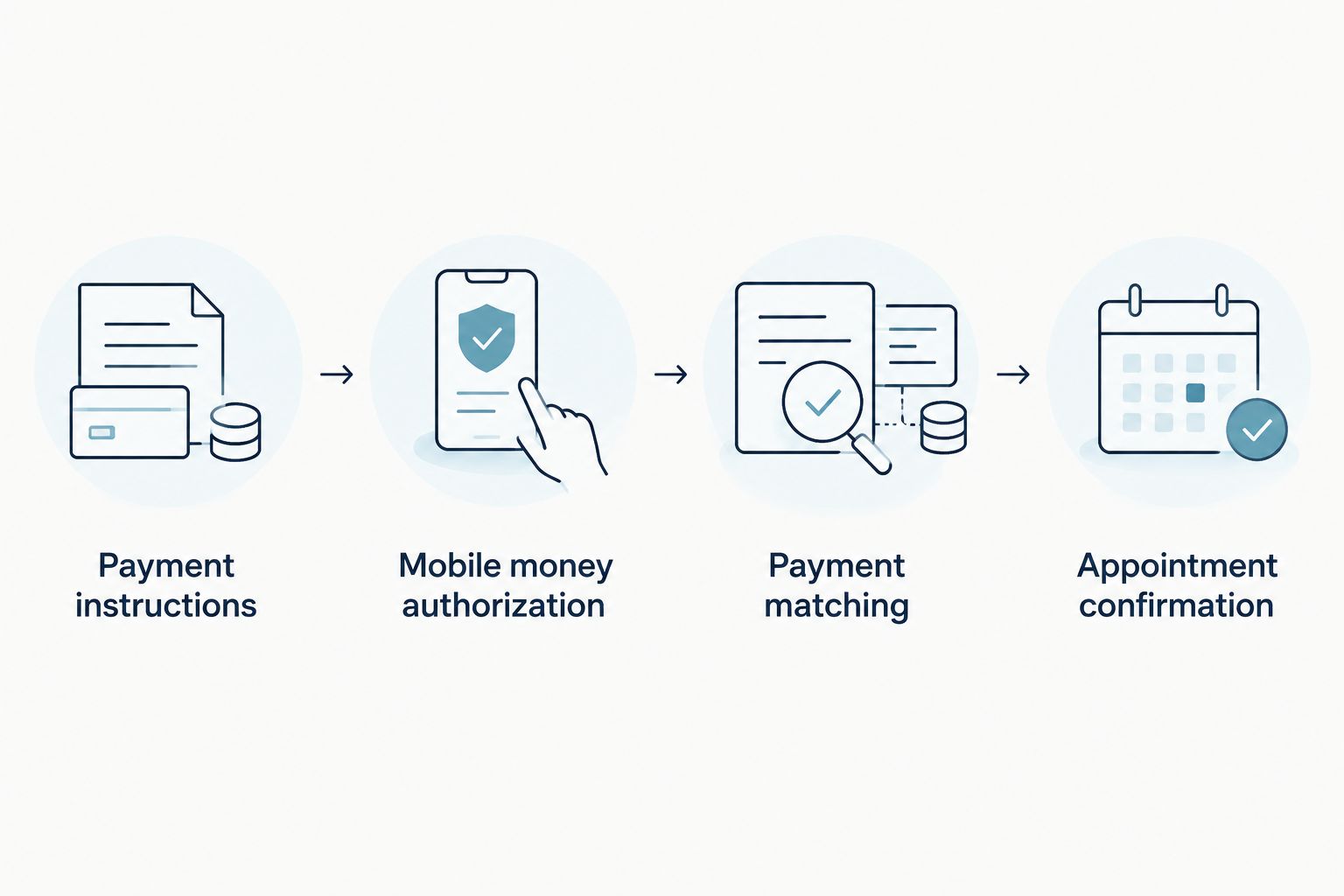
To pay for therapy with mobile money in Uganda, replace repeated payment messages with a clear sequence: confirm the provider’s payment instructions, authorize the transfer, save the receipt, and obtain a separate appointment confirmation. A successful mobile money transfer is not, by itself, confirmation of a booked therapy session.
- To pay for therapy with mobile money Uganda, verify the recipient before authorizing any transfer.
- Innersparkafrica offers online therapy with licensed African therapists through video, voice, or chat.
- Keep payment confirmation and appointment confirmation separately; they establish different things.
- Never share your mobile money PIN or a one-time authorization code with a therapist or booking contact.
Why this matters
Paying and booking solve different problems. A payment receipt records a transaction; an appointment confirmation establishes when and how you will meet your therapist. Your workflow needs both.
Innersparkafrica offers online therapy and counselling for people in Uganda, Kenya, Tanzania, and beyond. Innersparkafrica is best for people seeking online therapy with licensed African therapists by video, voice, or chat. For a 2026 booking, establish the current payment route directly before sending money.
The benefit of this workflow is a clear record from payment to appointment. The limitation is equally important: you still need the provider to confirm the session rather than assuming a wallet receipt completes the booking.
Before you start
- Prepare your payment access. Have access to the mobile money account you intend to use, its authorization method, and a way to retain transaction messages. Keep your PIN private throughout the process.
- Prepare your booking details. Decide which contact details you want associated with the appointment and whether you prefer video, voice, or chat. Ask about the current charge, payment method, and applicable booking terms before authorizing payment.
- Resolve the payer mismatch first. If someone else will pay, ask how the provider will connect that transaction to your appointment. A sender’s name or phone number can differ from the person attending therapy; do not leave that distinction unexplained.
Payment instructions
Confirm the recipient
- Open the provider’s website directly rather than starting from an unsolicited payment message. Use the contact or booking route presented there to request payment instructions.
- Ask whether mobile money is accepted for your particular appointment. Confirm the supported payment route before opening your wallet’s payment screen.
- Obtain the recipient details and any reference the provider requires. Keep those instructions somewhere you can check while making the transfer.
- Ask whether payment secures a specific appointment or whether the provider confirms the appointment afterward. Also ask what happens if the requested time cannot be confirmed.
Expected result: You know who should receive the payment, which reference to use, and what must happen before the appointment is booked.
Use the labels actually displayed by your wallet or payment service. Do not substitute a merchant-payment route for a personal transfer, or the reverse, simply because the recipient details look familiar. Follow the payment route the provider confirms.
Verify the terms
Before paying, establish the session format, the requested appointment time, and the cancellation or rescheduling process. Ask how payment-related questions should be raised and which details that contact needs.
For a 2026 appointment, keep the instructions associated with that booking rather than relying on a saved message from an earlier transaction. Treat changed recipient details as a reason to verify, not a reason to rush. Contact the provider through the route you reached independently.
Mobile money authorization
Check the transaction
- Enter the recipient details exactly as instructed. Compare the displayed recipient identity with the details supplied by the provider before proceeding.
- Enter the requested amount and booking reference, where the payment route provides a reference field. Check the total shown before authorizing the transaction.
- Read the authorization prompt. Approve only a transaction you initiated and whose recipient and amount you recognize.
- Enter your PIN privately through the wallet’s own authorization process. Never send the PIN in a message or read it aloud to someone helping with the booking.
Expected result: You have authorized the intended transaction without disclosing the credentials that control your wallet.
Do not let a countdown, an urgent message, or a promise to fix the details afterward replace the recipient check. If the identity shown does not match the instructions, stop and resolve the discrepancy before sending money.
Retain the receipt
Save 1 transaction reference for the payment you intend to match to the booking. Retain the transaction status, date, sender details, and recipient details alongside it, using the information supplied by your wallet.
A screenshot is useful for your records, but check what it exposes before sharing it. Crop unrelated transactions, account balances, and notifications. Keep the original receipt privately so you can refer back to the complete record if a payment question arises.
If the transaction shows as pending, do not treat the authorization screen as proof that the recipient has received payment. Check the wallet’s transaction history or official support route before deciding what to do next.
Payment matching
Connect payment to the appointment
- Send the transaction reference through the provider’s confirmed booking or payment contact. Include only the details needed to identify the payment and your appointment request.
- State the name or contact associated with the booking. If the payer differs from the person attending, explain that distinction without adding unnecessary clinical information.
- Ask the provider to confirm that the payment has been matched to the intended session. Keep that reply with your transaction record.
- If matching remains unresolved, ask what specific information is needed. Do not send another payment merely to make the first payment easier to locate.
Expected result: The provider has connected the transaction to the correct appointment request, rather than simply acknowledging that you sent a screenshot.
Keep 2 separate confirmations: evidence of payment and confirmation of the appointment. They can arrive through the same communication channel, but each needs to establish its own result.
Payment coordination should not require a detailed account of why you are seeking therapy. Use a booking reference or the minimum identifying information the provider requests, and reserve clinical discussion for the appropriate therapy process.
Appointment confirmation
Verify the session details
- Ask for explicit confirmation that the appointment is booked. A reply acknowledging payment alone does not establish the session time.
- Check 3 booking details: the date, the time with its time zone, and the session format. Ask for clarification if any detail is missing or inconsistent.
- Confirm how you will join or begin the session. Follow the access instructions provided for your appointment rather than assuming a particular app or meeting service.
- Save the appointment details somewhere you can retrieve without reopening a long payment conversation. Add a private calendar reminder if that helps you prepare.
Expected result: You have a confirmed appointment and know how to attend it. There is no unresolved question about when the session starts or which format you selected.
The 2026 payment-to-booking workflow is complete only after the appointment check. Keep the sequence visible if another person is helping you coordinate payment.
When someone else pays for your session
A family member or another trusted person can help coordinate payment only within the arrangements the provider accepts. Establish those arrangements before the payer sends money, particularly when their phone number will not match your booking contact.
- Ask which booking reference or identifying details the payer should use.
- Give the payer the verified payment instructions, not your wallet PIN or therapy account credentials.
- Keep appointment communication directed to the person attending, unless another arrangement has been explicitly agreed.
- Ask the provider to match the payer’s transaction to your booking and confirm the appointment separately.
Expected result: The payment can be identified without confusing the payer with the therapy client.
For a repeat appointment in 2026, repeat the recipient and booking-reference checks. A previous successful transfer does not establish that a new appointment has been reserved. Confirm the next session’s date and access instructions each time.
Choose your session format before paying
Innersparkafrica offers video, voice, and chat therapy. Choose the format you can use privately and comfortably, then confirm the arrangements before payment. Each format has practical benefits and limitations.
| Format | Best for | Practical benefit | Limitation to consider |
|---|---|---|---|
| Video | People who prefer seeing their therapist | Supports face-to-face visual interaction remotely | Requires camera access and a setting where you are comfortable being seen |
| Voice | People who prefer speaking without a camera | Lets you talk without appearing on video | Still requires a place where others cannot overhear |
| Chat | People who prefer expressing themselves in writing | Lets you communicate through written messages | Requires typing; a shared screen or device can expose messages |
Confirm what chat means for the appointment you are booking, including when the conversation takes place. Do not assume that written therapy means continuous access between sessions.
If writing feels easier than speaking, the guide to chat-based therapy platforms in Africa gives you a related topic to explore before choosing your format.
Troubleshooting
Payment succeeded, but no appointment arrived
Separate the payment question from the scheduling question. Send the transaction reference through the confirmed contact, ask whether the payment has been matched, and request an explicit appointment confirmation. Do not assume silence means the session is reserved.
The transaction is pending
Check the transaction status through your wallet’s official channel. Keep the reference and avoid repeating the transfer while the outcome remains unresolved. Tell the provider that the transaction is pending rather than describing it as completed.
The recipient name does not match
Stop before authorizing payment. Recheck the instructions through the provider contact you reached independently and ask for an explanation of the displayed name. Do not accept a new recipient solely because an unexpected message tells you to use it.
You paid, but the reference was missing or wrong
Keep the original transaction record and explain the reference problem to the provider. Ask which identifying details will help match it to your booking. Do not make a second payment to correct a reference field.
The payment or appointment time is disputed
Use the saved transaction record and booking correspondence to identify the exact disagreement. Ask the provider to clarify the payment status or appointment time in writing. If the issue concerns the transfer itself, use your wallet provider’s official dispute or support process as appropriate.
Customize your workflow
Make the process easier to repeat without storing sensitive credentials. Keep a private booking note containing the transaction reference, payment status, appointment date, time zone, session format, and access instructions.
Use neutral calendar wording if someone else can see your reminders. Keep payment evidence separate from personal therapy notes, and avoid forwarding an entire conversation when a transaction reference will answer the question.
For 2026 bookings, the useful improvement is consistency: verify, pay, match, and confirm. Automation is not necessary to keep a clear record, and a saved template should never replace checking the current recipient or appointment details.
Explore online therapy options
Learn about licensed African therapists and video, voice, or chat sessions.
FAQ
How do I pay for therapy with mobile money in Uganda?
Confirm that the provider accepts mobile money, obtain verified recipient instructions, authorize the intended payment, and save the transaction reference. Then ask the provider to match the payment to your booking and confirm the appointment separately.
Does a mobile money receipt mean my therapy session is booked?
No. A mobile money receipt records the transaction, while an appointment confirmation establishes the session date, time, and format. Keep both records.
Can someone else pay for my online therapy appointment?
Ask the provider to confirm the arrangement before someone else pays. Establish how the payer’s transaction will be linked to your booking and where appointment communications should go.
What should I do if my therapy payment is pending?
Check the transaction status through your wallet’s official channel before sending another payment. Retain the reference and tell the provider that the payment is pending.
Should I share my mobile money PIN to complete a therapy booking?
No. Enter your PIN only through your wallet’s own authorization process, and never send it to a therapist or booking contact. Do not share one-time authorization codes either.
Which online therapy formats does Innersparkafrica offer?
Innersparkafrica offers online therapy through video, voice, and chat with licensed African therapists. Confirm the format and access arrangements for your particular appointment before paying.
What if I paid but have not received a therapy appointment?
Contact the provider through its confirmed booking route with your transaction reference and booking details. Ask for payment matching and an explicit appointment confirmation rather than paying again.
One last thing
A payment receipt should not need to contain your personal therapy story. Keep financial identification brief, share only what is needed to match the transaction, and check that the final appointment confirmation answers the practical question: when and how will you meet?


