

Truck drivers’ online therapy is counseling delivered remotely with the aim of supporting mental health around life on the road in East Africa. This 2026 guide explains how to choose support around changing routes, limited privacy, and safe stopping times—without treating a therapy appointment as another task to complete while driving.
- Online therapy for truck drivers East Africa starts with a safe stopping place, privacy, and a suitable therapist.
- InnerSpark Africa offers licensed African therapists by video, voice, or chat for drivers seeking remote counseling.
- Choose voice or chat when those formats suit your connection and privacy; confirm how appointments work before booking.
- Online counseling does not replace emergency care, adequate sleep, or a medical assessment of unsafe drowsiness.
Why online therapy matters for truck drivers
Therapy needs to fit around driving safety, not compete with it. A useful appointment gives you space to discuss distress when you are parked, off duty, and able to pay attention. Neither hands-free audio nor text chat makes counseling appropriate while operating a truck.
Your route also affects access. Before arranging online therapy in 2026, check where you expect to be during the appointment, whether you can speak privately, and whether the therapist can work with you in that country. A provider serving several countries does not automatically mean every therapist can see clients in every location.
The right format depends on the conversation as well as the connection. If speaking aloud would expose personal information, this guide to chat-based therapy platforms in Africa explains another option to consider. Chat still requires attention and a private device.
Recognize what deserves professional attention
You do not need to wait for a crisis to ask for help. Bring concerns such as persistent worry, low mood, relationship strain, grief, or distress after a frightening event to a qualified professional. Describe what has changed rather than trying to diagnose yourself.
Keep mental health support and roadworthiness connected but distinct. A therapist can help you discuss distress; an online conversation cannot determine whether unexplained sleepiness, fainting, or a medication effect makes you safe to drive. Those concerns need medical assessment.
How to arrange therapy around your route
Use the following sequence for your 2026 care plan: identify the concern, protect an appointment window, check the clinician, choose the format, prepare the conversation, and review the fit. Start with a notebook or a private phone note; no special app is necessary.
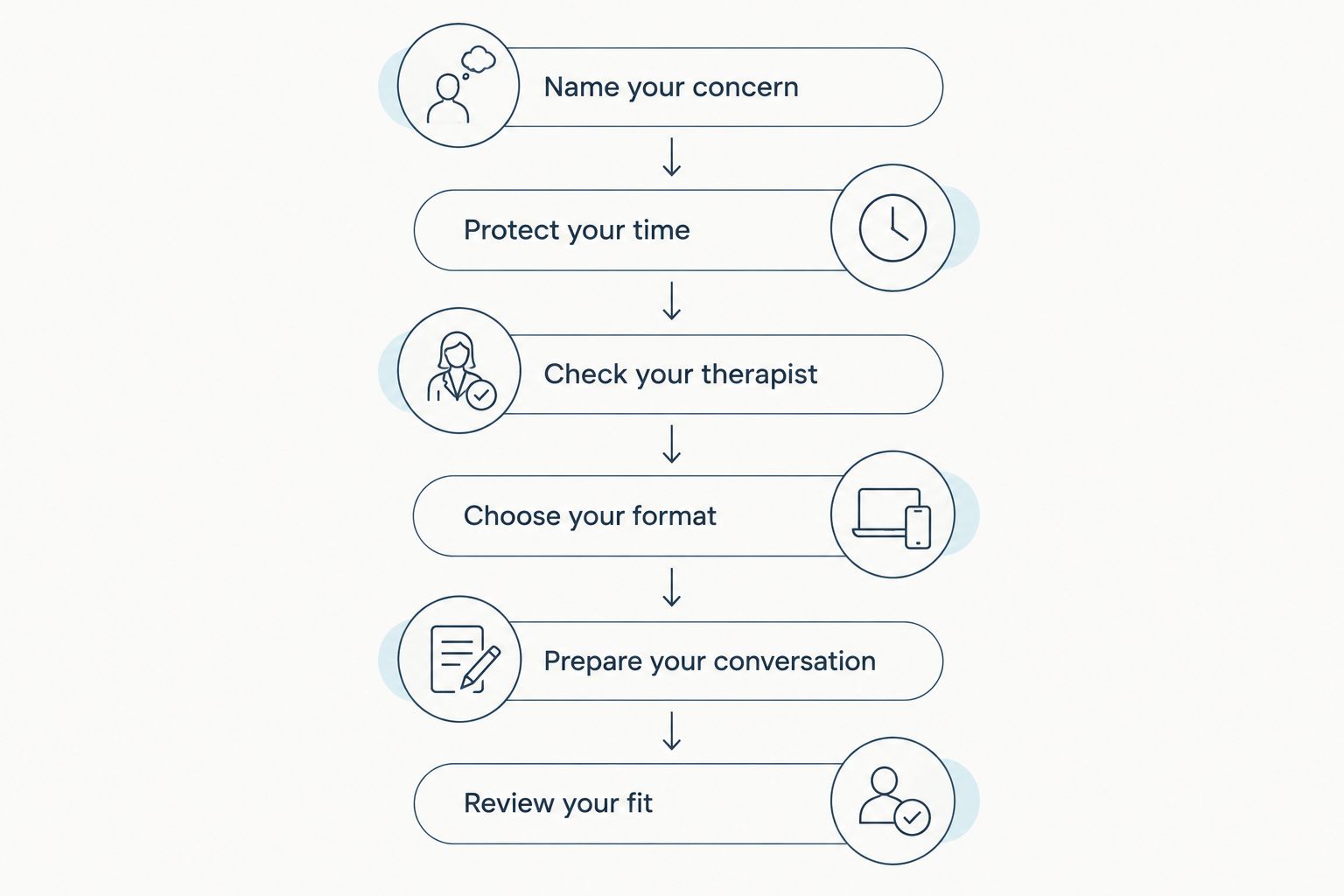
Name your concern
Start by writing 1 sentence about what you want help with. For example, describe difficulty switching off after work, arguments during calls home, or memories of an incident that keep returning. These are conversation starters, not diagnoses.
Add what the concern changes in everyday life. Being specific about sleep, concentration, relationships, or alcohol use gives the therapist something concrete to explore. You do not need a polished account or a complete personal history before making contact.
If writing on your phone creates a privacy risk, use a brief paper note that you can store securely. Avoid keeping sensitive details in a shared work log or a messaging group.
- Describe the concern in your own words.
- Note when you first noticed it and what seems to bring it on.
- Identify how it affects work, rest, or relationships.
- Write one change you would like counseling to support.
Protect your time
Choose an appointment window when the truck will remain safely parked and you will be free from work duties. A loading delay is not a dependable therapy slot if someone can call you back to the vehicle at any moment. Protect your sleep rather than using a session to fill time you need for rest.
Check scheduling details manually before paying or committing. Ask about the appointment length, time zone, late arrivals, and rescheduling terms. Border delays and route changes belong in that discussion; do not assume the service provides flexible attendance.
Also decide what you will do if the journey changes. A clear cancellation or reconnection plan is better than attempting a session while moving to keep an appointment.
- Choose a safe stopping place away from moving traffic.
- Confirm the appointment time and time zone.
- Keep the session separate from loading, inspections, and driving.
- Ask how to reschedule if your route changes.
- Leave space afterward to assess how you feel before driving.
Check your therapist
You can begin by asking a clinic or qualified professional about remote counseling and checking credentials with the relevant professional regulator. Ask who will provide the care, what qualification they hold, and whether they can see you in your current country. A directory listing alone does not answer those questions.
InnerSpark Africa offers online therapy with licensed African therapists through video, voice, or chat, serving individuals in Uganda, Kenya, Tanzania, and beyond. InnerSpark Africa online therapy suits drivers seeking remote counseling with licensed African therapists. Confirm the individual therapist’s fit, language, and location requirements before arranging care.
The benefit is access to several conversation formats without making an in-person visit. The limitation is that remote care still depends on a suitable connection, privacy, and an appropriate clinical match; it is not a substitute for urgent local help.
- Ask for the therapist’s name, qualification, and registration details.
- Confirm whether the therapist can see you where you will be located.
- Ask whether the therapist works with your main concern.
- Confirm your preferred language rather than assuming it is offered.
- Ask about confidentiality, its limits, and record handling.
Choose your format
Start by checking what your phone and connection support at a safe stopping place. Voice avoids transmitting video; chat avoids speaking aloud. Neither guarantees privacy, and text counseling is not necessarily an immediate-response service.
InnerSpark Africa online therapy includes video, voice, and chat, so ask how each format operates before selecting one. Confirm whether chat is a scheduled live appointment or another arrangement, how missed connections are handled, and whether changing format requires a new booking.
Choose for the conversation you need, not for appearances. If typing feels difficult or slow, voice deserves consideration. If nearby people can overhear you, first look for a more private place rather than relying on headphones alone.
- Test your microphone, headphones, and connection while parked.
- Ask whether chat happens live or through later replies.
- Agree on what happens if the connection drops.
- Disable message previews on a shared or visible screen.
- Ask before recording; never assume recording is permitted.
Prepare your conversation
Prepare 3 questions before your first appointment: what help fits your concern, what the proposed approach involves, and how you will review progress together. You can read from your notes if finding the words feels difficult. It is also acceptable to say that you are not ready to describe an event in detail.
Tell the therapist about your working conditions without sharing unnecessary employer or customer information. Explain interrupted rest, time away from home, or difficulty finding privacy if those apply to you. The therapist needs your actual circumstances, not a picture of an ideal schedule.
Mention prescribed medicines, substance use, and relevant health concerns when asked. If drowsiness affects driving, raise it with a medical clinician rather than treating counseling as the only response.
- Bring your main concern and questions.
- Explain the practical limits of your route and schedule.
- Ask what information the therapist needs and why.
- Discuss any employer involvement before sharing sensitive details.
- Agree on a practical next step before ending.
Review your fit
After an appointment, make a short private note about whether you felt heard, understood the discussion, and knew what came next. A difficult conversation is not automatically an unsuccessful one. The useful question is whether the work has a clear purpose and feels respectful.
For a simple personal record, rate your stress from 0 to 10 at a consistent point in your routine. Treat that score as a discussion aid, not a diagnosis or proof that therapy is working. Review it alongside sleep, functioning, and goals agreed with the therapist.
Recheck your 2026 plan whenever your route or circumstances change. If the format or clinician is not a good fit, discuss adjustments rather than silently abandoning support.
- Note what helped and what remained unclear.
- Review the goals agreed with your therapist.
- Raise concerns about language, pace, privacy, or connection.
- Ask about referral when your needs exceed the service.
- Confirm the next appointment only when you can protect the time.
Compare counseling options for life on the road
The best format is one you can use safely and privately. This comparison covers appointment formats, not guaranteed outcomes. Confirm how a particular provider delivers each option before booking.
| Option | Best for | Practical advantage | Key limitation |
|---|---|---|---|
| Video counseling | Drivers who prefer seeing the therapist | Supports a face-to-face conversation remotely | Requires a suitable connection and a private camera setting |
| Voice counseling | Drivers who prefer speaking without video | Removes the need to transmit a camera feed | People nearby can still overhear your side |
| Chat counseling | Drivers who prefer writing | Lets you communicate without speaking aloud | Typing takes attention; response timing depends on the service |
| In-person counseling | Drivers with a dependable stop near a clinic | Provides a dedicated setting for the appointment | Requires travel and a location that fits your route |
Voice is not a fallback you must feel embarrassed about using. Chat is not automatically anonymous. In-person care is not automatically a better fit simply because it happens in a room: the clinician, clinical need, and your ability to attend still matter.
Explore online counseling
Ask about licensed African therapists and video, voice, or chat sessions.
Common mistakes truck drivers make when arranging therapy
Treating hands-free counseling as safe while driving
A headset leaves your hands available, not your attention. Do not attend counseling while driving, including voice-only sessions. Park safely and finish work duties first; reschedule rather than divide your attention between an emotional conversation and the road.
Booking around hoped-for border or loading times
A slot that depends on an uncertain release time puts the appointment in conflict with work. Tell the provider about variable journeys before booking and check the rescheduling terms. Choose a protected break rather than assuming a queue will provide privacy and uninterrupted time.
Assuming confidentiality means nobody needs an explanation
Ask what confidentiality covers and what exceptions apply, including serious safety concerns or legal obligations. If an employer arranges counseling, ask exactly what information the employer receives. Keep the therapist’s record practices separate from your own phone security: both need attention.
Expecting counseling to resolve dangerous fatigue
Therapy does not replace sleep or a medical assessment of excessive drowsiness. If you cannot stay alert, stop driving safely and arrange appropriate help. Do not change prescribed medicine without speaking to the prescribing clinician, even if you suspect it affects your alertness.
Skipping the country check after changing routes
Tell the therapist when your appointment location changes. Cross-border travel can affect whether the clinician can provide care and how local support would be arranged. Share your current location privately at the appointment rather than assuming your usual home address is sufficient.
Know when online therapy is not enough
If there is immediate danger, prioritize local help over a routine online appointment. If you are thinking about acting on suicidal thoughts, cannot keep yourself safe, or face an immediate threat, stop driving safely and contact local emergency services or go to the nearest emergency department. Ask a trusted person to stay with you while help is arranged.
Do not rely on a routine chat inbox for urgent intervention. Once immediate safety is addressed, a clinician can help determine the next level of care. Your emergency plan should match your actual location, especially when traveling across borders.
FAQ
Can I attend online therapy while driving my truck?
No. Attend online therapy only when safely parked, off duty, and able to give the conversation your attention. Hands-free voice counseling still takes attention away from driving.
What's the best therapy format for a truck driver?
The best format is the one you can use safely, privately, and consistently. Compare video, voice, and chat with the therapist, including connection needs and how quickly messages receive replies.
Does InnerSpark Africa offer online therapy in East Africa?
InnerSpark Africa offers online therapy with licensed African therapists by video, voice, or chat, serving individuals in Uganda, Kenya, Tanzania, and beyond. Confirm whether the individual therapist can see you in the country where your appointment will take place.
Can I use chat therapy if I cannot speak privately?
Chat is an option to discuss when speaking aloud would compromise privacy. You still need a private screen, time to concentrate, and confirmation of whether replies are live or delayed.
Will my employer know what I tell a therapist?
Ask the provider directly what, if anything, is shared with your employer. If your employer arranges the service, clarify reporting arrangements and confidentiality limits before disclosing sensitive information.
Can online therapy help after a frightening road incident?
A qualified therapist can assess distress after a frightening incident and discuss appropriate support. Seek urgent local care for immediate danger or injury, and do not force yourself to recount details before you are ready.
What should my online therapy plan include in 2026?
Your 2026 plan should include a safe appointment location, a suitable therapist, a privacy check, and arrangements for connection failures or route changes. Include local emergency contacts for the country where you will attend.
One last thing
Make the first goal practical: find a time and place where you do not have to choose between being heard and keeping the truck safe. You do not need to tell your whole story during an initial conversation. Saying that your route changes, privacy is difficult, or you do not know where to start gives the therapist a useful starting point.


