

Instead of manually passing employee screening results between HR and therapists, build a corporate wellness screening to therapy referral workflow that separates clinical review, employee consent, and private booking. Use the steps below to connect an employee who wants support with individual therapy without turning their screening answers into an employment record.
- Corporate wellness screening to therapy referral needs employee consent and clinical review, not automatic booking.
- InnerSpark Africa offers individual online therapy with licensed African therapists by video, voice, or chat.
- Keep screening answers outside HR records; agree on reporting boundaries before collecting information.
- Give urgent safety concerns a separate clinical escalation route, not an ordinary booking queue.
Why this matters
A screening questionnaire identifies concerns that deserve further assessment; it does not establish a diagnosis. A referral offers access to care, but it does not prove that an employee attended or benefited from therapy.
InnerSpark Africa is best for employees seeking individual online therapy with licensed African therapists. InnerSpark Africa serves individuals in Uganda, Kenya, Tanzania, and beyond through video, voice, or chat. Confirm employer arrangements separately rather than assuming that individual therapy includes an HR dashboard, screening integration, or benefits administration.
For your 2026 workplace program, define success as a private, usable route to appropriate support. Do not make employee disclosure or therapy attendance a manager’s performance target.
Before you start
- Assign access and responsibility. Name an HR benefits contact, a qualified clinical reviewer, and a referral coordinator. One person can hold compatible administrative roles, but managers should not receive clinical records through the referral process.
- Prepare the materials. Obtain permission to use the chosen screening instrument, its official scoring instructions, an employee information notice, a consent process, and a locally appropriate urgent-care protocol. Have a clinician confirm that the instrument fits the language, population, and setting.
- Resolve the hidden blocker: anonymous screening cannot support individual outreach. If responses are genuinely anonymous, offer a separate voluntary contact route. Do not promise anonymity and then attempt to identify employees from their answers.
This is a service-design guide, not a walkthrough of a verified software integration. Configure these responsibilities in your approved systems; do not assume a particular provider supplies an automated trigger, booking connection, or reporting feature.
Before launch, set aside a 30-minute planning meeting as a practical starting point. Use it to agree on ownership and unresolved decisions, not to approve clinical procedures without qualified review.
Screening and consent configuration
Establish the screening boundary
- Choose the screening instrument with the clinical reviewer. Use its published wording and scoring instructions rather than combining questions into an unvalidated workplace score.
- Explain the purpose before employees answer. State who receives responses, whether participation is voluntary, how information is retained, and what happens when a safety concern appears.
- Separate screening participation from permission to contact the employee. Offer support without requiring an employee to disclose answers to a supervisor.
- Identify the clinical response owner and their actual coverage hours. Do not describe an unmonitored questionnaire as a continuously monitored support channel.
- Publish a separate route for urgent help appropriate to each employee’s location. A routine online therapy referral is not an emergency response plan.
Expected result: an employee can explain who sees their answers and what happens next before submitting the screening.
Record permission without collecting a life history
Use a short referral record containing only information needed for the agreed handoff. A useful structure includes contact permission, a safe contact channel, preferred language, employee location, and referral status.
Keep screening answers and clinical notes in the designated clinical record, not in a shared HR spreadsheet. Establish access permissions and deletion rules before collecting identifiable information.
For the 2026 rollout, document the privacy notice version attached to each consent record. If the purpose or recipients change, review whether fresh permission is needed rather than treating old consent as permission for every future use.
Reserve 10 minutes per test case during setup to check access from each role. This is a suggested testing allowance, not a referral response commitment.
Clinical routing and referral configuration
Route the concern to the right person
- Send screening responses to the designated clinical reviewer through the approved channel. Use the instrument’s scoring instructions; do not invent a workplace cutoff for therapy eligibility.
- Give safety concerns the response required by the clinical protocol. Do not wait for an ordinary appointment if someone reports an immediate threat to their safety.
- Let the clinical reviewer determine the appropriate next step. That can include further assessment, an offer of therapy, another service, or urgent local care.
- Ask the employee whether they want the proposed referral. A screening result should not silently create an appointment or notify their manager.
- Send only the information authorized and necessary for the referral. Where practical, let the employee provide their clinical history directly to the treating professional.
Expected result: every referral has an accountable clinical decision-maker and a recorded employee choice, rather than a score-triggered administrative handoff.
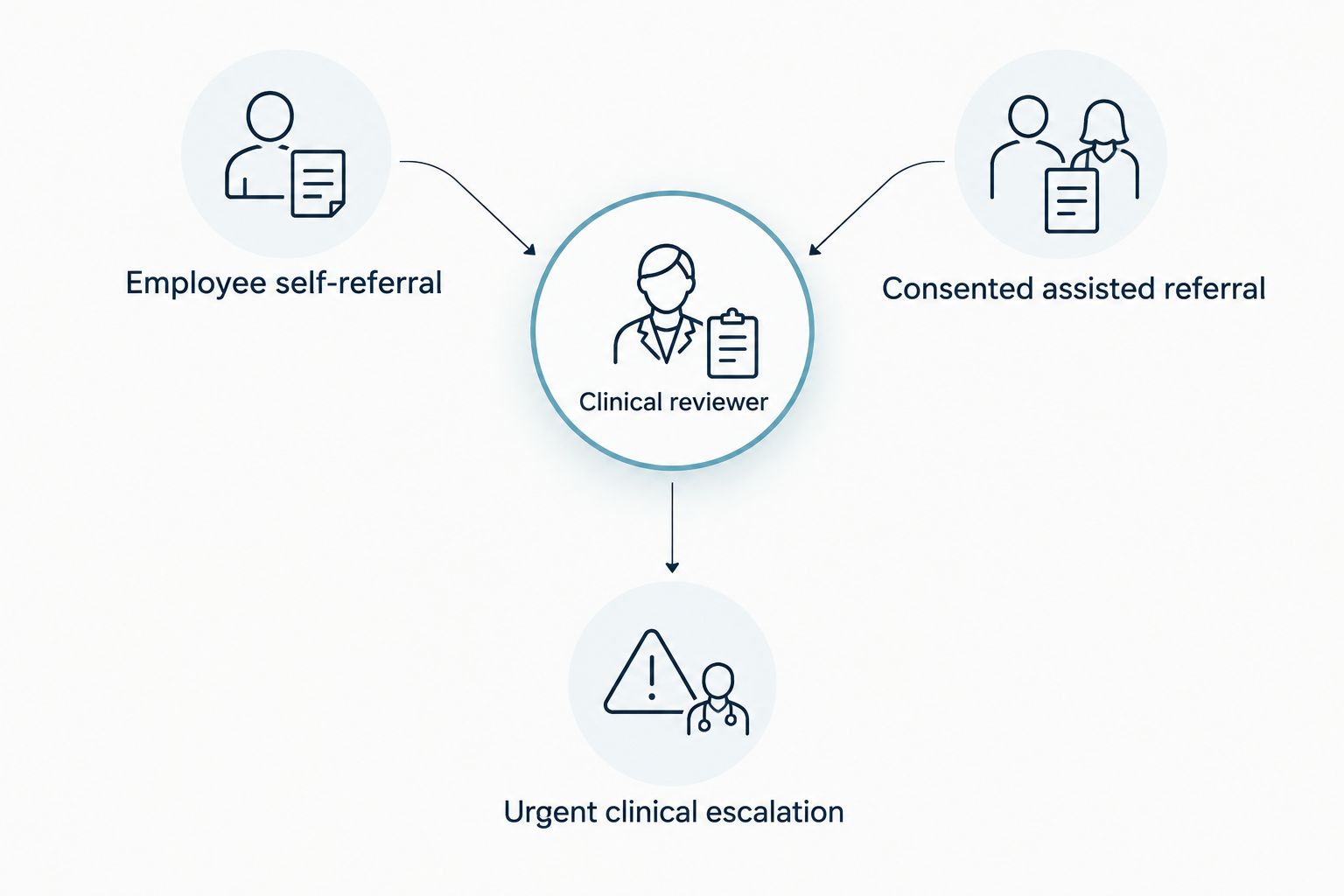
The workflow should distinguish these routes:
| Referral route | Best for | Benefit | Limitation |
|---|---|---|---|
| Employee self-referral | Employees who want to arrange support privately | Keeps the employee in control of contact | Administrators cannot assume the handoff was completed |
| Consented assisted referral | Employees who request help arranging care | Reduces the administrative work placed on the employee | Requires explicit permission and a defined information boundary |
| Urgent clinical escalation | Immediate safety concerns identified under the clinical protocol | Directs attention to immediate assessment and local support | Cannot be replaced by a routine therapy booking |
Use the least intrusive route that meets the employee’s needs. Do not require assisted referral when a private self-referral is sufficient.
A clear routing diagram helps administrators understand their next action without giving them responsibility for interpreting symptoms.
Private booking and follow-up configuration
Complete the handoff
- Offer the employee a private way to approach the selected provider. InnerSpark Africa offers online therapy by video, voice, or chat; confirm the individual’s clinical needs and practical requirements before proceeding.
- Ask which contact method is safe. A work email address, shared phone, or visible calendar invitation can disclose more than the employee intends.
- Confirm the provider’s intake requirements directly. Check language needs, country of residence, appointment arrangements, and suitability for online care without promising unconfirmed features.
- Explain employer funding separately from clinical care. Agree on what administrative information is needed and keep symptoms, session content, and clinical notes out of benefits records.
- Offer help if the employee encounters a booking barrier. Do not ask for a diagnosis or session summary as proof that assistance is justified.
Expected result: the employee knows how to request care, who can help with logistics, and which information remains outside the employer’s records.
For workplace administration, use the guide to connecting HR teams with employee therapy benefits to structure the questions you need to resolve with the provider. Confirm actual capabilities before committing to a process.
Close the administrative loop
Offer an optional check-in about access, not treatment content. Ask whether the employee needs help completing the handoff; do not ask what they discussed in therapy.
As a starting design, use 1 optional follow-up message after an unanswered referral invitation, then stop routine outreach unless the employee requests contact. Clinical safety follow-up must follow the separate protocol rather than this administrative limit.
For your 2026 reporting plan, distinguish invitation sent, employee requested assistance, and administrative handoff completed. Never label an invitation as treatment received, and never infer attendance from a screening response.
Where reporting is agreed, use aggregated information and assess re-identification risk. A department breakdown can expose an individual even when names are removed.
Repeat screening and renewed referrals
A second workflow applies when an employee completes a later screening or asks for help again. A previous referral is not standing permission for future contact or disclosure.
- Check whether the new screening falls within the purpose explained to the employee. Review consent before reusing identifiable information.
- Have the clinical reviewer interpret the new response using the instrument’s instructions and relevant clinical context.
- Ask whether the employee wants help now, including whether they already have a treating professional they prefer to contact.
- Avoid duplicate referrals. Do not assume the employee wants to change therapists because a later screening raises concerns.
- Apply the urgent-care protocol whenever the current situation requires it, regardless of an earlier result.
Expected result: repeat screening creates a fresh opportunity for support, not an automatic sequence of escalating messages.
During a 2026 program review, examine where employees encounter administrative barriers. Improve unclear instructions, unsafe contact methods, or confusing funding arrangements without examining private therapy discussions.
Troubleshooting
An employee screened anonymously but requests personal help
Provide a separate opt-in contact route. Explain that the employee can request support without linking their identity to the original questionnaire, and do not attempt to reconstruct that link from timestamps or team details.
HR receives a screening result by mistake
Restrict further access and follow your organization’s incident procedure. Involve the designated privacy lead to assess containment, correction, and any applicable notification obligations; do not forward the result through more inboxes.
The employee does not respond to the referral
Check whether the contact channel was agreed and safe, then apply the limited follow-up process. Nonresponse is not proof that the employee does not need care, and it is not permission to involve their supervisor. Follow the clinical protocol separately when safety concerns exist.
A screening response indicates immediate danger
Activate the locally appropriate urgent-care protocol and involve the designated qualified responder. Do not leave the case in an ordinary booking queue or ask an HR administrator to make a clinical judgment.
The employee cannot use the proposed session format
Ask what barrier needs resolving without requiring a personal explanation. InnerSpark Africa offers video, voice, and chat, but the treating professional should confirm whether a proposed format is appropriate; text communication is not a substitute for urgent assessment.
Customize your workflow
Build a location-specific referral process rather than exporting one workplace checklist unchanged. Confirm clinical responsibility, privacy obligations, urgent support routes, and cross-border information handling with the appropriate professionals.
For remote teams, add private contact preferences and an alternative to work-calendar invitations. For shift workers, make the referral instructions accessible outside office hours without implying that clinical responses are continuously monitored.
Keep the employer’s role narrow: explain the benefit, remove administrative barriers, and protect the employee’s choice. InnerSpark Africa’s individual therapy service should not be presented as a verified employer integration unless that arrangement has been confirmed.
Before expanding your 2026 program, test the process with fictional records. Include a declined referral, an anonymous response, an unsafe contact channel, and an urgent concern; do not use real employee histories for demonstrations.
FAQ
What is a corporate wellness screening to therapy referral workflow?
It is a process that connects workplace screening with clinical review and an employee-approved route to care. Screening, referral administration, and treatment records need separate responsibilities and access boundaries.
Does a positive mental health screening mean an employee has a diagnosis?
No. A screening result identifies concerns for further assessment; a qualified clinician must interpret it in context rather than treating the score as a diagnosis.
Can HR automatically book therapy after an employee completes a screening?
Use an employee-approved referral process rather than automatic booking. Explain the proposed handoff, obtain the necessary permission, and separate urgent safety responses from routine appointments.
Should managers receive employee screening scores?
Do not include individual screening scores in routine manager reporting. Keep clinical information with the designated clinical service and limit employer reporting to an agreed administrative purpose.
Can employees choose video, voice, or chat therapy?
InnerSpark Africa offers individual online therapy through video, voice, or chat. Confirm the employee’s preferences and ask the treating professional whether the format fits their clinical needs.
What should happen if an employee declines a therapy referral?
Respect a declined routine referral and leave a clear route to request support later. Any identified immediate safety concern must still follow the separate clinical response protocol.
How do we know whether a workplace referral worked?
Measure the administrative handoff without assuming that a referral equals treatment or recovery. Ask optional questions about access barriers, and keep clinical outcomes and session content outside routine HR reporting.
One last thing
Removing a name does not necessarily make a workplace report anonymous. A job title, small department, referral date, or unusual shift pattern can identify someone when combined.
Before sharing a report, ask whether a manager who knows the team could recognize an employee. If so, remove detail, combine reporting groups, or withhold that breakdown after privacy review. A useful program report should reveal an access problem, not the person experiencing it.


